Eddington confirms Einstein's theory of relativity during 1919 solar eclipse
On May 29, 1919, Arthur Eddington and his team confirmed Einstein's general theory of relativity by measuring light bending around the sun during a total solar eclipse. This pivotal experiment transf…
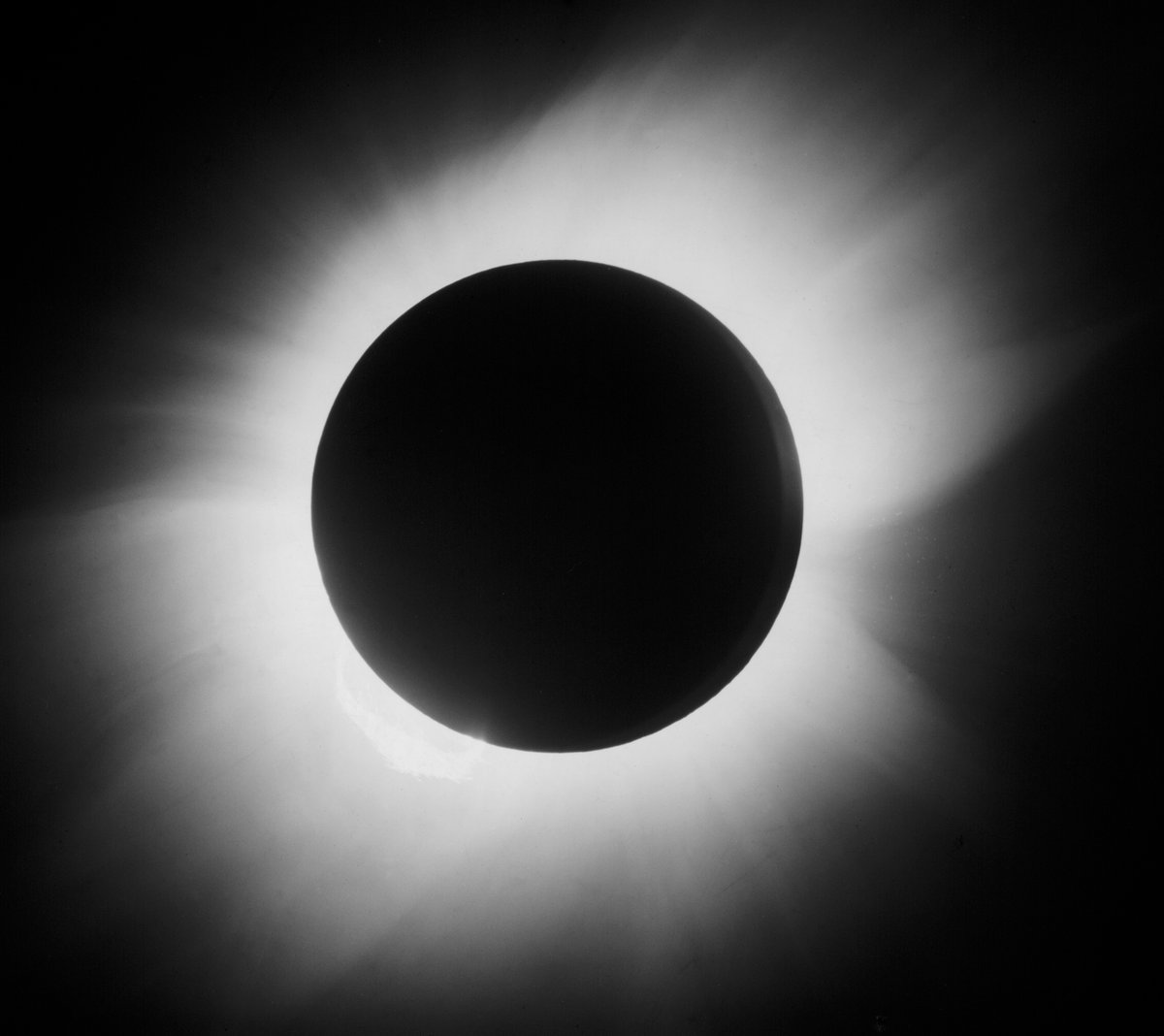
On May 29, 1919, a team of British scientists led by Arthur Eddington observed a total solar eclipse, providing key evidence for Albert Einstein's general theory of relativity. The experiment measured the bending of light from stars as it passed near the sun, confirming Einstein's prediction that massive objects warp the fabric of space-time.
The timing of the experiment was crucial. Einstein published his theory in 1915, but it faced skepticism, especially from established physicists. The 1919 eclipse provided a rare opportunity to test his ideas. Eddington’s expedition to the island of Principe off the west coast of Africa was one of the first large-scale scientific efforts to validate a groundbreaking theory. The results garnered significant media attention, elevating Einstein from relative obscurity to international fame.
The Eddington experiment showed that light from stars was indeed deflected by the sun's gravity, a finding that aligned with Einstein's calculations. The measurements indicated that light could bend by 1.75 arcseconds, a result that corroborated Einstein's theory and became a pivotal moment in the history of physics. The experiment not only changed perceptions of space and time but also sparked a broader acceptance of modern physics, influencing subsequent research in cosmology and gravitational physics.
Looking ahead, the legacy of the Eddington experiment continues to shape our understanding of the universe. It laid the groundwork for future astronomical discoveries, including the detection of gravitational waves and the study of black holes. As scientists explore the cosmos with advanced technology, the principles established by Einstein and validated by Eddington remain central to our quest for knowledge about the nature of reality.
Read Full Story at Scientific American →