Archaeologists find 60,000-year-old etched ostrich shells
Humans 60,000 years ago carved deliberate geometric patterns on ostrich eggshells, showing advanced planning and symbolic thought. This challenges earlier views of early human cognition, proving comp…
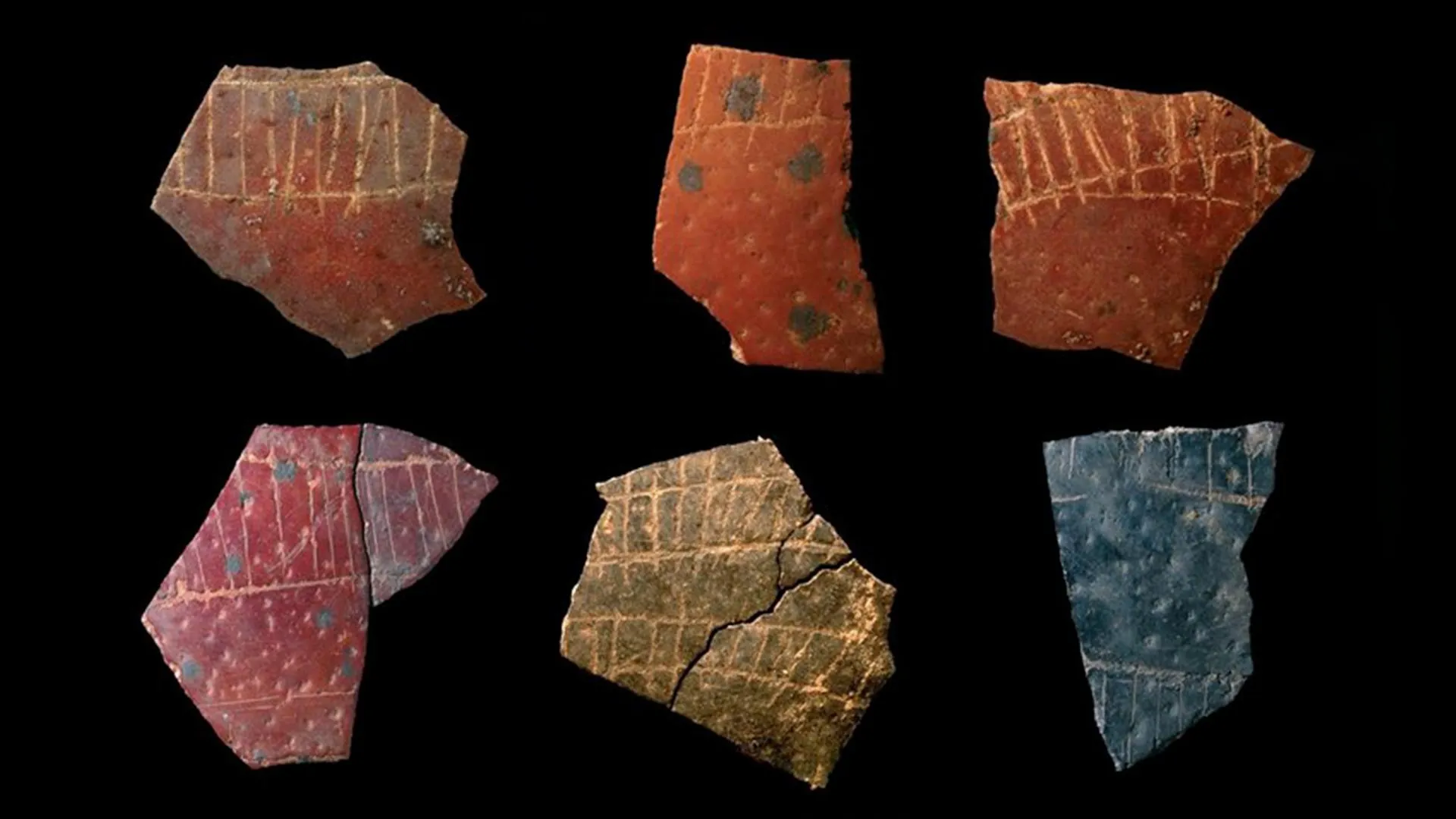
Humans in southern Africa carved intricate geometric patterns onto ostrich eggshells more than 60,000 years ago, a discovery that shows surprisingly advanced planning and rule-following in early human art.
The engravings feature recurring grids, parallel lines, right angles, and repeated shapes, suggesting the designs were not random scribbles but carefully structured compositions. Researchers analyzed over 400 engraved fragments from archaeological sites in Botswana, South Africa, and Zimbabwe, finding that many followed consistent patterns across different locations and time periods. The precision of the lines and the repetition of designs indicate that early humans had a clear mental plan before etching the shells.
This level of organization challenges the idea that early human art was purely abstract or improvised. Instead, it points to structured thinking, possibly tied to symbolic communication or early mathematical concepts. Some experts compare the patterns to modern-day doodles or even early forms of writing, where repetition and rules create meaning. The ostrich eggshells, often used as water containers, suggest the engravings may have held cultural or social significance beyond decoration.
The findings, published in the journal *Nature*, reshape our understanding of early human cognition, showing that complex thought and symbolic behavior emerged far earlier than previously believed. Archaeologists now see these engravings not just as art, but as evidence of structured thought, planning, and possibly even early systems of communication. This discovery adds to growing evidence that humans 60,000 years ago were more cognitively advanced than earlier research suggested.
Read Full Story at ScienceDaily →