‘A man of great appetites’: what’s it like to be a dictator’s personal chef?
In an often chilling new documentary, the chefs of brutal leaders from Idi Amin to Saddam Hussein, talk about their unusual lives behind the scenes K im Jong-il loved pepperoni pizza. Saddam Hussein couldn’t resist a fish barbecue. Idi Amin reportedly had the capacity for an ent
In an often chilling new documentary, the chefs of brutal leaders from Idi Amin to Saddam Hussein, talk about their unusual lives behind the scenes
K im Jong-il loved pepperoni pizza. Saddam Hussein couldn’t resist a fish barbecue. Idi Amin reportedly had the capacity for an entire roasted goat. The menus may have differed, but the appetite was the same. For history’s most notorious strongmen, the dining table doubled as a stage for power. For the cooks who served them, every meal came with extraordinary stakes. “It goes back to Hannah Arendt’s banality of evil a bit,” says director Andrew Neel. “These everyday things that are beloved to us, like food, can take on an entirely different dimension within the context of a dictatorship.”
In his latest film, How to Feed a Dictator, which premieres at the Tribeca film festival this week, five private chefs recount their intimate experiences serving some of the world’s most feared dictators and the ever-present dangers that came with the job. Based on the 2020 book by the Polish journalist Witold Szabłowski, the 95-minute documentary probes the fraught terrain between morality and survival, asking viewers to consider the choices these chefs made – and the choices they never really had. Structurally, the film is something of a tasting menu, serving up sobering morsels of human atrocity within the trappings of a decadent cooking show. It makes for especially uneasy viewing on an empty stomach.
Much like the menu on offer, the perspectives vary wildly. We meet Keo Samoun at the unkempt gravesite of her former boss, the Cambodian dictator Pol Pot, laying out a spread of fish, fruit and rice for a man she still regards almost as a god. Famed pizzaiolo Ermanno Furlanis, by contrast, recalls the terror of making pies for Kim Jong-il – his life under surveillance, his passport under guard, the state apparatchik who barged into his kitchen to ensure the olives on one pizza were spaced just so.
No chef is as tormented by their service as Ugandan Charles Otonde Odera. He describes his early days working for Ugandan despot Idi Amin as life-changing – a poor villager scraping by one day, and the next driving a Mercedes, supporting eight wives, and living in extraordinary comfort as Amin terrorized and brutalized the local masses. For all the chefs, comfort was the trade. By most measures, theirs was a great gig – logic that can excuse almost anything. “Saddam’s chef got a car every year,” Neel says. “That phrase, ‘it was a great gig,’ I think, actually runs the world. Like, ‘It was just business.’”
It wasn’t until Amin’s second wife, Kay, was found dead in the trunk of a car , amid rumors he had her killed for taking a lover, that Odera began to reconsider the bargain. “I missed my low wages from before,” he says in the doc. “At least my heart was at peace.”
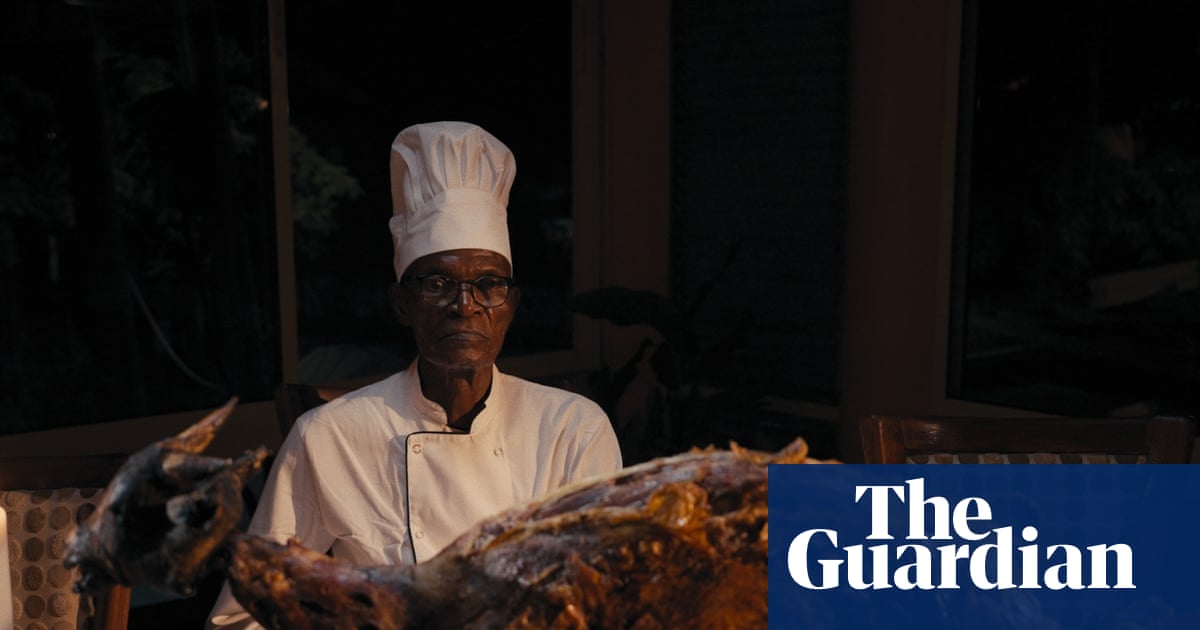
Odera characterizes Amin as “a man of great appetites” who appeared to delight in how speculation of his supposed cannibalism upset Uganda’s British interlopers, reinforcing the image of a ruler beyond both convention or restraint. (Amin famously denied the hearsay, insisting human flesh was “too salty”.) Odera remembers being ordered to cook a human heart, with Amin telling him that eating someone’s heart prevents their spirit from haunting you. His career took another dark turn when one of Amin’s children suffered a stomach ache after a meal, an innocuous incident that nonetheless earned the chef a death sentence.
As Odera shares these harrowing memories, he prepares a roasted goat with a team of cooks. In How to Feed a Dictator, images of animal butchery and state-sanctioned violence are deliberately paired. One can only imagine the discomfort of the crew filming all this sumptuous food, caught between the sensory pull of what was in front of them and the carnage it was set against.