) created
A team of astronomers from the University of California, Berkeley, the Max Planck Institute for Astrophysics and the Harvard‑Smithsonian Center for Astrophysics has unveiled a new supercomputer simul…
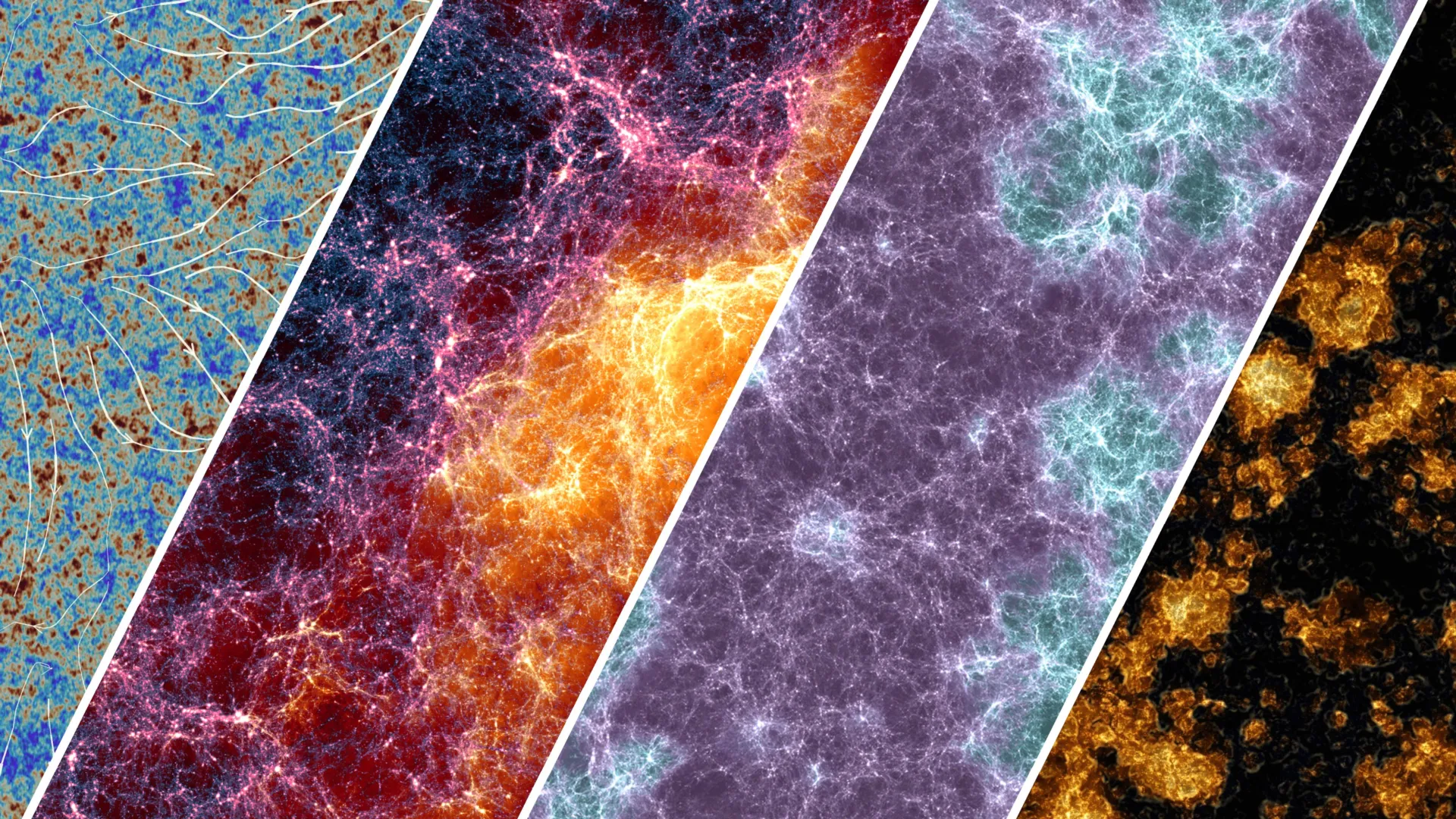
A team of astronomers from the University of California, Berkeley, the Max Planck Institute for Astrophysics and the Harvard‑Smithsonian Center for Astrophysics has unveiled a new supercomputer simulation called Lumina that tracks the universe’s first two billion years after the Big Bang. The model, released in June 2026, spans a region 1.6 billion light‑years across and follows the emergence of the first stars and galaxies from the cosmic dark age. Researchers ran the simulation on an exascale computer, using billions of particles to capture unprecedented detail.
The work matters because the universe’s “dark age” – a period after the Big Bang when no light sources existed – has been hard to study. Astronomers can only infer what happened from indirect clues, such as the faint glow of hydrogen gas. Past simulations could not resolve the small‑scale structures that gave rise to the first luminous objects, leaving a gap in our understanding of how the cosmos transitioned from darkness to light. Lumina fills that gap by modeling the complex interplay of gravity, gas physics and radiation at a resolution never before achieved.
Lumina shows that the first stars formed in isolated pockets, igniting locally and quickly ionizing surrounding hydrogen. The simulation predicts that reionization – the process that cleared the darkness – was highly patchy, with some regions clearing a few hundred million years earlier than others. The model also reproduces the observed abundance of early dwarf galaxies and matches the latest measurements from the James Webb Space Telescope. Lead author Dr Maria Gonzalez said the results “provide a concrete roadmap for interpreting the flood of data we expect from upcoming surveys.”
The team plans to extend Lumina to later epochs, linking the early burst of star formation to the growth of massive galaxies seen today. The findings will help guide observations with the Nancy Roman Space Telescope and future ground‑based observatories. By tightening the timeline of the universe’s first light, the simulation sharpens tests of cosmological theories and may reveal new physics hidden in the universe’s earliest moments.
Read Full Story at ScienceDaily →