Alien messages may have reached Earth without us realizing it
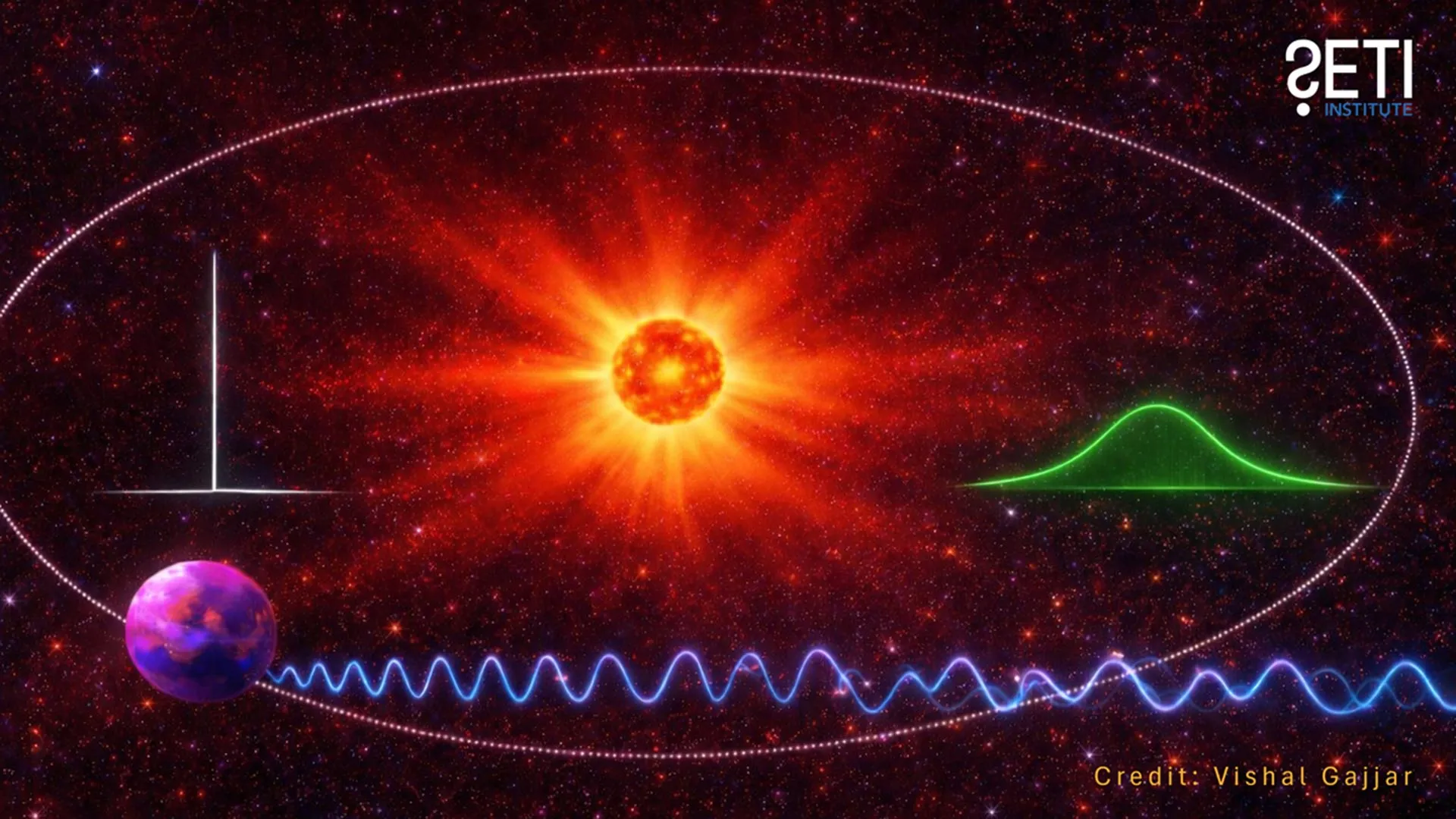
A new SETI study suggests we may be overlooking alien signals not because they aren't there, but because their own stars are scrambling them before they escape into space. Turbulent plasma and powerf…
ScienceDaily — 16 June 2026
Text:
17
0
0
A new SETI study suggests we may be overlooking alien signals not because they aren't there, but because their own stars are scrambling them before th
Read Full Story at ScienceDaily →
⚡ Quickyla Analysis
Original editorial context — not sourced from the article above
The revelation that alien signals might already be reaching Earth—but being obscured or scrambled by their own stars—challenges a fundamental assumption in the search for extraterrestrial intelligence. For decades, SETI researchers have scanned the cosmos for deliberate transmissions, often focusing on narrowband radio signals or optical pulses that stand out against cosmic noise. Yet if alien civilizations are broadcasting from star systems with turbulent plasma or intense magnetic fields, their messages could be distorted beyond recognition by the time they traverse interstellar space. This isn’t just a technical nuance; it suggests our current detection methods may be fundamentally limited, akin to searching for a whisper in a hurricane.
The broader significance lies in how this shifts the burden of proof. Rather than assuming we’ve simply missed signals, the study implies that the universe may be teeming with activity that our instruments aren’t equipped to perceive. This aligns with growing skepticism about the Fermi Paradox—the apparent contradiction between the high probability of alien life and the lack of evidence for it. If signals are being lost in transit, the silence we observe isn’t necessarily the absence of intelligence but the failure of our technology to decode it.
Relevant context includes the role of stellar activity in communication. Stars like red dwarfs, which are common and long-lived, emit violent flares and dense stellar winds that could scramble signals. Even in quieter systems, the ionized gas between stars acts as a cosmic lens, bending and distorting electromagnetic waves. This means that what we dismiss as background noise might actually be a garbled message—one that requires new algorithms or even entirely different detection techniques to unravel.
What happens next? Researchers may pivot toward developing "decoding" tools that account for stellar interference, or expand the search to include broader frequency ranges where distortions are less severe. There’s also the possibility that future telescopes, like the James Webb Space Telescope’s successors, could analyze exoplanet atmospheres for signs of technosignatures—indirect evidence that a civilization is altering its environment in detectable ways. The open question remains: if signals are being lost, how close are we to the right frequency, the right method, to finally hear them? The answer could redefine humanity’s place in the cosmos—or at least force us to ask why we’ve been listening to the wrong cosmic symphony.
Sources

🔬 Science
'Astonishing': James Webb telescope spots the most chemically primitive galaxy in the ancient universe

🔬 Science
El Niño Is Underway

🔬 Science
Astronomers gaze into the 'Crystal Ball Nebula' and see a vision of our dying sun — Space photo of the week

🔬 Science
Bacteria uncover distinct strategy to import rare sugar polymers, crystal structures show

🔬 Science
NASA Awards Contract for Johnson Space Center Infrastructure

🔬 Science
Repairing DNA damage: Scientists discover a surprising new benefit of melatonin

