An 'impossible' black hole merger may finally be solved thanks to Einstein's relativity — but it raises an even bigger mystery
Astronomers suspect that a never-before-seen variation of a space-time phenomenon could explain an "impossible" black hole merger that has puzzled experts for years. But if their theory is true, it c…
Astronomers suspect that a never-before-seen variation of a space-time phenomenon could explain an "impossible" black hole merger that has puzzled experts for years. But if their theory is true, it creates an entirely new mystery to solve.
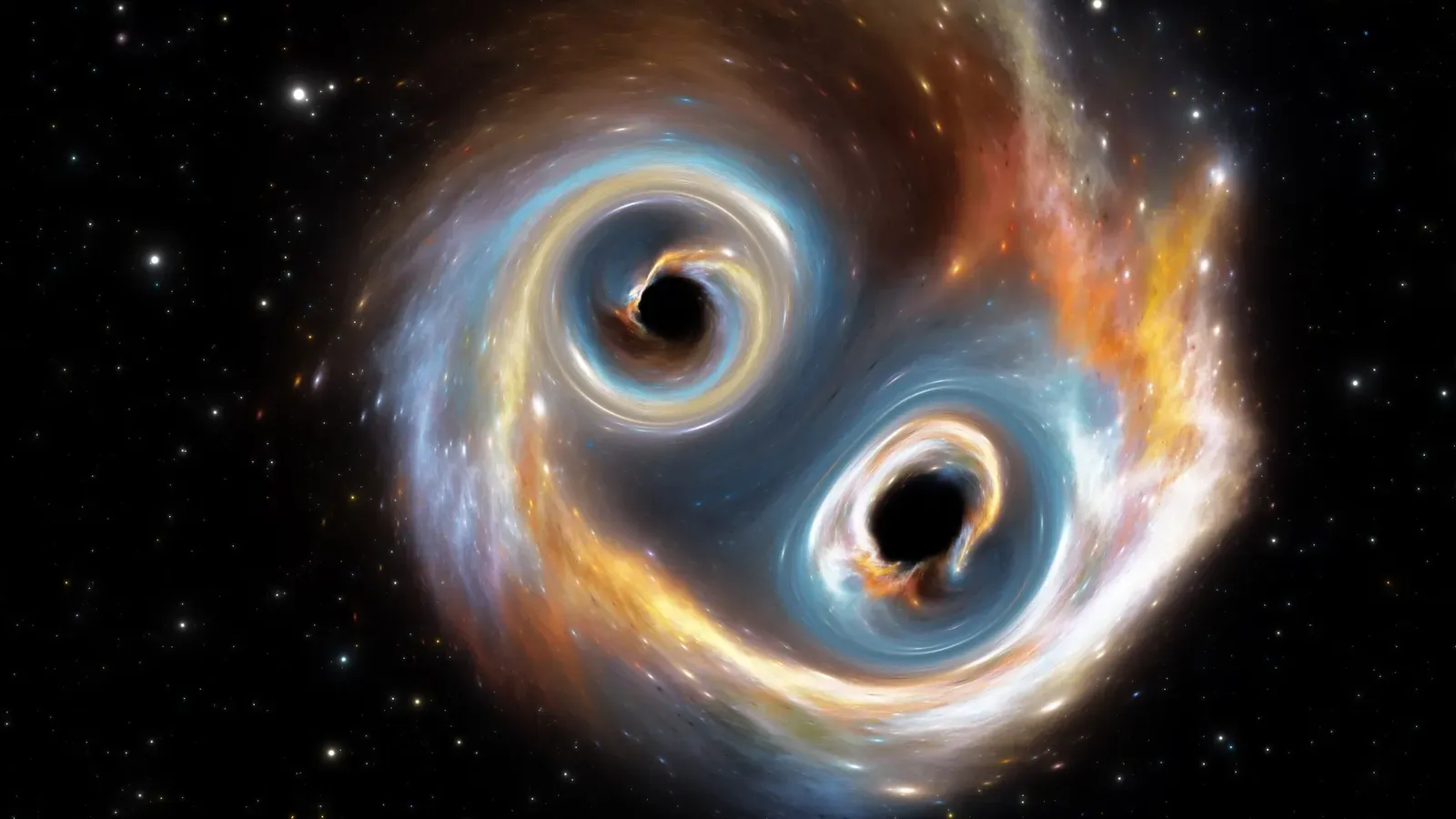
On Nov. 23, 2023, both halves of the Laser Interferometer Gravitational-Wave Observatory (LIGO) — located in Washington and Louisiana — detected an unusual set of gravitational waves. These ripples in the fabric of space-time can be triggered by some of the universe's most powerful events , such as exploding stars and rapidly spinning neutron stars . But in this case, the signal, dubbed GW231123 , originated from a pair of colliding black holes around 2 billion light-years from Earth.
The merger also made waves in the media as the most massive black hole collision to date , with the two parent black holes birthing a singularity around 230 times more massive than the sun . The only problem is that the colliding black holes — which weighed 100 and 130 solar masses, respectively — are too large to be explained by our current understanding of the universe.
The pair dwell in what astronomers call a "mass gap," meaning they are too large to be stellar-mass black holes, created by collapsing stars, but they are smaller than intermediate-mass black holes, which we still do not fully understand . Adding to the strangeness, the black holes were spinning much faster than expected when they smashed into each other.
Researchers have put forward several potential explanations for the black holes' "forbidden" sizes. One study released last year proposed a new pathway by which singularities of this size could form : via the collapse of larger stars that would otherwise explode as supernovas. However, this idea goes against a lot of previous observational evidence.
Now, in a study published Aug. 25 in The Astrophysical Journal Letters , researchers propose a simpler, yet equally intriguing explanation for GW231123. They suggest that the signal from the merger was warped by a strange space-time phenomenon called gravitational lensing, which occurs when distant emissions pass through patches of distorted space-time bent by the gravity of massive foreground objects.
This effect has been shown to magnify, or otherwise warp, distant light sources many times before. However, until now, researchers had found no evidence that gravitational lensing could happen to ripples in space-time.
Get the world’s most fascinating discoveries delivered straight to your inbox.
Read Full Story at Live Science →