Amazon plane crash at Miami airport kills five
An Amazon cargo plane crashed at Miami International Airport, killing at least five people. The incident highlights safety risks in high-volume cargo aviation operations.
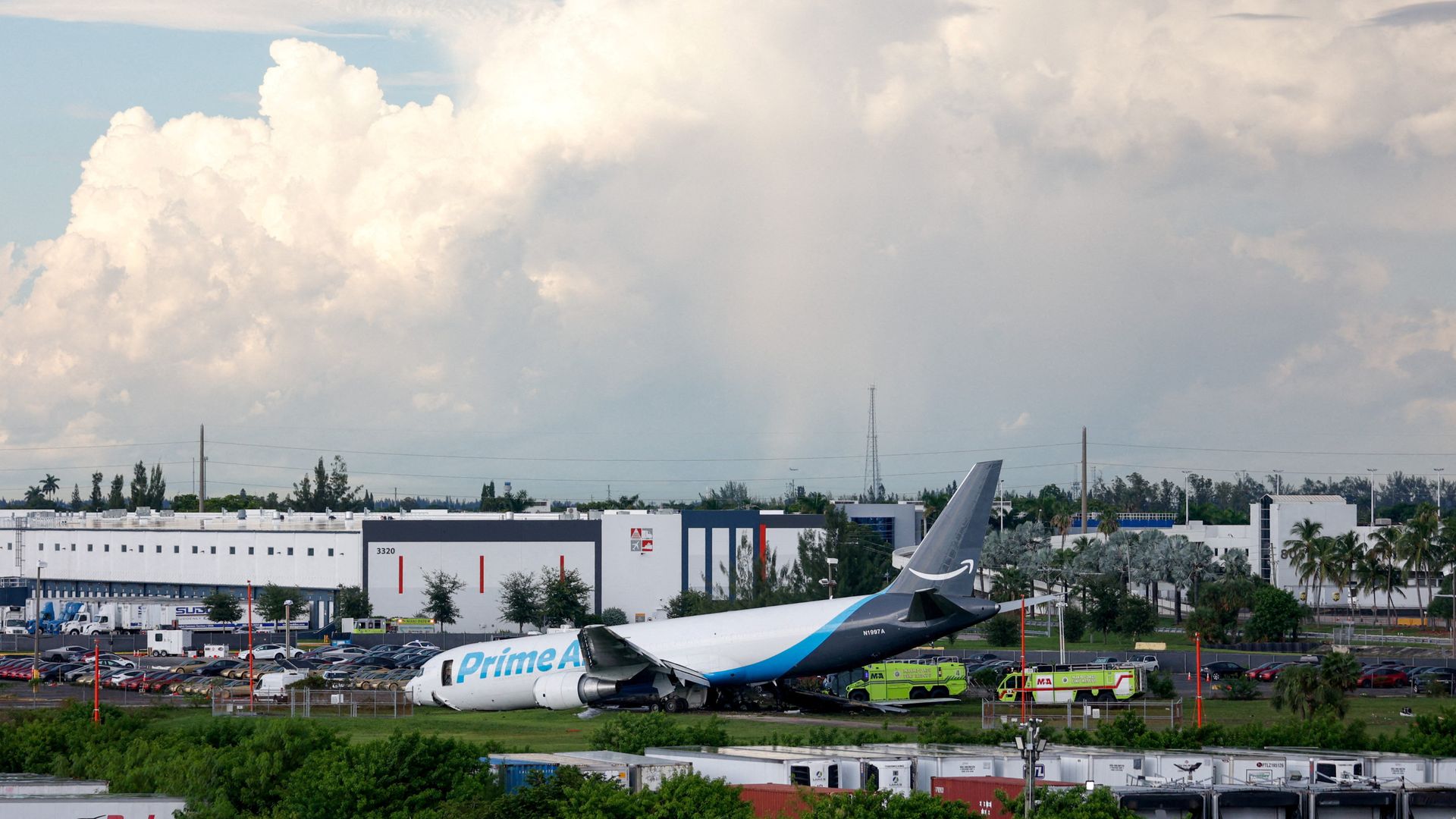
An Amazon cargo plane overshot the runway at Miami International Airport early Tuesday morning, crashing through a perimeter fence and striking multiple vehicles, resulting in at least five confirmed deaths. The aircraft, a Boeing 767 freighter operated by Air Prime on behalf of Amazon Air, was attempting to land in heavy rain and strong crosswinds when it lost traction on the wet tarmac. Emergency responders rushed to the scene after the plane slid past the end of the runway, rupturing its fuel tanks and igniting a large fire that consumed the tail section and several parked cars in a nearby lot. The severity of the impact and the subsequent blaze prevented immediate entry by rescue crews, complicating efforts to determine the exact number of casualties among ground personnel and bystanders.
This incident underscores the persistent risks associated with cargo aviation, which often operates with smaller crews and during night hours when visibility and weather conditions can deteriorate rapidly. Miami International Airport is one of the busiest hubs in the United States, handling a significant volume of international freight, particularly for e-commerce giants like Amazon. The reliance on just-in-time delivery models has increased the frequency of cargo flights, putting additional strain on airport infrastructure and air traffic control systems. While passenger flights receive more public scrutiny and regulatory oversight, cargo operations have historically been subject to different safety standards, though recent years have seen a push for greater transparency and stricter enforcement of maintenance and pilot training protocols. The crash highlights the vulnerability of airport perimeters, where commercial and logistical zones often intersect with public access points, raising questions about safety buffers and emergency response planning.
The National Transportation Safety Board has launched an investigation to determine the precise cause of the accident, focusing on weather data, maintenance records, and cockpit voice recordings. Preliminary reports indicate that the pilot declared an emergency shortly before landing, citing difficult conditions, but was unable to bring the heavy aircraft to a stop within the available runway length. Amazon has stated that it is cooperating fully with authorities and is providing support to the families of the victims, though it has not yet released specific details about the cargo on board. Local officials have described the scene as chaotic, with smoke billowing into the night sky and emergency vehicles converging from multiple directions. The crash has temporarily disrupted operations at the airport, with several runways closed for cleanup and investigation, causing delays for both passenger and cargo flights.
In the aftermath, stakeholders are calling for a comprehensive review of safety procedures at major cargo hubs. The incident may prompt regulators to examine whether current runway lengths and surface treatments are adequate for modern, heavier freight aircraft, especially in adverse weather. It also raises broader concerns about the integration of high-volume e-commerce logistics into traditional airport environments, which were not originally designed to handle such intense freight traffic. As the investigation progresses, more details are expected to emerge regarding the sequence of events leading to the crash, potentially influencing future aviation safety standards. For now, the focus remains on supporting the victims and their families, while the aviation industry reflects on the critical need to balance efficiency with safety in an increasingly complex global supply chain.
Read Full Story at Sky News →