Can quantum computers solve math’s hardest problem?
Can quantum computers solve math’s hardest problem? A million-dollar math mystery may someday be resolved in a physics lab. A new study brings this vision one step closer. The Riemann hypothesis cl…
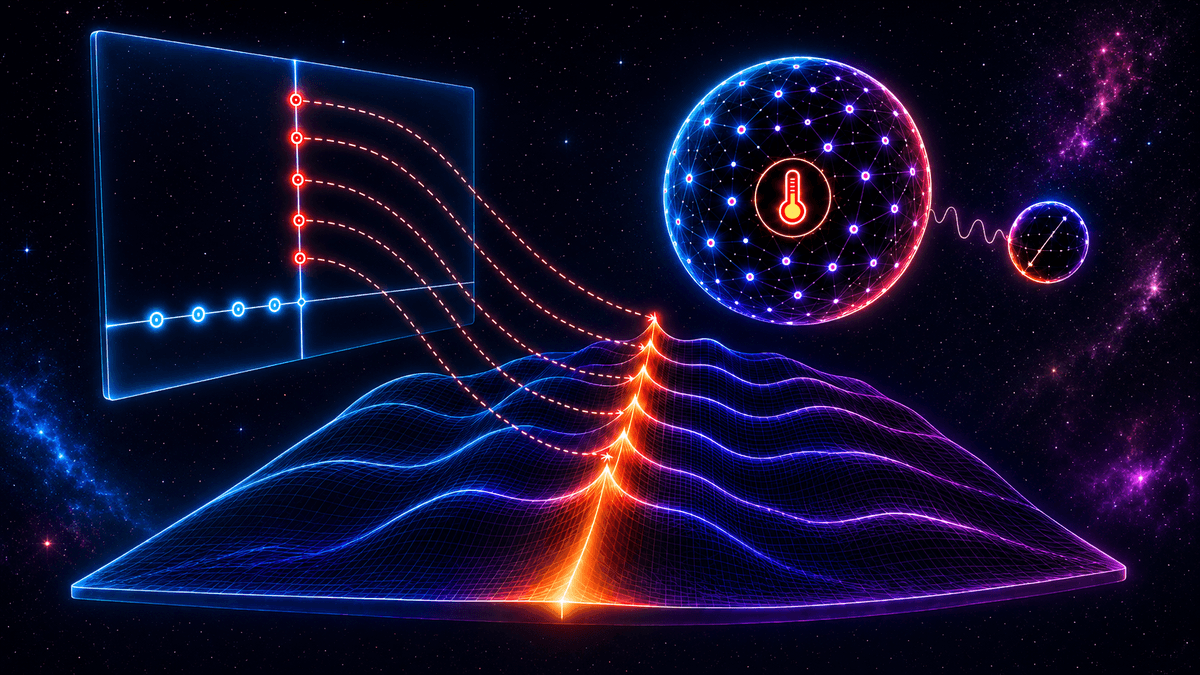
A million-dollar math mystery may someday be resolved in a physics lab. A new study brings this vision one step closer.
The Riemann hypothesis claims that the locations of prime numbers along the infinite number line all adhere to a beautiful and orderly but obscure formula. Yet 167 years after German mathematician Bernhard Riemann made this guess, and in spite of a million-dollar bounty , mathematicians still have no idea how to prove it.
Now a team in China has managed to encode that formula into a physical system and explore its workings using a quantum computer. The researchers’ work, an unedited version of which saw early publication last month in the journal Nature Communications, makes this abstract question about prime numbers more tangible than ever before.
“It provides a new perspective on the Riemann hypothesis,” says Shijie Wei of the Beijing Academy of Quantum Information Sciences, the study’s co-lead author. He hopes the work will prove “that quantum computing will serve as a powerful avenue for investigating major mathematical conjectures.”
If you're enjoying this article, consider supporting our award-winning journalism by subscribing . By purchasing a subscription you are helping to ensure the future of impactful stories about the discoveries and ideas shaping our world today.
The notion struck Wei a decade ago, when he saw a lecture about the exploration of a related mathematical formula, called the Möbius inversion, with a quantum computer. “Inspired by this idea, I thought that maybe the Riemann hypothesis can also connect to quantum systems,” he says.
At the center of the hypothesis is the Riemann zeta function, a gnarly equation involving a sum of infinitely many pieces. First, you plug in its input—a number with a real part and an imaginary part (the latter is “imaginary” because it involves something seemingly nonsensical: the square root of –1). Then, once you calculate that infinite sum, the result is a single number.
Riemann showed that the locations of the zeta function’s “zeros”—the different inputs that cause its infinite sum to exactly equal zero—encode the locations of all the prime numbers along the number line. Moreover, he hypothesized that these zeros happen only when the input’s real part is exactly 1 ⁄ 2 . If true, this would reveal remarkable order hiding beneath the primes’ apparent chaos. But if you find any zero where the input’s real part isn’t 1 ⁄ 2 (regardless of the imaginary part’s value), you’ve disproved the conjecture—and should write to the Clay Mathematics Institute to receive your $1 million.
Read Full Story at Scientific American →