Cars burn in Belfast, bricks fly in Southampton – and the ubiquitous cry of ‘civil war’ goes up again | John Harris
For most, what we see in real life is mundane. But those who wish to fan the flames of anti-immigrant feeling share a different image online I t was the summer of 2024 when it all decisively started, with the horrific murders in Southport, countrywide violence and Elon Musk’s ob
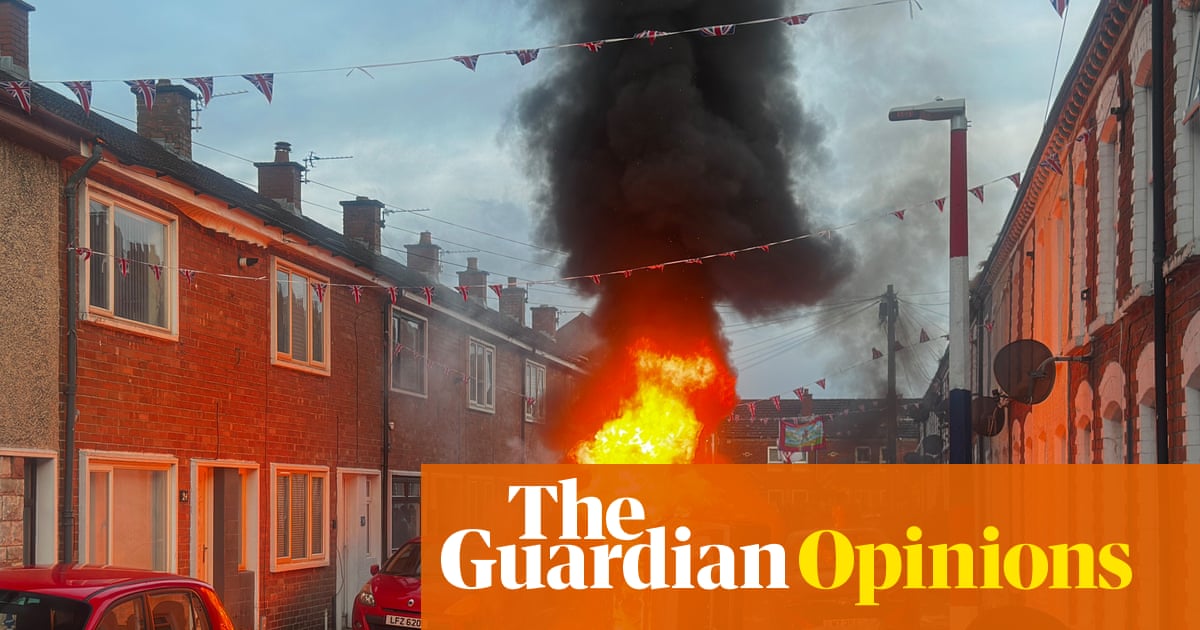
For most, what we see in real life is mundane. But those who wish to fan the flames of anti-immigrant feeling share a different image online
I t was the summer of 2024 when it all decisively started, with the horrific murders in Southport, countrywide violence and Elon Musk’s observation that a British civil war was somehow “inevitable”. A year later came a hot season of flags on lamp-posts , protests outside hotels used to accommodate asylum seekers, the ubiquitous use of the word “tinderbox” and constant predictions of widespread riots that never actually materialised. Now here we are again, in the aftermath of the awful murder and treatment by the police of Henry Nowak and frightening violence and arson in Belfast, and the civil war predictions seem to be increasing by the hour.
The archive of such material is already bulging. In August 2024, amid the riots, a YouGov poll found that 32% of people thought a UK civil war was either “very” or “somewhat” likely. A year later, Dominic Cummings said the UK was only “random viral posts away from riots and prairie fires getting out of control”. Even Labour’s Lisa Nandy offered the opinion that the north of England was so tense “it could go up in flames”.
But then as now, the king of civil war genre, even if he usually avoids directly using the term, remained Nigel Farage, whose lexicon of expressions for anarchy and general breakdown includes “ societal collapse ” and “ civil disobedience on a vast scale ”, as well as predictions that Britain is “ not far from major civil disorder ”, presumably fired by the “ pure, cold rage ” he so disgracefully incited last week. Unsurprisingly, such talk is an international phenomenon, as evidenced by similar predictions of civil conflict, strife and war – usually pinned on immigration and Islam – from just about all the key populist politicians of mainland Europe.
All of which, it seems, has left the Tory party feeling rather left out. So Kemi Badenoch has tried to combine a vague tone of restraint and reason with the use of a telltale term presumably intended to grab the attention of disaffected former Tory voters who now support Reform UK (or, if they have more hardcore tastes, Rupert Lowe’s Restore Britain). Her interview for a new BBC Radio 4 programme, titled England’s Identity Crisis , resulted in a quote that was a bit of rambling mess – an attempt to blame “ identity politics ” for social fragmentation, of a piece with her proposal to scrap parts of the Equality Act – but she eventually uttered the two crucial words.
“We are seeing more and more hostility to people of every ethnicity,” she said, “whether they’re English or not English, because people are bringing political conflict into an area where we didn’t have political conflict … This is why it’s really important that politicians understand this properly and have policies that make a difference, rather than use the political conflict as a way to get some votes from one particular community … In the long term, that’s how you end up with civil war.”
If you want a more pointed set of civil war predictions, one high-profile source is David Betz, a Canadian academic and “ civic nationalist ” based at King’s College London who looks and sounds like a character from a peak-period JG Ballard novel. Among other factors, he blames multiculturalism and degenerate elites for what he sees as the very real prospect of civil war across the west , which will be “demarcated along ethnic lines”. For reasons that elude some of his readers, he thinks Britain stands an 18.5% chance of falling into such a conflict in the next four years, and that such an eventuality would entail the death of about 23,000 people a year.
The essential theory behind this is based on the idea of society breaking into three “zones” – as he puts it : “urban enclaves where non-native populations dominate”, “mixed regions where instability will be fiercest, particularly capital cities where state authority still exerts influence” and “largely contiguous native-dominated areas, comparable to the French regions voting National Rally in 2024, forming bases for counter-mobilisation”. The west’s urban centres, he says, may turn into what the US military once called “feral cities”. Such projections, moreover, come wrapped in cast-iron confidence: “That civil war is looming in the west is a logical conclusion of standard, well-understood precepts of social science,” he reckons (although the KCL professor of economics and public policy Jonathan Portes considers his ideas “absurd” .







