China’s Tianwen-2 spacecraft arrives at one of Earth’s mysterious ‘quasi-moons’
China’s Tianwen-2 spacecraft just arrived at a mysterious ‘quasi-moon’ of Earth The Tianwen-2 spacecraft is slowly closing in on the near-Earth asteroid Kamo‘oalewa, on a mission that would bring China’s first asteroid samples back to Earth in 2027 Over the weekend, China’s sec
China’s Tianwen-2 spacecraft just arrived at a mysterious ‘quasi-moon’ of Earth
The Tianwen-2 spacecraft is slowly closing in on the near-Earth asteroid Kamo‘oalewa, on a mission that would bring China’s first asteroid samples back to Earth in 2027
Over the weekend, China’s second deep-space mission, Tianwen-2, quietly performed a crucial engine burn to rendezvous with a mysterious tiny world in a quasi-Earth orbit. Although China’s space administration has yet to acknowledge the milestone, amateur radio observers using telescopes in Germany and the Netherlands tracked the maneuver, observing Tianwen-2 to now be in the vicinity of the near-Earth asteroid Kamoʻoalewa. Over the next four weeks, the spacecraft will approach the rapidly spinning asteroid to begin studying and mapping its surface, lining up future sampling attempts.
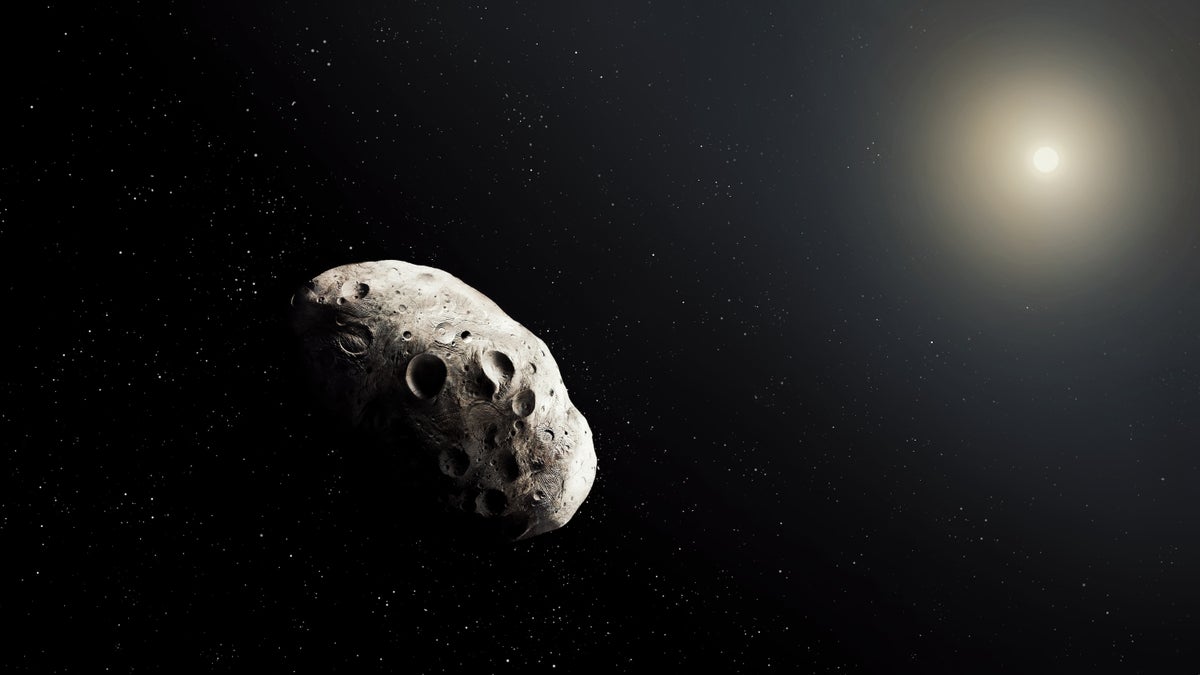
Kamoʻoalewa is a space rock between about 40 to 100 meters in size that rotates once every 28 minutes. It’s also one of seven known quasi-moons of Earth, bodies that orbit the sun in tune with our planet, making slow retrograde loops around us. But at least until Tianwen-2 gets close enough to see it in more detail, scientists can’t say much more about the enigmatic, smaller than soccer-pitch-size object.
“Every new image of an asteroid has been a surprise,” says Patrick Michel, director of research at the French National Center for Scientific Research and principal investigator of the European Space Agency’s Hera mission , who has studied Kamoʻoalewa extensively. “We have everything to learn.”
If you're enjoying this article, consider supporting our award-winning journalism by subscribing . By purchasing a subscription you are helping to ensure the future of impactful stories about the discoveries and ideas shaping our world today.
The asteroid’s rapid spin may give some clues as to its composition because, if it were a “gravel pile,” it should shed debris as it twirled. Instead it could be, in the words of planetary scientist Christine Hartzell of the University of Maryland, “a chunk of rock or a couple of chunks of rock held together.” A mission paper from the Tianwen-2 team acknowledges as much, noting that while Kamoʻoalewa’s surface is likely composed of millimeter- to centimeter-scale grains, deeper down, it could be essentially one giant boulder—or a coalesced rubble pile.
Another open question is how this apparent asteroid found its way into a weird orbit alongside Earth’s. One theory, espoused by Michel and others based on the asteroid’s reddish appearance, which resembles that of common moon rocks, is that Kamoʻoalewa began as a chunk of the lunar farside. It was then blasted into orbit sometime in the past 10 million years by the impactor that created the 22-kilometer-wide Giordano Bruno Crater.