Drought threatens power supplies in Danube countries
Riverbeds reduced to tiny streams, asphalt melting like butter, dried-up fields — these are currently the images of drought in Central and Southeastern Europe. The record-breaking lack of rainfall in…
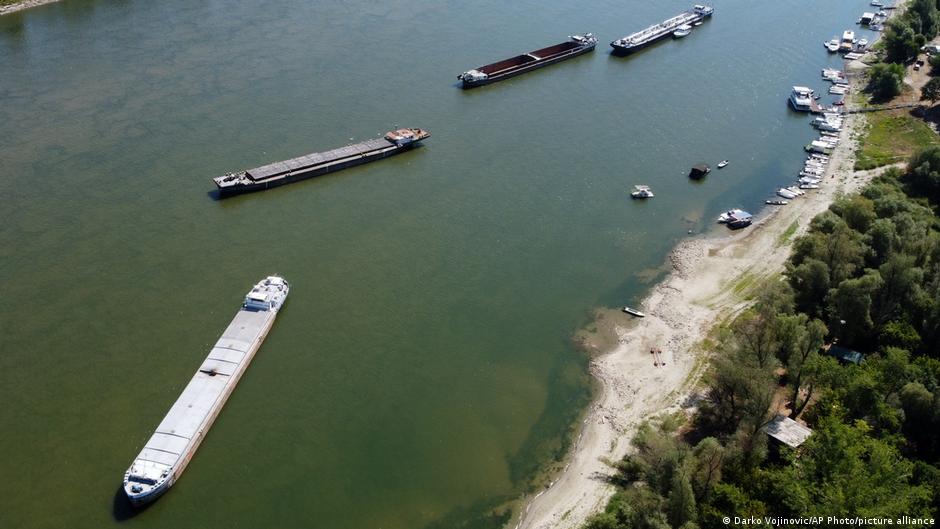
Riverbeds reduced to tiny streams, asphalt melting like butter, dried-up fields — these are currently the images of drought in Central and Southeastern Europe. The record-breaking lack of rainfall in recent months and this summer's heatwaves have caused severe damage to the region's economy and infrastructure.
In the agriculture sector, it has been clear for some time that harvests in Southeastern Europe, especially maize and sunflower crops, will be significantly below average. The heatwaves are also repeatedly disrupting road, rail and, above all, shipping transport. But, most importantly, the drought has triggered an unprecedented crisis in electricity generation in several Central and Southeastern European countries, forcing companies to halt production due to the historically low water level of the Danube.
Hungary and Romania are currently most affected by the energy crisis. Other countries bordering the Danube — Austria , Slovakia , Serbia and Bulgaria — are also suffering from low water levels, although not as severely as Hungary and Romania.
DW outlines the situation in each country and explains why, despite facing similar weather conditions, some are more severely affected than others.
No country in the region is currently as severely affected by drought and heat as Hungary. For months, there has been little or no rainfall in large parts of the country. On Wednesday, temperatures reached 43 degrees Celsius (109.4 degrees Fahrenheit) in the capital Budapest , and exceeded 40 degrees in many places across the country.
Due to the record-low water levels of the Danube, the Paks nuclear power plant south of Budapest had to largely shut down operations, as there is no longer sufficent cooling water available and the temperature of the Danube water is too high. The plant is currently operating at around 12% of its capacity. If Danube water levels continue to drop, the plant will have to be shut down completely.
Due to the energy crisis, the Hungarian government has been urging large energy consumers to conserve electricity. As a result, several car manufacturers, including Audi Gyor, oil and gas company MOL and other large companies have scaled back production. Hungary's energy crisis — the worst in decades — is so severe because of the country's unfavorable energy mix. Paks generates around 50% of the electricity produced in Hungary and about one-third of the electricity consumed. Although Hungary has significant solar energy capacity, it lacks storage facilities, has too few modern gas-fired power plants and very little wind or hydropower capacity.
Even if the Danube water levels rise significantly again, the Paks nuclear power plant cannot simply be brought back online quickly — the process takes a considerable amount of time. Therefore, Hungary's energy crisis will continue for at least several more weeks, during which the country will have to import electricity at high prices. In response to the crisis, the new government under Peter Magyar has announced a comprehensive review of Hungary's energy development strategy.
Read Full Story at DW World →