Fingal's Cave: Scotland's 'cave of melody' where eerie echoes bounce off pillars of solidified lava
Fingal’s Cave, on Scotland’s Staffa Island, formed 58 million years ago, features striking hexagonal basalt columns and unique acoustics. Inspired Mendelssohn’s *Hebrides Overture* and attracts researchers studying its sound-reflecting properties.
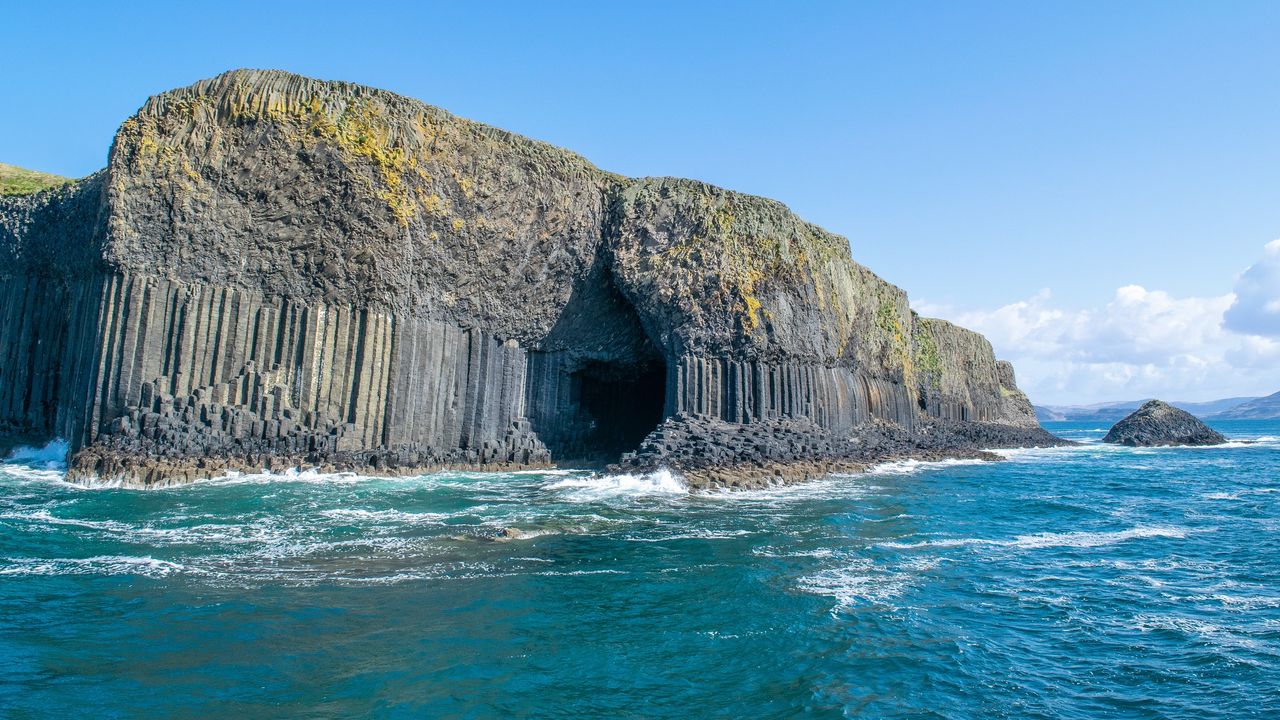
Fingal’s Cave, a natural wonder on the uninhabited island of Staffa in Scotland’s Inner Hebrides, has long captivated visitors with its otherworldly acoustics and striking hexagonal basalt columns. Formed around 58 million years ago during a period of intense volcanic activity, the cave’s walls are composed of near-identical, interlocking columns of solidified lava, creating a geometric marvel that has inspired centuries of myth and art. The cave’s name derives from the Gaelic *Uamh Bhin*, meaning “melodious cave,” a nod to the eerie, resonant sounds produced when waves crash against the pillars or when voices echo through the chamber. This acoustic phenomenon, combined with the cave’s dramatic appearance, has cemented its reputation as one of the most acoustically unique geological formations in the world.
The cave’s allure extends beyond its geological oddities, drawing comparisons to Ireland’s Giant’s Causeway and even the mythical caves of Homer’s *Odyssey*. Fingal’s Cave gained particular fame in the 18th and 19th centuries when romantic poets like Sir Walter Scott and composers such as Felix Mendelssohn visited, the latter composing his *Hebrides Overture* (also known as *Fingal’s Cave*) after experiencing the cave’s echoes. Today, it remains a site of cultural and scientific fascination, attracting geologists, musicians, and tourists alike. Its remote location and protected status as a Site of Special Scientific Interest ensure that its pristine conditions are preserved, though this also makes access challenging, requiring boat trips from nearby islands.
Recent years have seen renewed interest in Fingal’s Cave as a symbol of Scotland’s natural heritage and a case study in acoustic geology. In 2022, researchers from the University of Salford conducted a study to map the cave’s sound reflections, confirming that its structure amplifies certain frequencies while muting others—a discovery with potential applications in architectural acoustics. The findings underscored how natural formations can inadvertently serve as models for human-designed soundscapes. Meanwhile, climate change poses an indirect threat to the cave, with rising sea levels and increased storm activity accelerating coastal erosion. Conservationists warn that without careful monitoring, the cave’s delicate basalt columns could be destabilised over time.
Fingal’s Cave stands as a testament to the interplay between geology, acoustics, and human creativity. Its haunting melodies and architectural grandeur continue to inspire, bridging the gap between science and art. As climate pressures mount, the need to safeguard such sites grows ever more urgent, ensuring that future generations can experience their magic—and hear their echoes.