Humanoid robots 'the future' of car making, says BMW
BMW will deploy humanoid robots, Aeon, at its Leipzig plant this summer for car manufacturing, integrating with human workers due to their adaptable size and dexterity. Aeon, equipped with 21 sensors and trained via teleoperation and simulation, stands 1.65m tall, weighs 60kg, and can handle payloads up to 15kg.
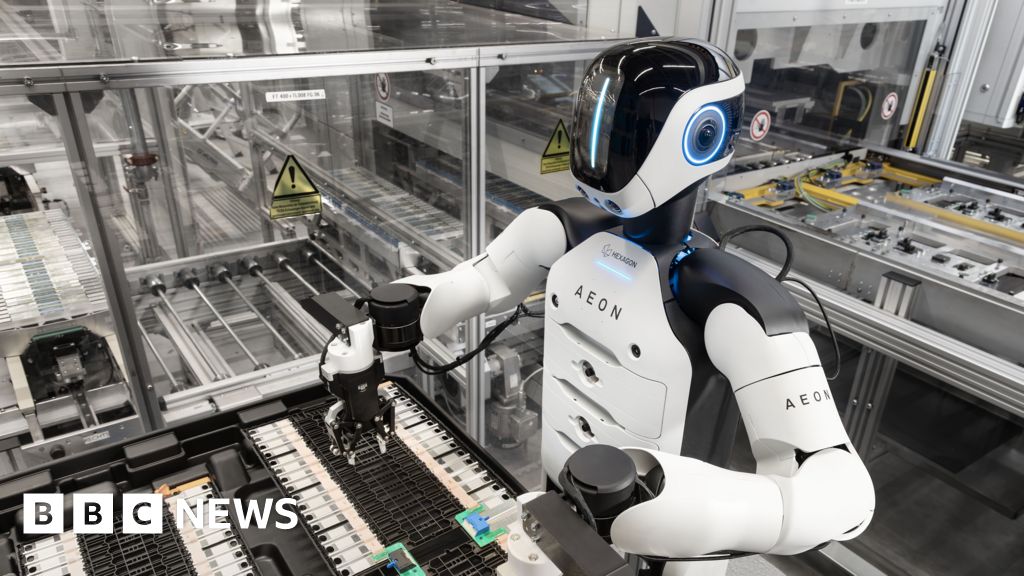
BMW is set to deploy humanoid robots in car manufacturing at its Leipzig plant this summer, marking a significant shift in European automotive production. The two robots, named Aeon and developed by Hexagon Robotics, will operate alongside human workers, integrating seamlessly into existing assembly lines. Michael Nikolaides, BMW’s head of process management and digitalisation, described this as “the future of automotive production,” emphasising that humanoid robots can adapt to human workspaces due to their size and dexterity. Unlike traditional industrial robots, which often require factory redesigns, Aeon’s human-like form allows it to fit into current processes without costly modifications, making it a cost-effective solution as robotics costs decline.
Aeon stands 1.65 metres tall and weighs 60 kilograms, equipped with 21 sensors—including cameras, radar, and force sensors—to navigate and manipulate objects. Its top speed is 2.4 metres per second, with a payload capacity of 15 kilograms for short tasks or 8 kilograms continuously. Training the robots involved a mix of teleoperation—where sensors track human movements—and simulation in a digital twin of the factory, leveraging Nvidia’s software. This approach, known as reinforcement learning, allowed the robots to simulate tasks repeatedly to refine their performance. For complex actions like picking up parts, teleoperation provided real-world examples for the robot to emulate.
The rapid advancement of robotics training methods is a key factor in this development. Arnaud Robert, president of robotics at Hexagon, highlighted imitation learning—a technique where robots observe human tasks through video or motion sensors—as a game-changer. This method could reduce training time from months to days, making deployment far more efficient. “The best translation [from human to robot] is when the teacher and the student have the same form factor,” Robert noted, suggesting that robots could eventually learn tasks simply by watching workers. While Aeon’s current battery life lasts only three hours—requiring a quick three-minute swap for an eight-hour shift—engineers are working to extend its autonomy.
Industry analysts predict further breakthroughs in robotics within the next three to five years. Bill Ray, a distinguished VP analyst at Gartner, forecasts that robots will soon respond to simple voice commands, streamlining operations further. As humanoid robots like Aeon prove their utility, they could redefine manufacturing efficiency, safety, and adaptability. For now, BMW’s deployment serves as a pioneering test case, potentially paving the way for broader adoption across the automotive sector and beyond.