India bets big on domestic drones for future warfare
For decades, India's military relied primarily on troops, fighter aircraft, satellites and conventional surveillance systems to monitor its borders. The 2020 military standoff with China in eastern Ladakh exposed the challenge of maintaining constant surveillance across vast str
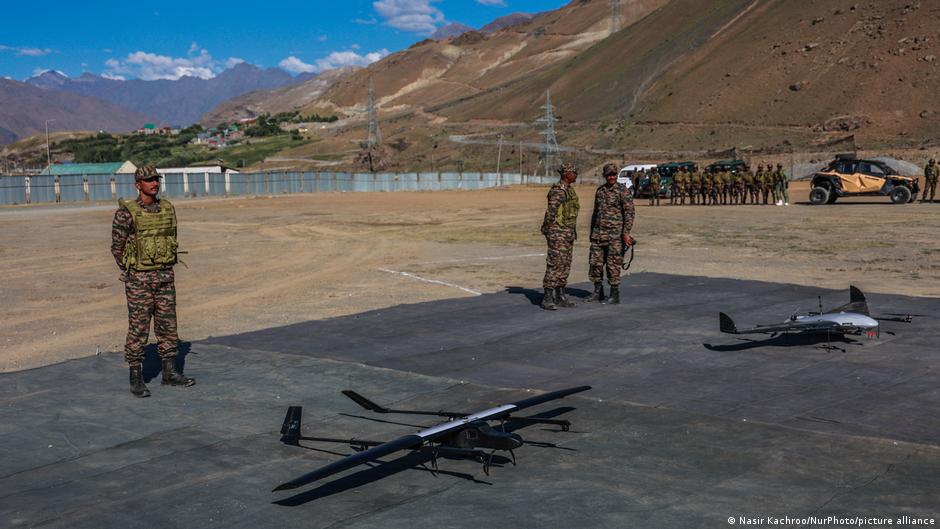
For decades, India's military relied primarily on troops, fighter aircraft, satellites and conventional surveillance systems to monitor its borders.
The 2020 military standoff with China in eastern Ladakh exposed the challenge of maintaining constant surveillance across vast stretches of difficult high-altitude terrain.
Now India is preparing to place a record military drone order worth over $2 billion (€1.7 billion) with domestic manufacturers, including major firms like Adani Group, Tata Advanced Systems and Larsen & Toubro as well as startups such as ideaForge and Asteria Aerospace, marking this its largest-ever unmanned systems procurement.
Drones are increasingly seen as the eyes and ears of the battlefield , capable of gathering intelligence, tracking troop movements, delivering supplies and carrying out precision strikes.
The drones are expected to be deployed along some of India's most sensitive frontiers including the Line of Actual Control with China , the borders with Pakistan and Bangladesh , and the Indian Ocean.
On the surface, it is a major defense purchase. In reality, it reflects a profound shift in how India views future warfare and how quickly drones have moved from the margins of military planning to the center of it. The shift has been shaped by a series of developments.
In May 2025, India and Pakistan came to the brink of a wider conflict after the Pahalgam attack in India-administered Kashmir, with both sides deploying drones and advanced air power before a US-backed ceasefire restored a fragile peace.
In the aftermath, India launched Cold Start, the largest drone warfare exercise in its history, involving the army, navy and air force.