'It's a nightmare.' Former refugee, professor on Trump's new Medicaid policy
Mohammad Attaie and his wife Deena, newly arrived from Afghanistan, get assistance from medical translator Jahannaz Afshar making a doctor's appointment at the Valley Health Center TB/Refugee Program…
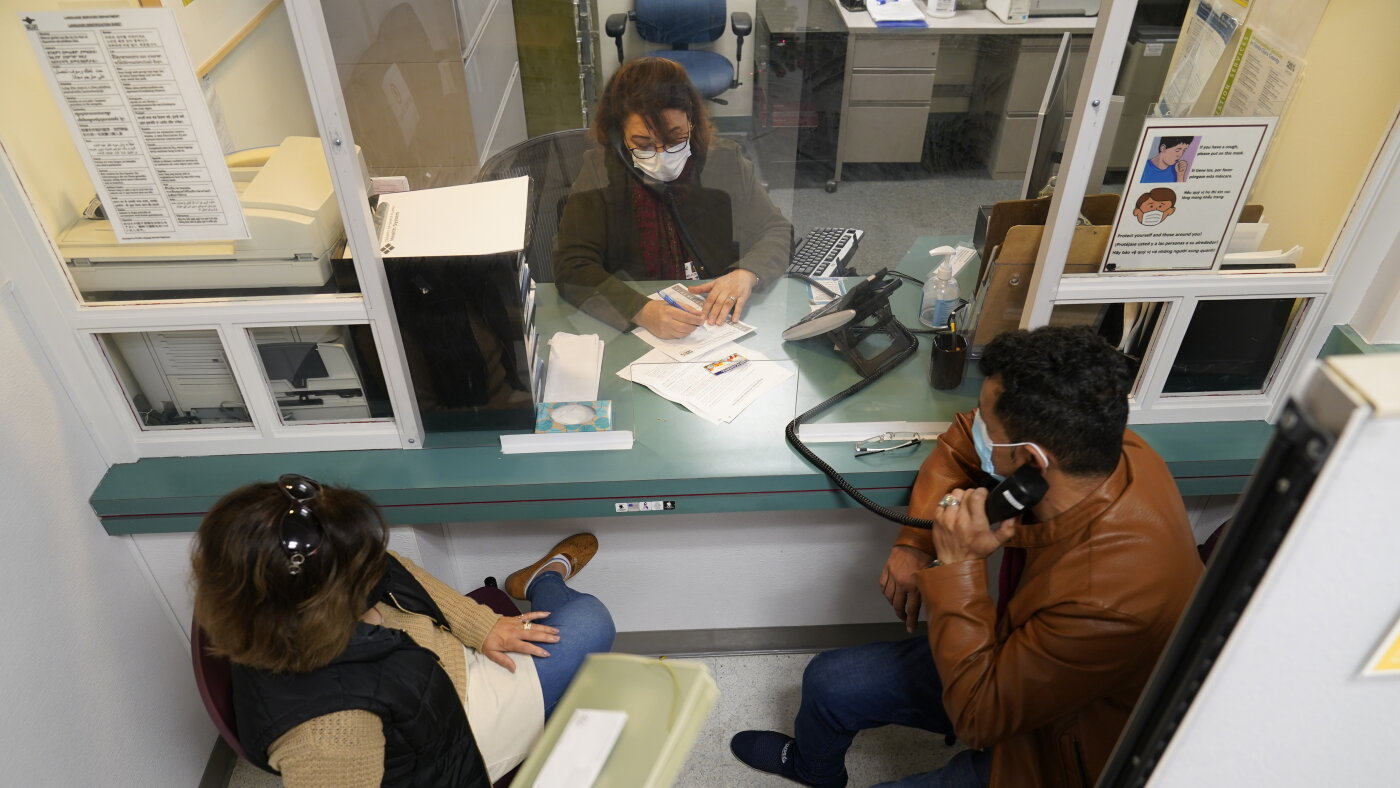
Mohammad Attaie and his wife Deena, newly arrived from Afghanistan, get assistance from medical translator Jahannaz Afshar making a doctor's appointment at the Valley Health Center TB/Refugee Program in San Jose, Calif., on Dec. 9, 2021. Eric Risberg/AP hide caption
For stories on the science of healthy living, subscribe to NPR's Health newsletter.
Mustafa Rfat has been getting frantic phone calls recently from refugees with disabilities. As of Oct. 1, refugees are losing access to Medicaid across the country because of H.R. 1, the Trump administration's major budget bill Republicans passed last summer.
"I spent these past two weeks just talking with so many of them, literally just terrorized by the reality that their children with disabilities are losing coverage," he says. "For example, a father is a refugee with disabilities, with two kids with disabilities, and he's just confused how he's going to get the medication."
Rfat is a professor of social work at the University of Nebraska at Omaha, and his research focuses on refugees with disabilities, an experience he knows firsthand.
When he arrived in the U.S. as a refugee from Iraq in 2011, the chronic condition that affects his spine was severe. "I was in a very bad situation," he says. "I couldn't walk. I was in so much pain. I missed my medications for a long time. I didn't see a doctor. So it was a very, very difficult and vulnerable situation."
When Mustafa Rfat arrived in the U.S. as a refugee from Iraq in 2011, the chronic condition that affects his spine was severe. He says Medicaid was a lifeline for him. Now, he's trying to help refugees with disabilities facing the challenges of navigating life in the U.S. without that lifeline. Mustafa Rfat hide caption
As he moved from Alabama to Illinois to West Virginia trying to find housing and continue his education, Medicaid was a lifeline, Rfat says. "I had to climb this big mountain of acclimating into the culture here, learning English, dealing with the traumas of the war, the loss of family members, the challenges that I faced, being alone with a disability," he says.
Read Full Story at NPR Health →