Japan hits 6G key milestone with high-frequency speeds topping 100 Gbps
Japanese researchers achieved 100+ Gbps speeds in 6G tech using a miniaturized terahertz system. The chip, 90x smaller than alternatives, uses optical frequency combs for stable, high-speed data transfer.
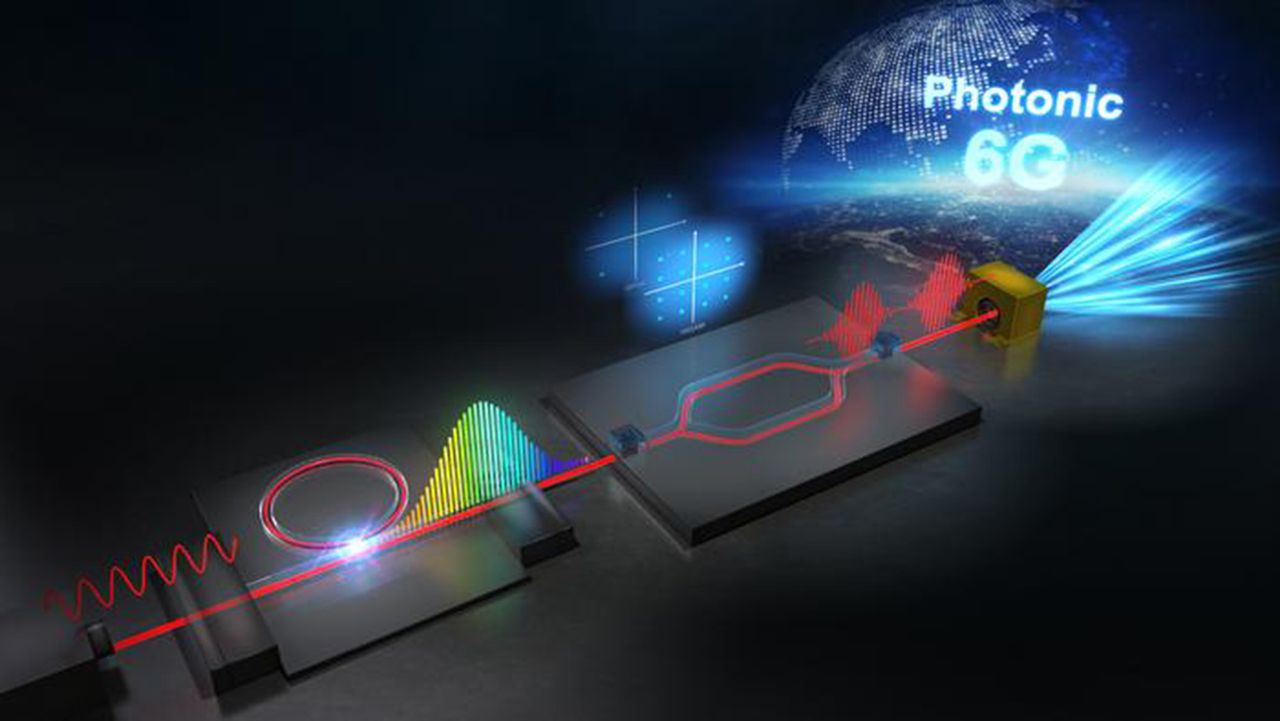
Japanese researchers have achieved a significant breakthrough in wireless communication technology, demonstrating a miniaturized microcomb-driven terahertz wireless system capable of delivering data-transfer speeds exceeding 100 Gbps at ultrahigh frequencies. The innovation marks a milestone in the development of sixth-generation (6G) networks, offering speeds that are roughly 100 times faster than current 5G technology. According to a report by Live Science, the system’s chip is 90 times smaller than conventional alternatives, a reduction that could pave the way for more compact and energy-efficient devices in the future.
The achievement underscores Japan’s growing role in the global race to deploy 6G technology, which is expected to revolutionize industries by enabling near-instantaneous data transmission. Terahertz frequencies, which lie between microwaves and infrared light, have long been considered a promising but challenging frontier for wireless communication due to their ability to carry vast amounts of data. However, previous systems have struggled with size constraints and signal stability. The new microcomb-driven approach, developed by researchers at Japan’s National Institute of Information and Communications Technology (NICT), addresses these challenges by using optical frequency combs to stabilize terahertz signals, allowing for high-speed data transfer in a more compact form factor.
This development comes amid intensifying global competition in 6G research, with countries like China, South Korea, and the United States also investing heavily in next-generation wireless technologies. In 2023, China demonstrated a 6G prototype capable of transmitting data at 1 terabit per second, while South Korea’s Electronics and Telecommunications Research Institute (ETRI) has explored terahertz communication for industrial applications. Japan’s breakthrough, however, stands out for its focus on miniaturization, which could accelerate the commercial viability of terahertz communication for consumer devices, autonomous vehicles, and smart cities.
Industry analysts suggest that 6G could begin rolling out commercially by the late 2020s or early 2030s, with early applications likely to include ultra-high-definition video streaming, real-time holographic communication, and advanced AI-driven networks. The Japanese team’s work, published in a recent issue of *Photonics*, signals a critical step forward in overcoming the technical hurdles that have delayed the widespread adoption of terahertz communication. As global demand for faster, more reliable connectivity grows, innovations like this one could redefine the future of digital infrastructure.