Astronomers discover black hole star 100 billion times brighter than Sun
Astronomers have discovered a "black hole star" using the James Webb Space Telescope, which shines 100 billion times brighter than typical stars and contains a black hole with 100,000 times the mass …
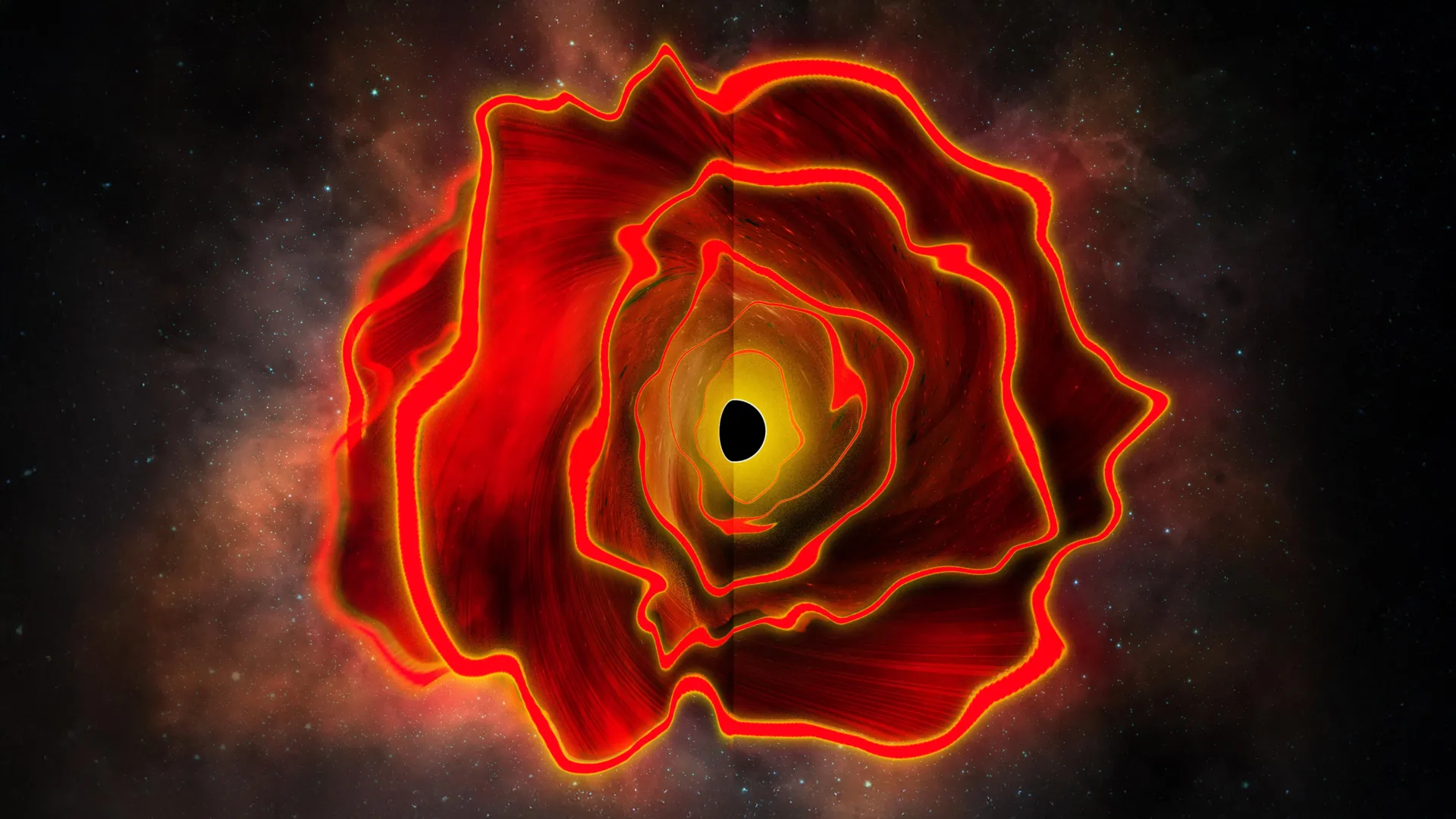
Astronomers using the James Webb Space Telescope have found a bizarre object, dubbed a “black hole star,” that shines 100 billion times brighter than a normal star. The red, star‑like blob lies just a few hundred million years after the Big Bang, when the universe was only a few percent of its current age. JWST’s near‑infrared camera captured its light in the heart of a distant galaxy, revealing a massive, luminous source that cannot be explained by ordinary stellar physics.
The discovery comes at a time when JWST is probing the earliest epochs of cosmic history. Early observations aim to map the first galaxies and the seeds of supermassive black holes that later power quasars. Finding an object that looks like a giant star yet outshines any known star challenges current models of how black holes grow and how stars form in the early universe. It suggests that some black holes may have formed rapidly and been shrouded in dense gas, making them appear star‑like to distant observers.
Detailed analysis shows the object contains a black hole roughly 100,000 times the mass of the Sun, wrapped in a cocoon of hydrogen the size of our solar system. The cocoon emits a bright, red glow that makes the whole system look like a massive star to JWST’s instruments. The sheer luminosity—hundreds of billions of times that of a typical star—implies extreme accretion rates or an unusual energy source. Scientists are scrambling to model how such a massive black hole could be fed so efficiently so early in cosmic history, and whether similar objects might have been common but missed by earlier telescopes.
Follow‑up observations are already planned with JWST’s spectrograph to pin down the composition and motion of the surrounding gas. If confirmed, this “black hole star” could provide a missing link between the first stars and the supermassive black holes that anchor present‑day galaxies. The find also raises questions about the role of early black holes in reionising the universe and shaping galaxy evolution. As more data arrive, astronomers hope to rewrite the story of how the first luminous objects formed and evolved.
Read Full Story at ScienceDaily →