La Brea Tar Pits disgorge rare ice age toad
This marks only the second ice age amphibian found in North America—and it gives researchers vital information abot the ancient climate By Damien Pine edited by Sarah Lewin Frasier At the beginning…
This marks only the second ice age amphibian found in North America—and it gives researchers vital information abot the ancient climate
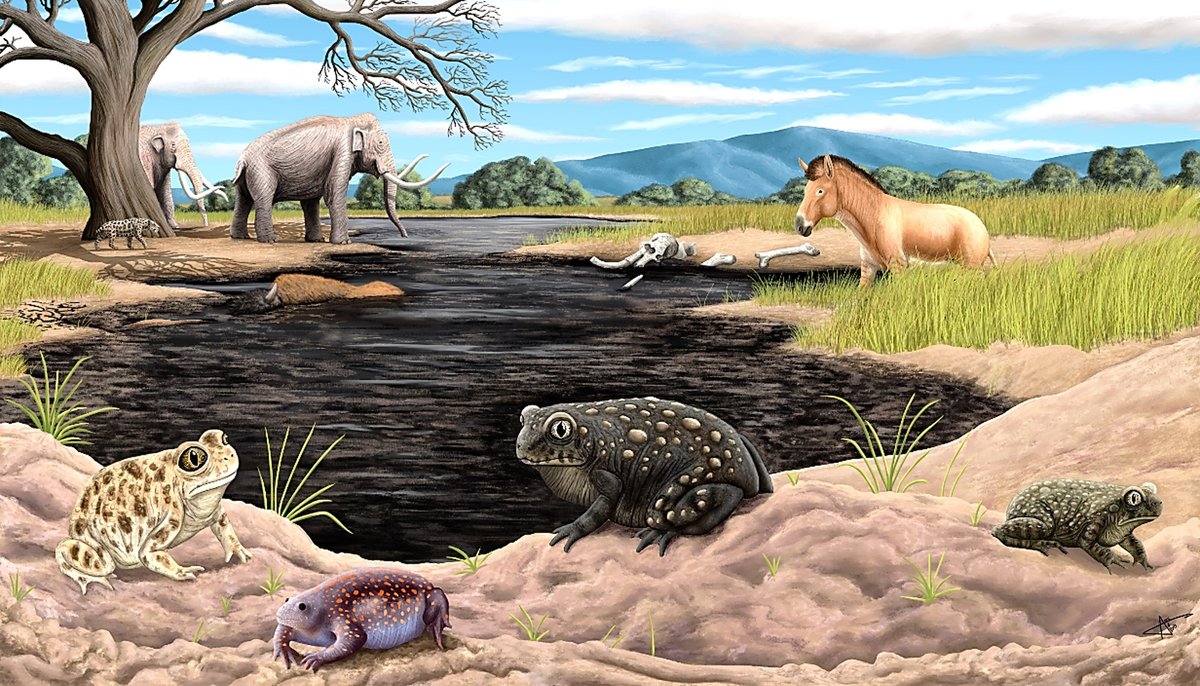
At the beginning of the end of the last ice age, when the future site of Los Angeles was still a cold, wet forest roamed by mammoths, horses and camels, a toad made a bad decision. It hopped into a bubbling pool of tar, where its fragile bones were preserved for researchers to find roughly 45,000 years later, along with remnants of ancient mammoths, insects, bird nests, plants and rat poop. It’s only the second ice age amphibian fossil ever found in North America.
While looking over amphibian specimens excavated from the La Brea Tar Pits in Los Angeles, J. Alberto Cruz, a paleoecologist at the National Institute of Anthropology and History in Mexico and research associate at the La Brea Tar Pits, noticed one of the toad bones was “very different to the spadefoot toads that I know.” He compared the toad’s hip bone with spadefoot toad bones across the globe and discovered it belonged to an entirely new spadefoot toad species . “I’m very happy, very excited, because it’s my first new species in all my career,” Cruz says. He and his colleagues described the find in the Journal of Vertebrate Paleontology .
Spadefoot toads are unusual because their sacrum and urostyle bones are fused (making up part of their hips), while, in most frogs and toads, the two bones form a joint. The five bones making up the ice age specimen were, like those of many creatures at the time, bigger than those of modern-day spadefoots and had enough differences to make it very clear they came from a unique species.
If you're enjoying this article, consider supporting our award-winning journalism by subscribing . By purchasing a subscription you are helping to ensure the future of impactful stories about the discoveries and ideas shaping our world today.
The specimen’s precise age is uncertain (because radiocarbon dating it directly would destroy it). But comparing it with other specimens found in the same tar deposit suggests it’s at least roughly 45,000 years old, putting it in the last ice age.
Amphibian fossils are rare because the little creatures’ bones are very small and delicate—fossilization is uncommon, and when it happens, the bones sometimes get overlooked, according to David Ledesma, a paleoherpetologist at the Natural History Museum of Los Angeles County, who was not involved in the study.
But when they are identified, these tiny fossils can give researchers information about the past climate that bigger fossils can’t. Larger creatures and birds often flee when a climate becomes inhospitable. But small creatures such as toads can only hop so far from water, so finding this fossil tells us the temperature, humidity and other conditions must have been right for water to regularly exist in that location. And unlike mammals, which generate their own internal heat, frogs, toads, lizards and snakes all rely on the environment to regulate their temperatures and run their metabolic systems. This makes them extra sensitive to climate change and reliable indicators to “infer the climate of the past,” Cruz says, even as far back as 45,000 years ago.
Read Full Story at Scientific American →