NASA’s Webb telescope captures Lion Nebula’s glow
NASA's James Webb Space Telescope captured detailed images of the Lion Nebula, a glowing planetary nebula 3,000 light-years away, revealing its intricate dust and gas structures for the first time. T…
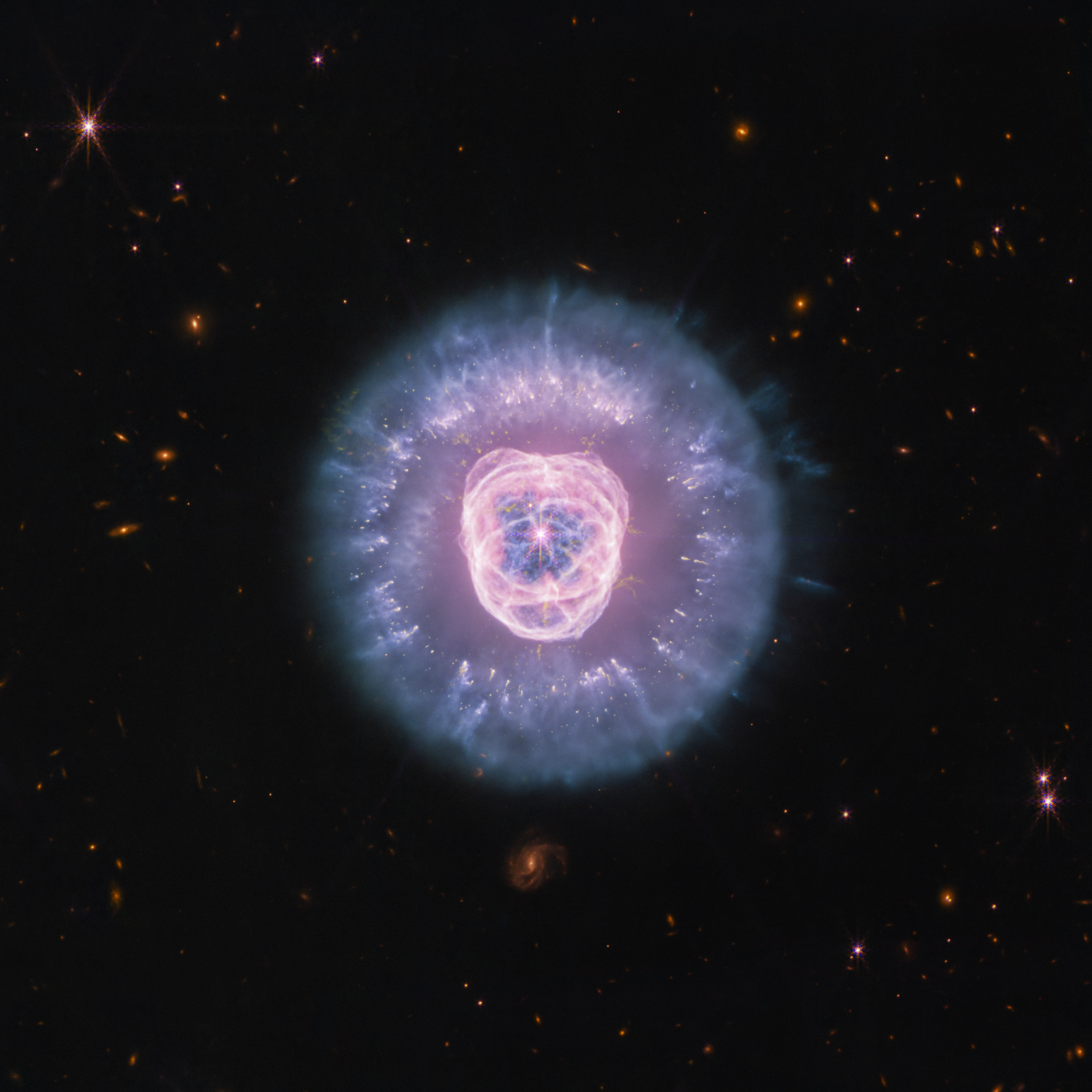
NASA’s James Webb Space Telescope has captured striking new images of NGC 2392, a glowing planetary nebula nicknamed the Lion Nebula for its lion-face shape. The snapshots, released Tuesday, reveal the nebula’s intricate filaments of dust and gas in unprecedented detail. Webb’s infrared instruments cut through the cosmic haze, exposing delicate structures that even Hubble’s 2000 observations couldn’t fully resolve. This is the first time the nebula’s “mane” of comet-shaped objects—laced with carbon-based molecules—has been seen so clearly.
The Lion Nebula is the glowing shroud of a dying star about 3,000 light-years away in the constellation Gemini. When Sun-like stars exhaust their fuel, they cast off outer layers, creating these brief but brilliant nebulae. Studying them helps scientists trace how stars recycle material back into space, seeding future planets and stars. Webb’s mid-infrared and near-infrared cameras are uniquely suited to this task. They detect the faint heat from dust and complex molecules, mapping where carbon, oxygen, and other elements are flung outward.
The new images show the nebula’s central star, now a white dwarf, surrounded by a bright ring of ejected gas. Beyond that, a halo of fainter gas stretches outward, its edges lit by ultraviolet radiation from the dying star. Webb’s data reveal that the “comet tails” in the mane are actually dense clumps of material being sculpted by the stellar wind. Astronomers now plan to compare these infrared views with existing Hubble data to build a three-dimensional model of the nebula’s structure.
This isn’t just a pretty picture. The Lion Nebula is a nearby laboratory for understanding how stars like our Sun die and how their chemistry enriches the galaxy. Webb’s sharp eye will let researchers study similar nebulae across the Milky Way, testing theories of stellar evolution and cosmic recycling. It’s the latest example of how Webb is rewriting the book on how stars live—and how they end.
Read Full Story at NASA →