‘Not just a singer’: Argentinians queue for miles to mourn biggest rockstar most of world has never heard of
Hundreds of thousands gather to remember Carlos ‘Indio’ Solari, who inspired cross-generational devotion, especially among working class The line stretched for more than 7km (four miles). Mourners sang rock songs, waved banners, and carried speakers blasting music while smoke ro
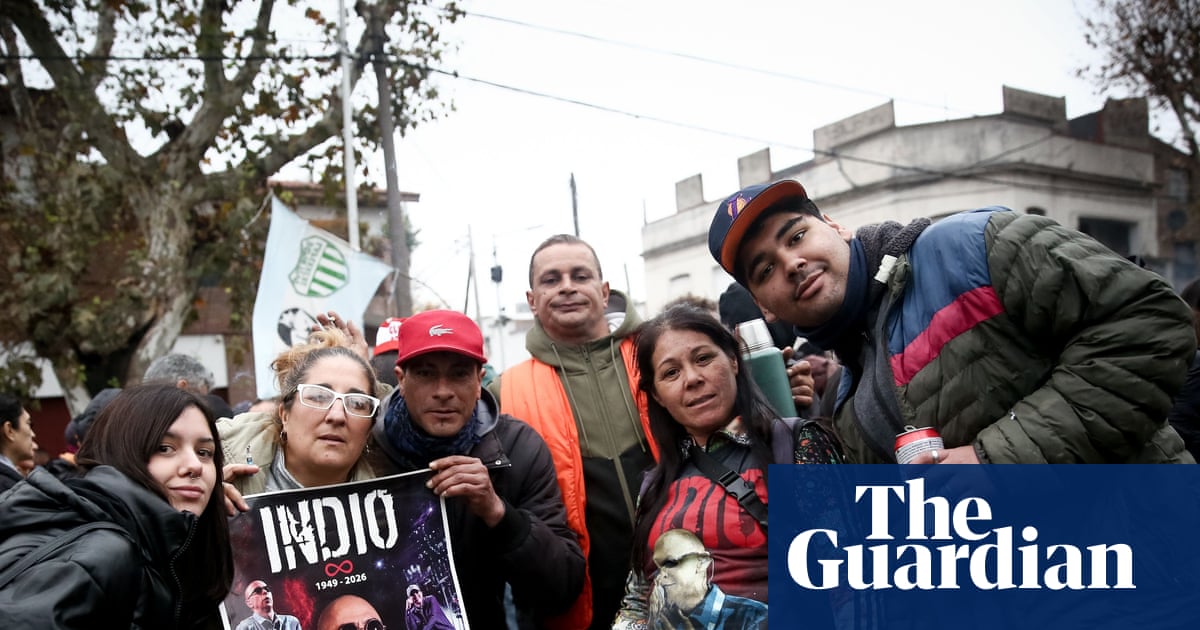
Hundreds of thousands gather to remember Carlos ‘Indio’ Solari, who inspired cross-generational devotion, especially among working class
The line stretched for more than 7km (four miles). Mourners sang rock songs, waved banners, and carried speakers blasting music while smoke rose from makeshift barbecues and vendors sold T-shirts bearing the image of a bald man with sunglasses.
As evening fell, a drizzle set in, but the queue remained. At the end of the line in Avellaneda, outer Buenos Aires, stood a chapel containing the body of a rock star.
Hundreds of thousands of people attended the wake on Sunday for the singer Carlos “Indio” Solari.
Solari, who died on Friday from a stroke at the age of 77, was widely regarded as Argentina ’s most popular musician: his last concert in 2017 was attended by as many as 400,000 people.
But his popularity challenges assumptions about a shared Latin American cultural sphere: Solari was virtually unknown outside Argentina and neighbouring Uruguay, which shares much of its cultural and linguistic heritage.
His lyrics – usually dense, cryptic, and laden with literary, political and historical references – inspired a devoted following that cut across generations, though it is particularly strong among working-class young people. Ji ji ji , a frenetic anthem, or La gran bestia pop , a critique of the music industry, are ubiquitous at weddings, football matches and parties across Argentina. Phrases such as “every prisoner is a political prisoner” or “violence is to lie” became mottoes for political resistance.
Solari co-founded the influential rock band Patricio Rey y sus Redonditos de Ricota in 1976. After the group split in 2002, he continued performing with a new band until Parkinson’s disease forced him to stop appearing live.