Ötzi the murdered Iceman’s microbiome is still active
5,300 years after his death, Ötzi the murdered Iceman’s microbiome is still active More than 5,300 years after Ötzi’s death, researchers found genetic material from his gut microbiome and identified yeasts that continue to exist despite the mummy being kept below freezing Ötzi
5,300 years after his death, Ötzi the murdered Iceman’s microbiome is still active
More than 5,300 years after Ötzi’s death, researchers found genetic material from his gut microbiome and identified yeasts that continue to exist despite the mummy being kept below freezing
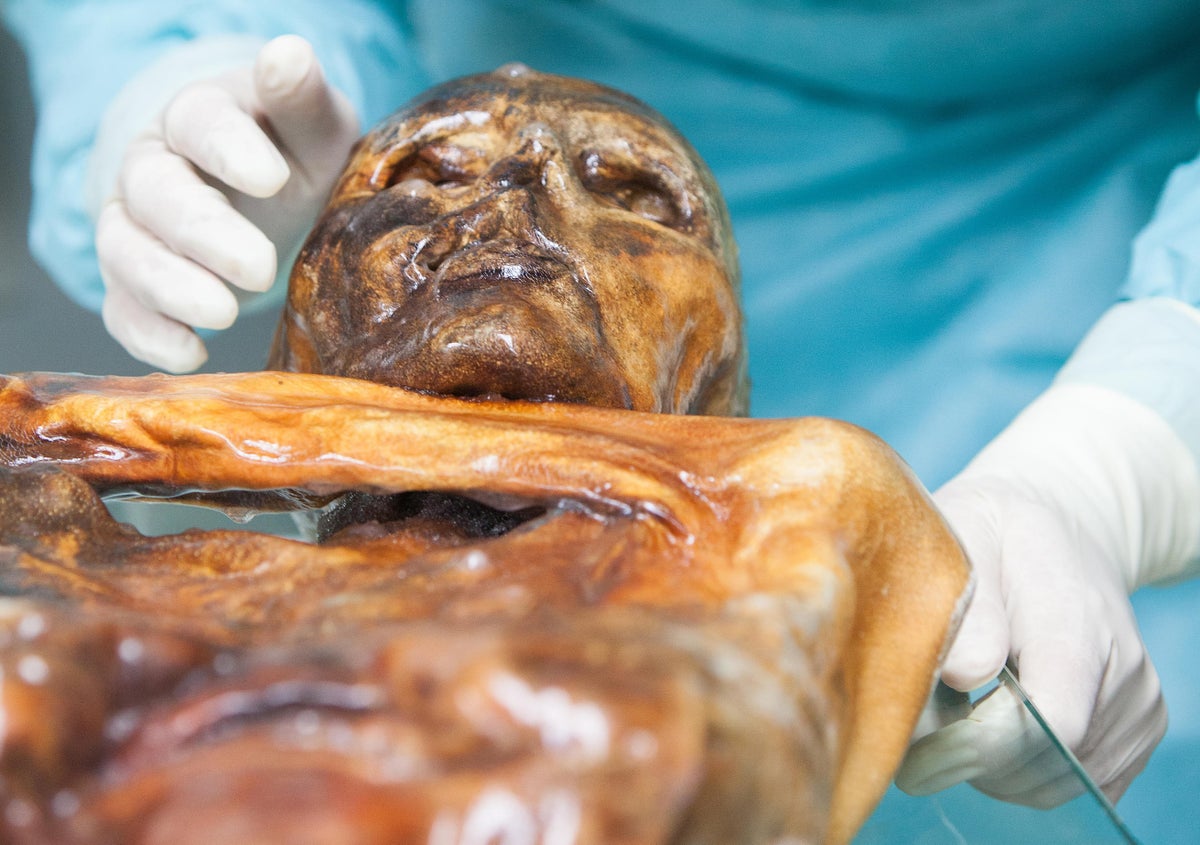
Ötzi the Iceman may have been murdered by an arrow some 5,300 years ago, but his body is still buzzing with microbial activity, researchers reveal. Yeast strains that may have lain dormant in the mummy for millennia, some of which were specially adapted to extreme cold, may still be metabolically active, a new study published in Microbiome finds.
Ötzi died in a glacial area of the Italian Alps; the cold and relatively low oxygen preserved his body, effectively mummifying it for millennia. Since then the body has been kept in a refrigerated chamber at minus six degrees Celsius (21.2 degrees Fahrenheit) and high humidity to keep it intact. Incredibly, fragments of genetic material from the microbes living in Ötzi’s gut were also preserved—thanks to both the conditions before he was discovered and after.
“This combination preserved the DNA of the mummy and also the DNA of the bacteria, the indigenous microbiome, but also the environmental DNA surrounding the mummy,” says Mohamed Sarhan, a microbiologist at Italy’s Eurac Research Institute for Mummy Studies and lead author of the new paper.
If you're enjoying this article, consider supporting our award-winning journalism by subscribing . By purchasing a subscription you are helping to ensure the future of impactful stories about the discoveries and ideas shaping our world today.
Sarhan and his team analyzed the microbial and fungal populations on Ötzi’s skin, various tissues and thawed water collected from inside the mummy. They found multiple species of anaerobic bacteria, such as Romboutsia hominis, Clostridium moniliforme, Ruminococcus bromii and others, that would have helped Ötzi digest his food. A previous analysis of his stomach and its microbiome suggested that Ötzi, who was discovered by hikers in 1991, ate a high-fat diet and snacked on dried wild meat and cereals, as well as a poisonous fern . And his gut microbes largely seem to match that diet, Sarhan says, because the identified species are well suited to thrive on those foods. Some of them can still be found in the intestines of modern-day humans. But others that are present in the mummy have become far rarer as our diets have evolved.
“We have two or three species that were never reported before in [Ötzi’s] case that we know already are very rarely found in modern humans,” Sarhan says. “We can still find them in some nonindustrialized societies, like some tribes in Africa or South America and also some places in Europe, but in very, very rare cases.”