Questioning everything
Where did stars, and light itself, come from? Is there a hidden sector of particles and forces called “dark energy” affecting the cosmos? “Most of the matter in our universe is invisible,” write Tracy R. Slatyer and Tim M. P. Tait in this special edition. Slatyer is an astropart
Where did stars, and light itself, come from? Is there a hidden sector of particles and forces called “dark energy” affecting the cosmos?
“Most of the matter in our universe is invisible,” write Tracy R. Slatyer and Tim M. P. Tait in this special edition. Slatyer is an astroparticle physicist at the Massachusetts Institute of Technology, and Tait is a high-energy particle physicist at the University of California, Irvine. They’ve been looking for the bulk of the universe for a long time—and missing it. “We can measure the gravitational pull of this ‘dark matter,’” they say in this article . They can see how it bends light and how it affects remnants of the hot big bang. “We have every reason to believe dark matter is everywhere. Yet we still don’t know what it is.”
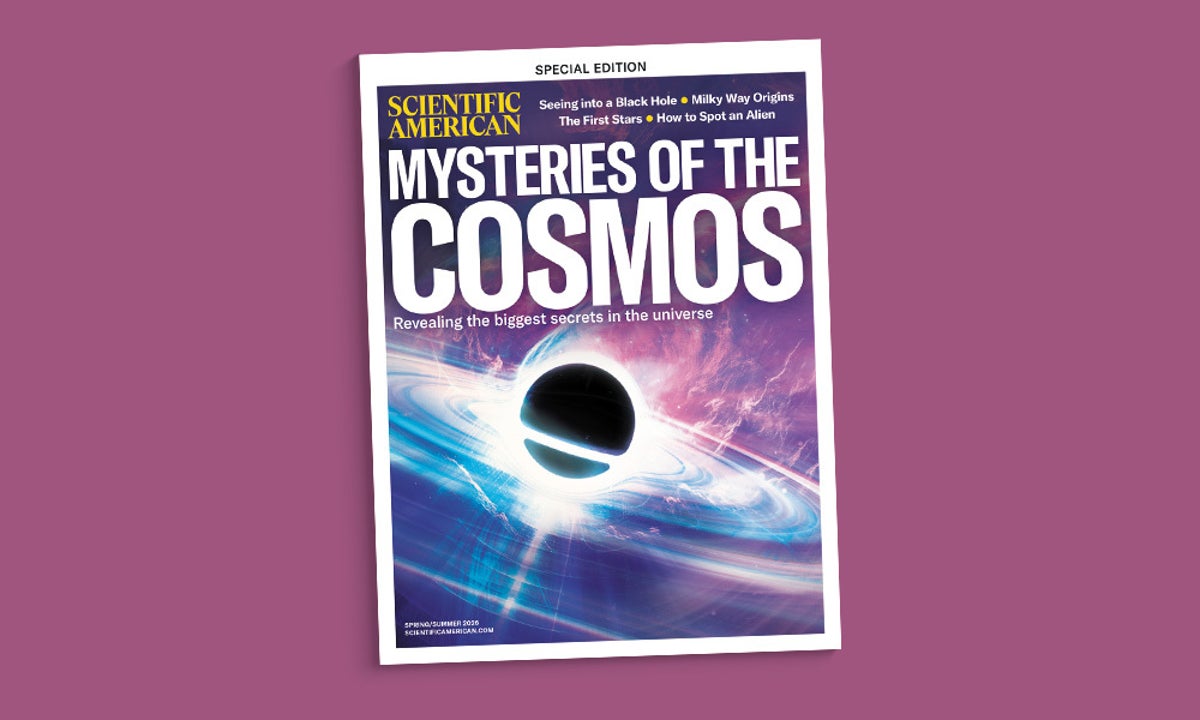
So most of existence is everywhere—and at the same time it is nowhere. This is just one of the giant conundrums of cosmology that Scientific American explores in this collection . Where did stars, and light itself, come from? Is there a hidden sector of particles and forces called “dark energy” that is affecting the evolution of the cosmos? Is the universe getting bigger at a faster or slower rate? What’s inside a black hole? And if Earth isn’t the only planet that hosts life, where are the others, and what might alien life look like, anyway?
It’s not that scientists don’t have answers for these puzzles. They do. They have a lot of them. The big task now is to figure out which one is right. Amazing instruments such as the James Webb Space Telescope (JWST) have been launched recently to help with these problems. “The observatory has started answering some of the biggest questions in astronomy. It’s also raised many new ones ,” writes José María Diego Rodríguez, an astrophysicist at the Spanish National Research Council. Diego Rodríguez is particularly focused on JWST’s discovery of “supermassive” black holes dating from near the beginning of time. These beasts may be mergers of smaller black holes that in turn originated from explosions of so-called dinosaur stars. If astrophysicists succeed in spying such stars, they will also have detected the earliest starlight, which shaped the evolution of the universe .
If you're enjoying this article, consider supporting our award-winning journalism by subscribing . By purchasing a subscription you are helping to ensure the future of impactful stories about the discoveries and ideas shaping our world today.
And as the universe changed, life might have evolved with it —not just on Earth but perhaps on some of the more than 6,200 other worlds identified by the Kepler space mission and similar endeavors, as journalist Sarah Scoles writes. Such life could resemble microbes living underneath the polar ice caps on Mars; as we report on here , the Perseverance rover has been looking for signs on the Red Planet. Or life might exist in oceans buried on Europa , one of Jupiter’s moons, or in geysers on Enceladus, one of Saturn’s.
There are some aspects of space that are more certain, and we can show them to you in eye-catching visuals. Some are the magnetic fields of other planets such as Jupiter, detected by probes. In this piece , we chart the growing number of people who have been to outer space, a who’s who of explorers recently joined by the crew of the thrilling Artemis II mission to the farside of the moon. The astronauts have increased in number and diversity, but all still have something in common: a human desire to answer questions about everything in the universe.
If you enjoyed this article, I’d like to ask for your support. Scientific American has served as an advocate for science and industry for 180 years, and right now may be the most critical moment in that two-century history.