Rare meteorite might be a relic from a ‘lost world’
This meteorite could be a relic from a ‘lost world’ Hints of high-pressure chemistry within a rare meteorite suggest this fallen space rock comes from a planet gone wrong in the solar system’s early history Much of modern astronomy revolves around the study of strange alien wor
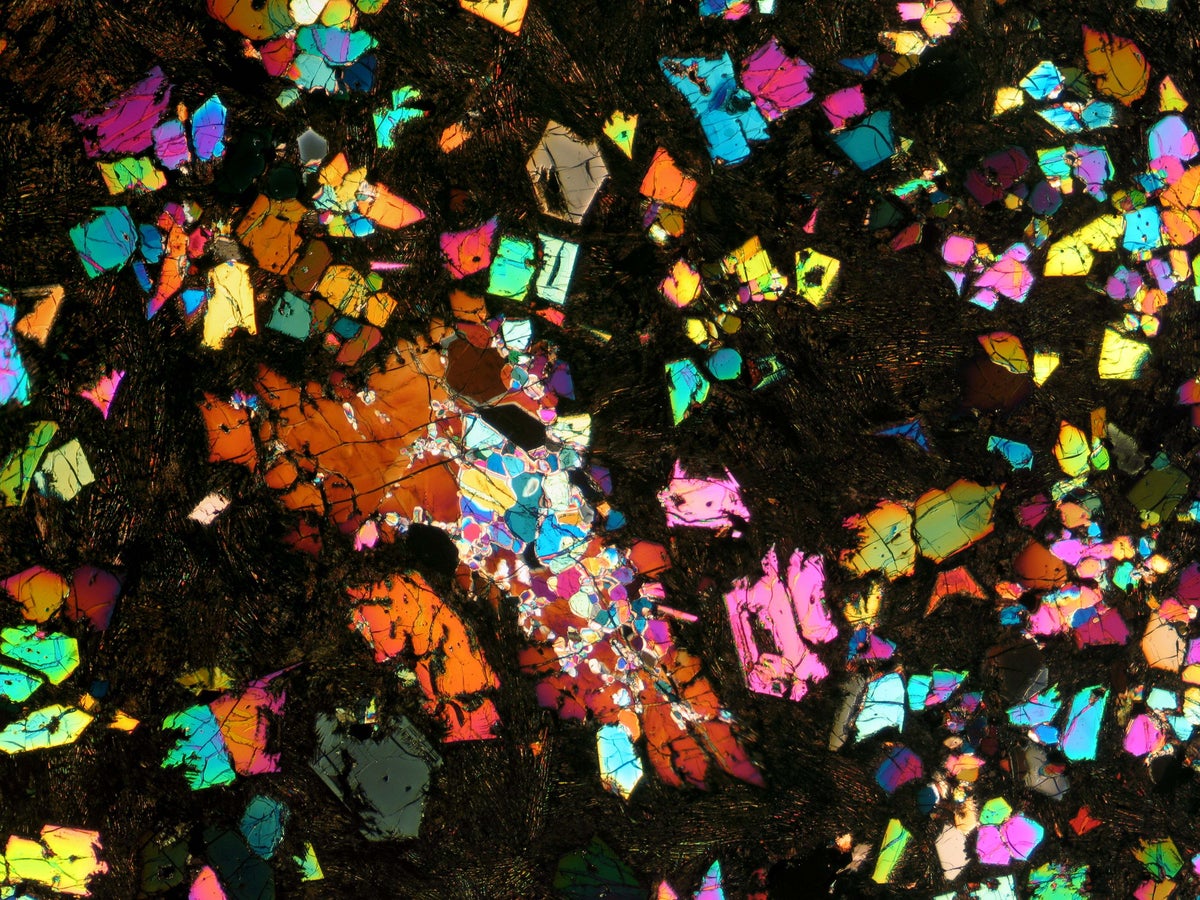
Hints of high-pressure chemistry within a rare meteorite suggest this fallen space rock comes from a planet gone wrong in the solar system’s early history
Much of modern astronomy revolves around the study of strange alien worlds—from the sun’s retinue of satellites to the thousands of known exoplanets orbiting other stars. But what about a world that never quite came to be?
That seems to be exactly what one research group has discovered in a new study published in the journal Earth and Planetary Science Letters . By analyzing the chemical composition of an about 4.56-billion-year-old meteorite recovered from the Sahara Desert in 2019 , the team found that the primordial space rock probably came from the high-pressure depths of a massive, maybe moon-sized, long-lost protoplanet during the solar system’s earliest epochs .
The discovery has major implications for our understanding of cosmic history, says Francois Tissot, a geochemistry researcher at the California Institute of Technology, who was not involved in the study. “This means that, within four million years [of the solar system’s formation], you’re making things that are the size of the moon,” he says. “It’s a very, very rapid formation timescale.”
If you're enjoying this article, consider supporting our award-winning journalism by subscribing . By purchasing a subscription you are helping to ensure the future of impactful stories about the discoveries and ideas shaping our world today.
The meteorite in question, called NWA 12774, is of a very rare class called angrites. These are among the oldest known volcanic rocks, tracing back to just a few million years after the formation of the solar system itself some 4.56 billion years ago. Of the about 80,000 meteorites ever cataloged on Earth, fewer than 70 are angrites.
Despite angrites’ rarity and extreme antiquity, and the fact that no one has ever confirmed the meteorites’ parent body, many scientists had previously assumed they were fragments chipped from larger space rocks rather than remnants of full-fledged worlds. The idea of a large parent body had come up before , but “most people had looked at angrites as being from a small, asteroidal-sized body,” says Aaron Bell, an experimental petrologist at the University of Colorado Boulder and lead author of the new study. “We just accepted that because there was no evidence of the contrary.”
Bell and his colleagues began reconsidering that assumption when their examination of NWA 12774 showed that the meteorite’s crystals of a mineral called clinopyroxene contained an especially large amount of aluminum. This is a telltale sign that the crystals formed at great pressure within a parent body. “That was the flashing red light that there was something unusual about this meteorite,” Bell says.







