Scientists reveal surprising mechanism behind Venus flytrap’s rapid snap
Intricate tests show hair-trigger detection causes cells on outer surface of leaf to soften, prompting closure The Venus flytrap is one of nature’s most impressive predators, luring insects with the intoxicating scent of nectar before capturing them with a snap of its jaw-like l
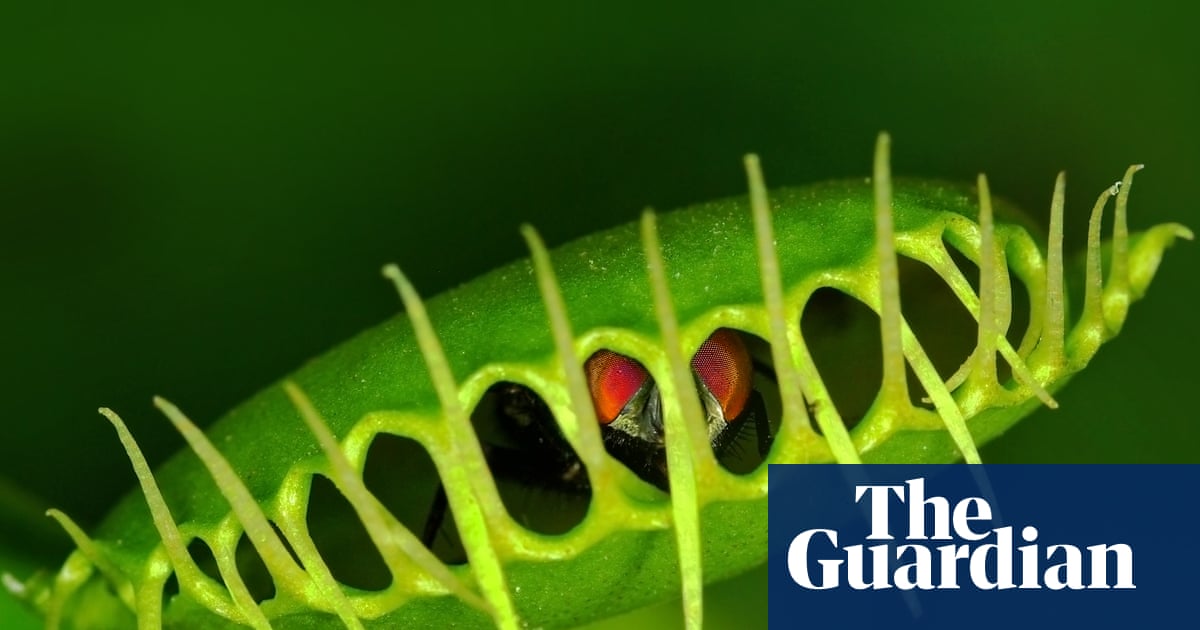
Intricate tests show hair-trigger detection causes cells on outer surface of leaf to soften, prompting closure
The Venus flytrap is one of nature’s most impressive predators, luring insects with the intoxicating scent of nectar before capturing them with a snap of its jaw-like leaves.
Now, scientists have revealed the mechanism that allows the carnivorous plant to react with lightning speed, resolving a problem that stumped Charles Darwin and many researchers after him.
In an intricate series of experiments, scientists found that a hair-trigger detection causes the cells on the outer surface of the leaf to soften. This prompts the flytrap to flip into a closed position within a second of a bug landing on the leaf.
“When Darwin saw these plants move so fast, he was convinced that the plant had a muscle inside, but plants do not have muscles and they do not have nerves,” said Dr Yoël Forterre, a physicist at the French National Centre for Scientific Research (CNRS) and Aix-Marseille University and senior author of the research. “For more than a century there have been many hypotheses. It’s very surprising that plant cell walls can tune their mechanical properties so fast.”
A key challenge, Forterre said, was making physical measurements of such a finely tuned system that moves incredibly quickly. “As soon as you perturb it, it closes,” he said. “If you close it accidentally with a drop of water, it will close and then reopen the next day. If it catches an insect, it has to digest it and dissolve the skeleton, which will take several weeks.”
Forterre and colleagues performed a series of experiments in which the plant’s leaves were carefully immobilised using dental glue, meaning the trap could be triggered to shut but remained stationary. Venus flytraps typically have three trigger hairs on each lobe of their trapping leaves, and previous work has shown that bending the hairs prompts an electrical signal to spread across both sides of the trap within one-tenth of a second.
The latest research used a device called a nanoindenter, a metal tip, to poke the outer surface of the leaf to measure its pressure. “It gives you the same feeling of stiffness as if you poke a balloon with your finger,” Forterre said.