See the hidden fungal network so big it could stretch to Proxima Centauri and back
See the hidden fungal network so big it could stretch to Proxima Centauri and back Researchers have created the first high-resolution global map of the extent of one of Earth’s largest—and least visible—living networks By Sam Macdonald edited by Sarah Lewin Frasier If you’ve n
See the hidden fungal network so big it could stretch to Proxima Centauri and back
Researchers have created the first high-resolution global map of the extent of one of Earth’s largest—and least visible—living networks
If you’ve never heard of arbuscular mycorrhizal (AM) fungi before, I wouldn’t blame you—unless you happen to be a ficus. With symbiotic trade relationships spanning roughly 70 percent of plant species on Earth, these charismatic topsoil denizens should be on the radar of any self-respecting photosynthesizer. Yet although AM fungi haul roughly four billion metric tons of carbon from plants into the soil each year, there’s still a lot we humans don’t know about this type of fungus, starting with how much of it there actually is.
Until now: in a new paper published in Science , researchers combined data from more than 300 studies to estimate the total global biomass of AM fungi . The task is deceptively difficult. Biomass depends in part on the thickness of fungal filaments, meaning that even small errors in estimating their average diameter can dramatically affect the final calculation. To illustrate the challenge, co-author Justin D. Stewart, a data scientist at the Society for the Protection of Underground Networks (SPUN), offers an analogy: Imagine lying beneath a tree and trying to determine the average width of all its branches. Some are long and incredibly thin, while others are short and thick.
If you're enjoying this article, consider supporting our award-winning journalism by subscribing . By purchasing a subscription you are helping to ensure the future of impactful stories about the discoveries and ideas shaping our world today.
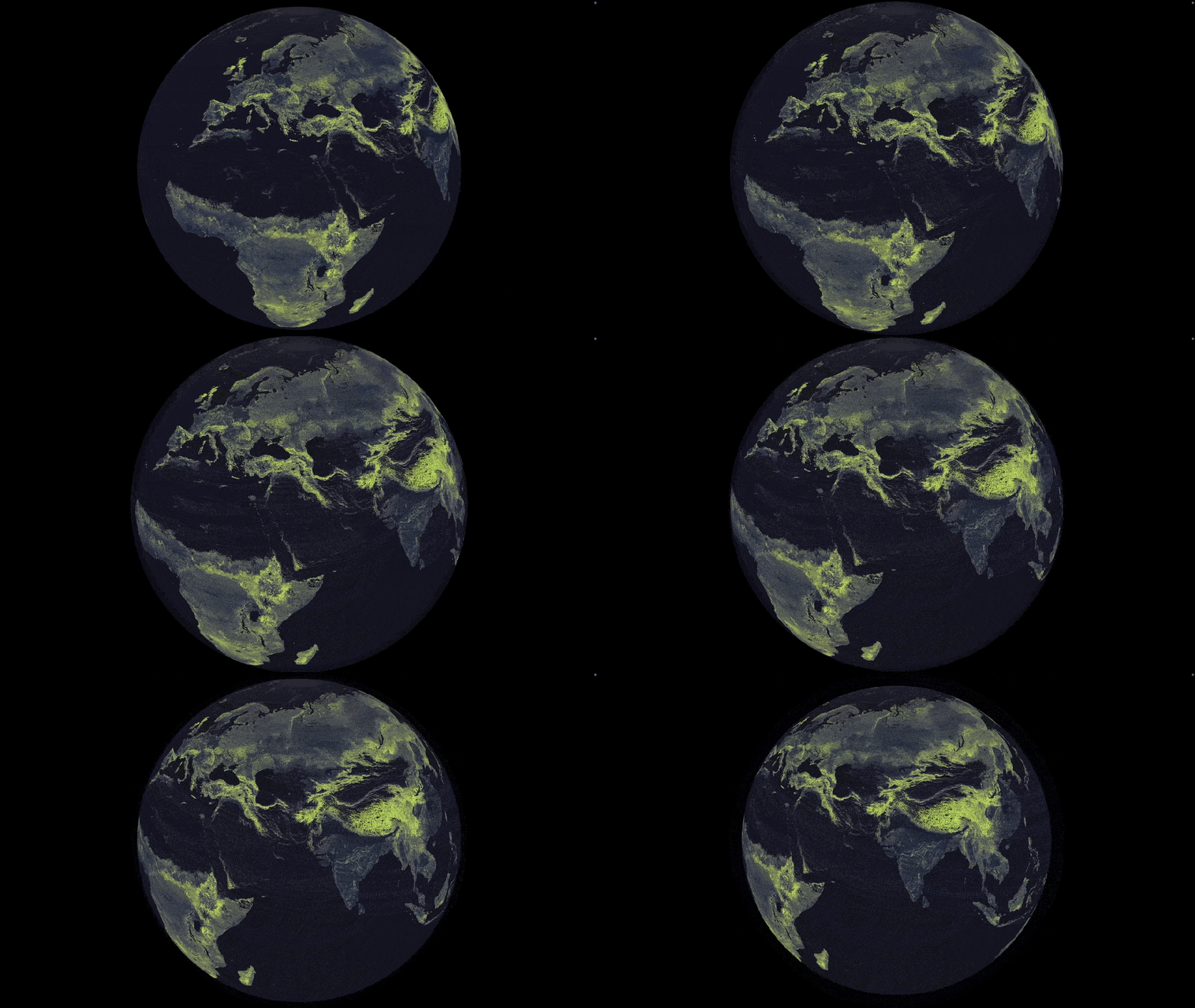
To tackle the problem, the team used a custom-built robot named Prince, which captured more than 300,000 measurements of growing fungal networks. (For those interested, other robotic residents of the lab include Donna Summer and Aretha Franklin.) Combined with mathematical modeling and published data from around the world, those measurements let the researchers estimate global fungal biomass and, with data visualizer Moritz Stefaner, create an interactive mycorrhizal infrastructure map covering Earth’s landmasses down to each square kilometer.
“We’re surrounded by numbers and data,” says Stefaner, who was immediately drawn to the aesthetic qualities of the dataset. “Everybody wants to make sense of it. Everybody wants to see the big picture.”
The answer is simultaneously more and less than you might expect. By biomass, the world’s AM fungi weigh roughly five times as much as all humans combined. That’s substantial but not nearly as much as many researchers anticipated.







