Trump's Latin America allies open arms to Israel
A three-week military offensive in the Gaza Strip in 2009, which killed more than 1,400 people, including an estimated 1,100 civilians, spurred Venezuela's Socialist president at the time, Hugo Chave…
A three-week military offensive in the Gaza Strip in 2009, which killed more than 1,400 people, including an estimated 1,100 civilians, spurred Venezuela's Socialist president at the time, Hugo Chavez, to expel the Israeli ambassador in protest and end diplomatic relations.
Seventeen years later, Venezuela and Israel have agreed to establish a mechanism for the resumption of consular services. It's a limited step, but one that until recently would have been unthinkable.
In Colombia , the nationalist government of new President Abelardo de la Espriella recently reversed the decision by his predecessor, Gustavo Petro , to sever diplomatic relations with Israel in protest of the country's most recent war in Gaza , which has killed more than 70,000 people, nearly one-third of them children.
De la Espriella has even announced that Colombia will relocate its embassy to Jerusalem, and this week declared that Colombia would join the United States as the only two countries that recognize "Israeli sovereignty" over the Golan Heights, which is Syrian territory under international law but has been occupied by Israel since 1967. The vast majority of the international community, including Germany and the UN, does not recognize the annexation of the Golan Heights by Israel.
"There is a trend toward rapprochement with Israel as a response to the surge of the radical right in the region," said Isaac Caro, a professor at Alberto Hurtado University in Chile. Caro said authoritarians in Latin America were linking relations with Israel to "an active alignment with US foreign policy." He said reinforcing ties with Israel had become a characteristic of Latin America's radical right in the region as part of the renewed discourse of region's place in Judeo-Christian Western civilization.
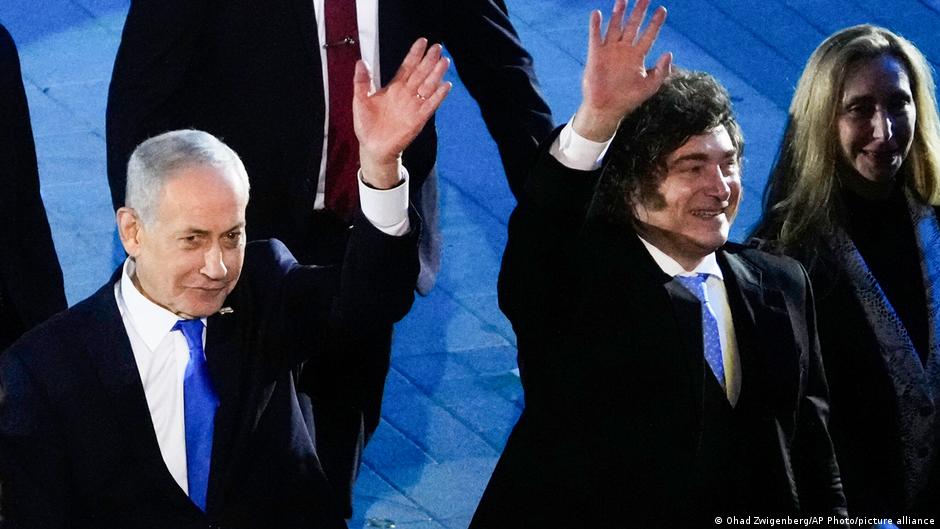
In Argentina, for example, ultraconservative President Javier Milei has made close relations with Israel a defining feature of both his foreign policy and his own political identity.
Daniel Wajner, associate professor of international relations at the Hebrew University of Jerusalem, said there had been a "surge" in diplomacy between Israel and Latin American governments. Wajner said Jair Bolsonaro , the neoliberal former president of Brazil, and El Salvadoran President Nayib Bukele, the self-described "world's coolest dictator," were early adopters of warmer ties with Israel. They were followed by Milei and others.
Wajner said Latin America's authoritarians were actively "embracing" the national-conservative government of Prime Minister Benjamin Netanyahu . He also said there were ideological, religious and strategic factors in governments' tightening of bonds with the country, such as the desire to signal a like-minded international orientation with the United States.
Read Full Story at DW World →