3,000-year-old burial of ancient Egyptian horse found — and a nearby stone carving depicts a captured prisoner
Archaeologists have unearthed a 3,000-year-old burial of a horse, likely used for military purposes, inside an ancient fort on the western Nile Delta in Egypt. The horse was a young male of medium s…
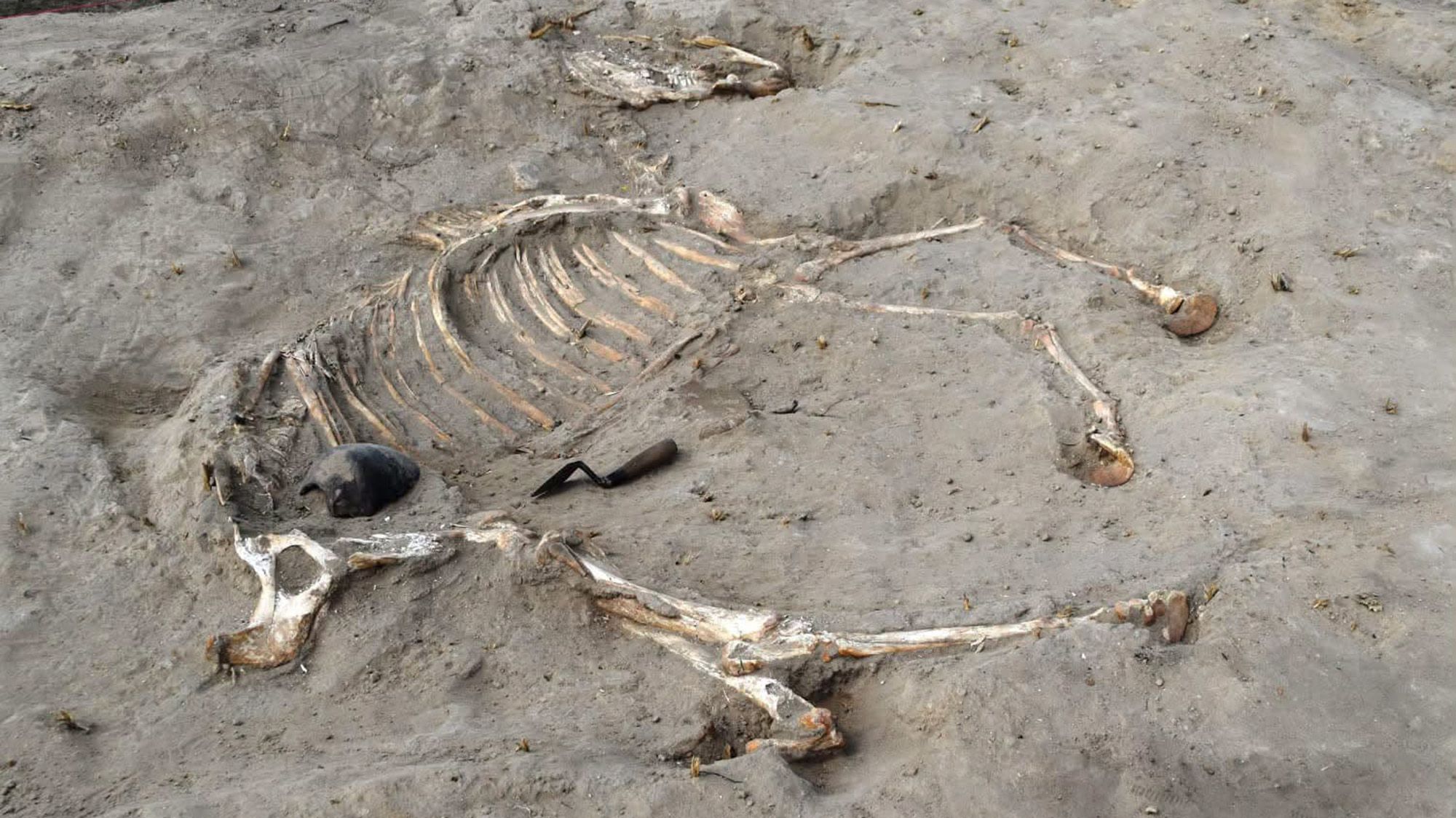
Archaeologists have unearthed a 3,000-year-old burial of a horse, likely used for military purposes, inside an ancient fort on the western Nile Delta in Egypt.
The horse was a young male of medium size that may have pulled a chariot or worked in other military activities. Archaeologists also found remains of the chariot horse's harness fittings nearby. Given these discoveries, it's likely that this was a ceremonial burial, according to a translated statement from the Egyptian Ministry of Tourism and Antiquities.
The fort, which was found at the archaeological site of Abqaa' in Egypt's Lake District, dates to the New Kingdom period (circa 1550 to 1070 B.C.) and was used to guard against hostile Libyan tribes to the west. Among the finds from the fort excavation was a tablet depicting a Libyan prisoner whose clothing signifies his membership in the Meshwesh tribe, a group that Egypt was often in conflict with.
The prisoner is shown with his hands bound behind his bent body, a posture that signifies his submission, the statement noted.
A hieroglyphic tablet with the name of pharaoh Ramesses II was also found; he reigned from about 1279 to 1213 B.C. A second tablet included the name of the pharaoh Merneptah, who reigned from about 1213 to 1203 B.C., and compared his strength to that of Seth , an ancient Egyptian god associated with the desert and storms.
The horse burial is a unique discovery, scholars not associated with the excavation told Live Science.
"It is an amazing find, simply because we have so few horse remains from Pharaonic Egypt," especially complete skeletons, Lonneke Delpeut , a researcher at the University of Vienna who has conducted extensive research into ancient Egyptian horses, told Live Science in an email.
Get the world’s most fascinating discoveries delivered straight to your inbox.
Read Full Story at Live Science →