Excavation in Poland reveals Stone Age man buried with decapitated heads and a tooth necklace
Archaeologists were excavating in a Roman-period cemetery in Poland when they came across something extremely unusual: the grave of a man who was buried with two decapitated human heads, a necklace m…
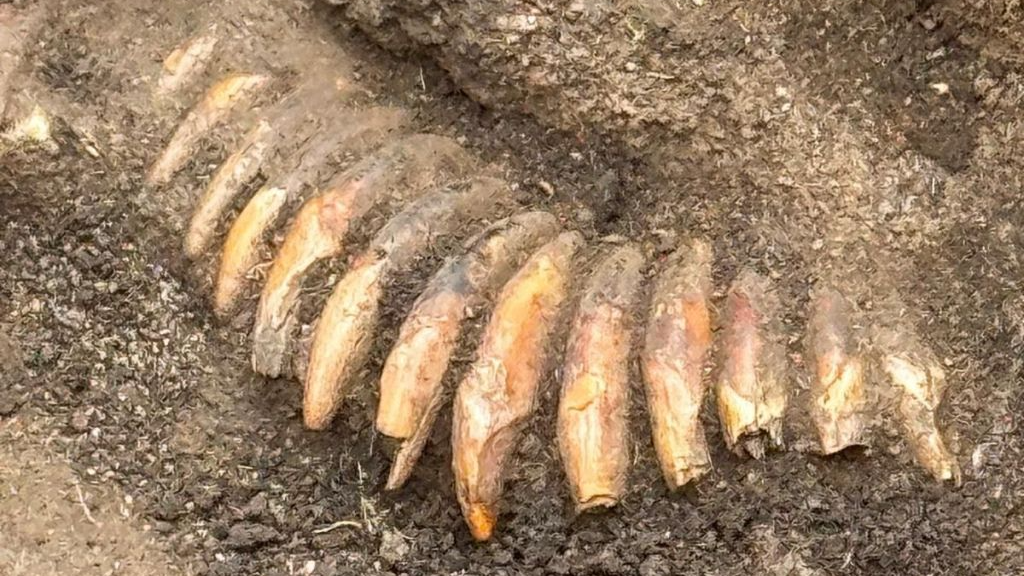
Archaeologists were excavating in a Roman-period cemetery in Poland when they came across something extremely unusual: the grave of a man who was buried with two decapitated human heads, a necklace made from 42 mammal teeth, and a battle ax. That ax provided an important clue: He was actually from the Stone Age, three millennia older than the Roman cemetery.
"We were practically packing up, and then we discovered a circular shape in the ground and began digging," Paweł Dąbrowski , a biological anthropologist at Wrocław Medical University, said in a Sept. 2 translated statement . "We found fairly well-preserved animal teeth arranged in a necklace."
The grave, which was found near Wrocław in southwest Poland, included the nearly complete skeleton of an adult male who was buried with amber beads, a flint blade and a battle ax made of serpentinite, a greenish metamorphic rock. The style of the stone ax suggests the burial was made around 2900 B.C., during the Middle Neolithic period (New Stone Age), according to the statement.
But a handful of teeth and bones that were also deposited in the grave as funeral offerings made the burial stand out as particularly unusual.
"The arrangement of the 42 teeth was precise," Dąbrowski said, "and upon further inspection, it turned out that all of them had holes drilled through their roots. They must have formed a kind of necklace."
The teeth that made up the necklace were incisors and canines that belonged to large mammals, such as wolves, deer, bears and potentially humans, Dąbrowski said in a Sept. 4 translated statement .
"It's possible we've discovered the grave of a warrior or hunter, but because of this necklace, we can assume it was someone important, for example, the leader of a family clan," Dąbrowski said.
Get the world’s most fascinating discoveries delivered straight to your inbox.
Read Full Story at Live Science →