Physicists at Large Hadron Collider find evidence for glueballs
Physicists at the Large Hadron Collider have found new evidence suggesting the existence of glueballs, particles made entirely of gluons, which could enhance our understanding of strong nuclear inter…
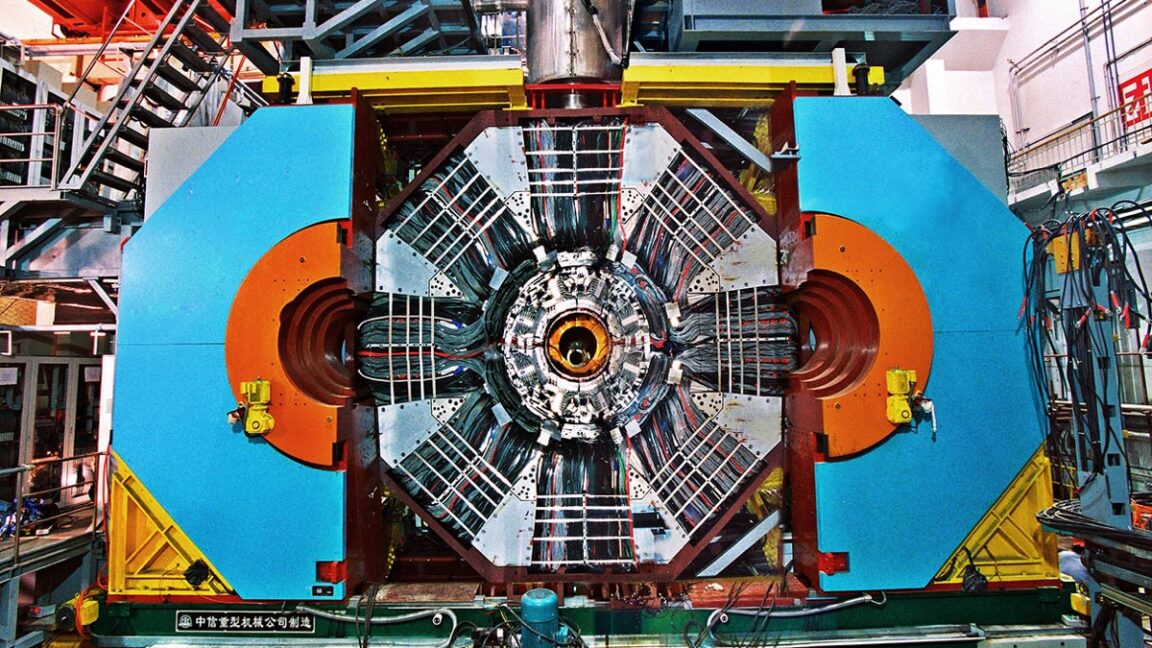
Physicists have presented new evidence suggesting the existence of glueballs, a type of particle that is theorized to be composed entirely of gluons, which are the fundamental force carriers of the strong nuclear force. This finding comes from recent experiments at the Large Hadron Collider (LHC) at CERN and marks a significant step in particle physics. Researchers observed unusual behaviors in certain decay patterns that align with the predicted characteristics of glueballs.
The study of glueballs has been a long-standing pursuit in physics due to their potential to deepen our understanding of quantum chromodynamics, the theory that describes how quarks and gluons interact. Although theoretical models have predicted the existence of glueballs for decades, direct evidence has been elusive. The timing of this discovery is particularly crucial as it aligns with renewed interest in exploring the strong force, especially following significant advancements in particle detection technology and analysis methods.
The new findings suggest that particles with strong glueball components could exist naturally. Researchers have analyzed data from high-energy collisions, identifying specific signals that point to the formation of these particles. The implications of this research could reshape our understanding of how matter is held together at a fundamental level. Some physicists believe that confirming the existence of glueballs could lead to new insights into dark matter and the early universe, where conditions may have favored the formation of such exotic states of matter.
Looking ahead, scientists will continue to investigate these signals in upcoming experiments. Further research is expected to focus on isolating glueballs and studying their properties in greater detail. If confirmed, glueballs could become a key piece of the puzzle in understanding the strong force and the fundamental structure of matter, potentially unlocking new avenues in both theoretical and experimental physics.
Read Full Story at Ars Technica →