I took a big risk for the Aug. 12 total solar eclipse — and the reward was glorious
SCORESBY SOUND, Greenland — There's no feeling more exhilarating than waking up inside the imminent path of a total solar eclipse to see a clear blue sky. It was Wednesday, Aug. 12, and after over …
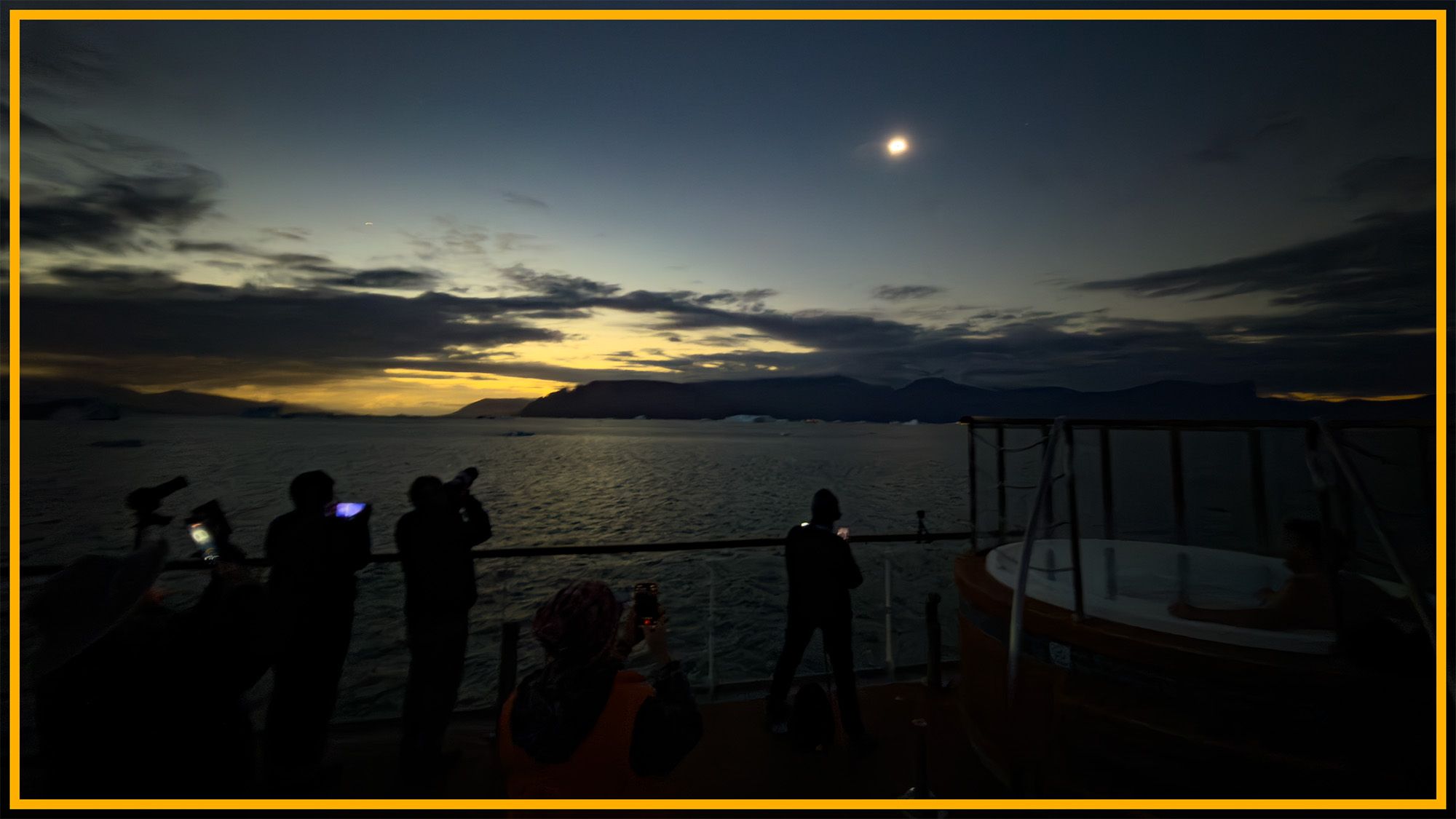
SCORESBY SOUND, Greenland — There's no feeling more exhilarating than waking up inside the imminent path of a total solar eclipse to see a clear blue sky. It was Wednesday, Aug. 12, and after over two years of planning, I was in the farthest reaches of eastern Greenland's beautiful Scoresby Sound (or Scoresbysund) fjord system aboard the Aurora Expeditions cruise ship the Sylvia Earle. We were creeping toward Ukattip Kungersiva, also known as Harefjord, in the icy depths of Ofjord.
Up on the observation deck, I scanned the sky for even a slight cloud. There was not a trace. I addressed the planet directly: "Are you kidding me?!" I smiled with utter joy, as it had been 1,210 days since my last clear view of the sun's corona — an eternity for an avid eclipse chaser like me. Clouds had thwarted my previous eclipse chase in Texas for the 2024 total solar eclipse, which was followed by almost two-and-a-half years without a total solar eclipse.
Today, 117 eclipse chasers on the expedition were depending on the decisions made by a few of us on the ship — the ship's captain, the expedition leader (and noted Arctic adventurer) Greg Mortimer and I. We had taken a risk to position the ship in a glorious location — the confluence of four fjord channels, with icebergs passing below ice-capped mountains — and, it seemed, in good weather — and we were also almost bang on the centerline of the path, where the sun would be blocked by the moon for 2 minutes, 16 seconds. That was just two seconds off the maximum possible totality anywhere on Earth. We were asking Mother Nature for everything on offer, but there were zero guarantees, aside from the moon's dark shadow enveloping us and cutting the light.
Jamie Carter is a Cardiff, U.K.-based freelance science journalist and a regular contributor to Live Science. He is the author of A Stargazing Program For Beginners and co-author of The Eclipse Effect , and leads international stargazing and eclipse-chasing tours. His work appears regularly in Space.com, Forbes, New Scientist, BBC Sky at Night, Sky & Telescope, and other major science and astronomy publications. He is also the editor of WhenIsTheNextEclipse.com .
The day before, we'd surveyed the aptly named Sol Glacier, a wall of ice on the shores of Scoresby Sund. The sound of thousands of tons of ice calving into the sea will stay with me forever, but I had the prospect of something else even more dramatic on my mind. We had to decide where to put the cruise ship for the total solar eclipse the next day. I looked at the latest cloud forecast and sighed; it showed a blue hole of sky far away on Greenland's Blosseville Coast, back the way we'd come from Iceland. Could we make it in time?
Yes, if we left soon. But watching an eclipse far out at sea could bring its own problems. The swell would make the ship unsteady, and mist and clouds were likely. Our first choice, the centerline of the path of totality down narrow Ofjord, had looked cloudy on forecasts all week, though the chances of clear skies had improved slightly today. I headed to the bridge — the ship’s command center — just as the latest forecast was updated. It was good news.
"We're seeing a trend for Ofjord to clear," said Mortimer, who, in addition to being expedition leader, is a mountaineer who's used to shooting for the summit when conditions allowed. To disappear down the channels of Scoresby was a risk; due to narwhals, the speed limit was just 3 knots (about 3.5 mph, or 5.6 km/h) — and there was no escape route. We decided to take the chance.
Being on a cruise ship that could change position paid off in spades. We had hugged the northern side of the fjord to prevent any rising clouds from blocking totality; as it neared, two other cruise ships joined us. The temperature dropped like a stone; three eclipse chasers watching from the ship's open-air hot tubs suddenly appeared to be the most sensible of all.
Read Full Story at Live Science →