Mice with human brain cells offer a tool to study disease. Ethicists ask: What's next?
This side view of a lab mouse brain shows nerve fibers extending from the human graft (colored with green and red fluorescent proteins) through the mouse brain (colored with blue). Scale bar = 1 mm. …
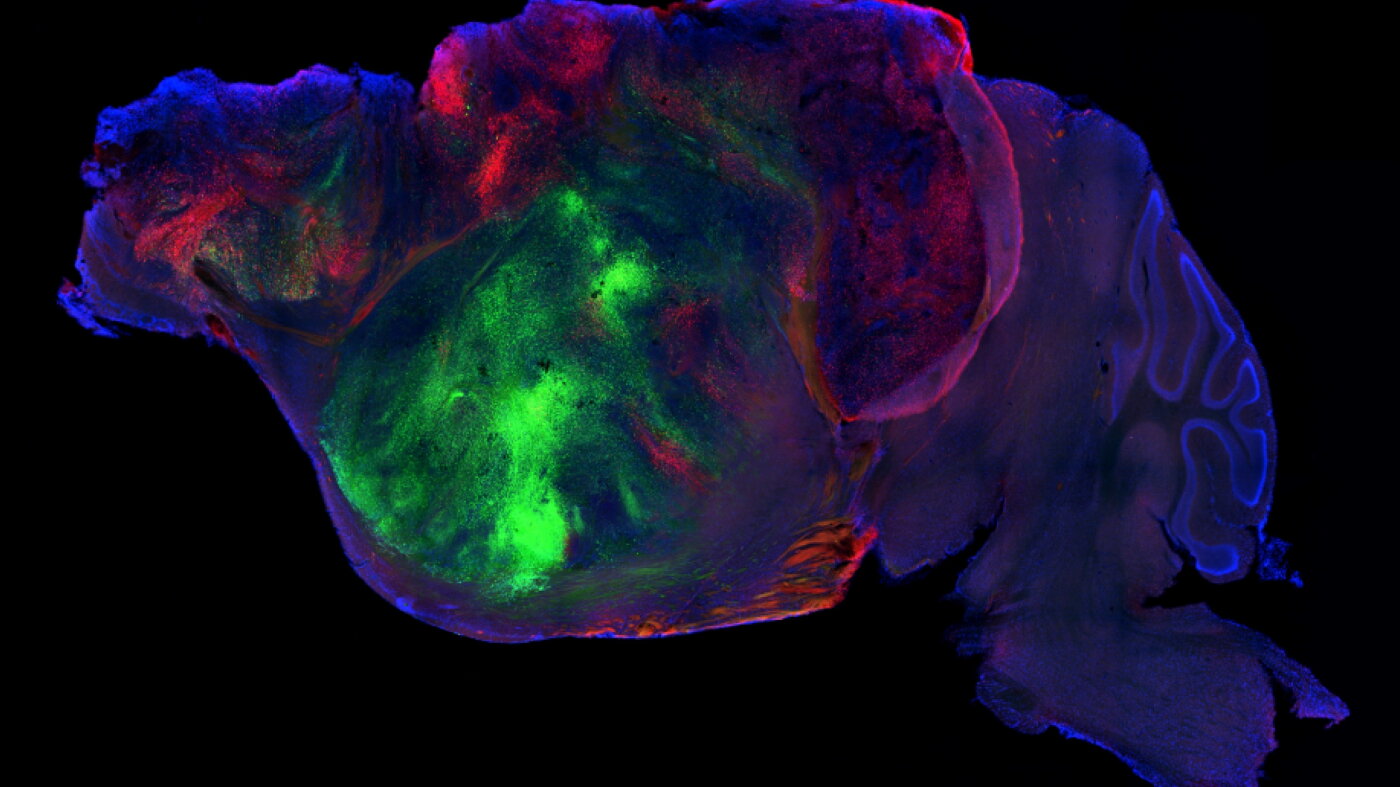
This side view of a lab mouse brain shows nerve fibers extending from the human graft (colored with green and red fluorescent proteins) through the mouse brain (colored with blue). Scale bar = 1 mm. S. Pașca lab/Stanford University hide caption
Researchers have developed a new way to install millions of human brain cells into mice, as a way of creating better scientific models for studying neurodegenerative disease.
Using genetic tools, the scientists bred mice that were missing most of their cerebral cortexes – the outermost layer of the brain involved with reasoning, memory and consciousness. Then, they replaced a large part of those missing mouse cells with lab-grown human brain cells, creating mice with human neurons that can be altered to approximate human brain conditions researchers are eager to study.
"For the past two decades, there's been a quest to try to build models of the human brain outside of the human body," says Sergiu Pașca , professor of psychiatry and behavioral sciences at Stanford University and senior author on the paper, published in the journal Nature . "This is not going to replace all the models we had before, but it's going to provide us access to other aspects of human brain function that would be very difficult to study otherwise."
Pașca says this research was conducted with strong ethical oversight and pushes research forward. At the same time, outside researchers point out that the development raises significant questions about where it could lead.
"It's really a powerful technology to study human neurons and how human brain circuits can form in a more natural environment" than a petri dish, says Hongkui Zeng , executive vice president and director of brain science at the Allen Institute in Seattle, Washington, who was not affiliated with the study.
But "going forward, there will be some considerations, if not concerns," she added — such as the implications of deploying this technique in larger and longer-living animals.
While it's not the first time human brain cells have been installed in mice, this new effort manages to connect significantly more human cells than before.
Read Full Story at NPR News →