Vera C. Rubin Observatory detects one of the smallest and faintest satellite galaxies ever seen
In one of the first major discoveries from the Vera C. Rubin Observatory in Chile, scientists have revealed a previously unknown galaxy orbiting the Milky Way . Described in a study that hasn’t been …
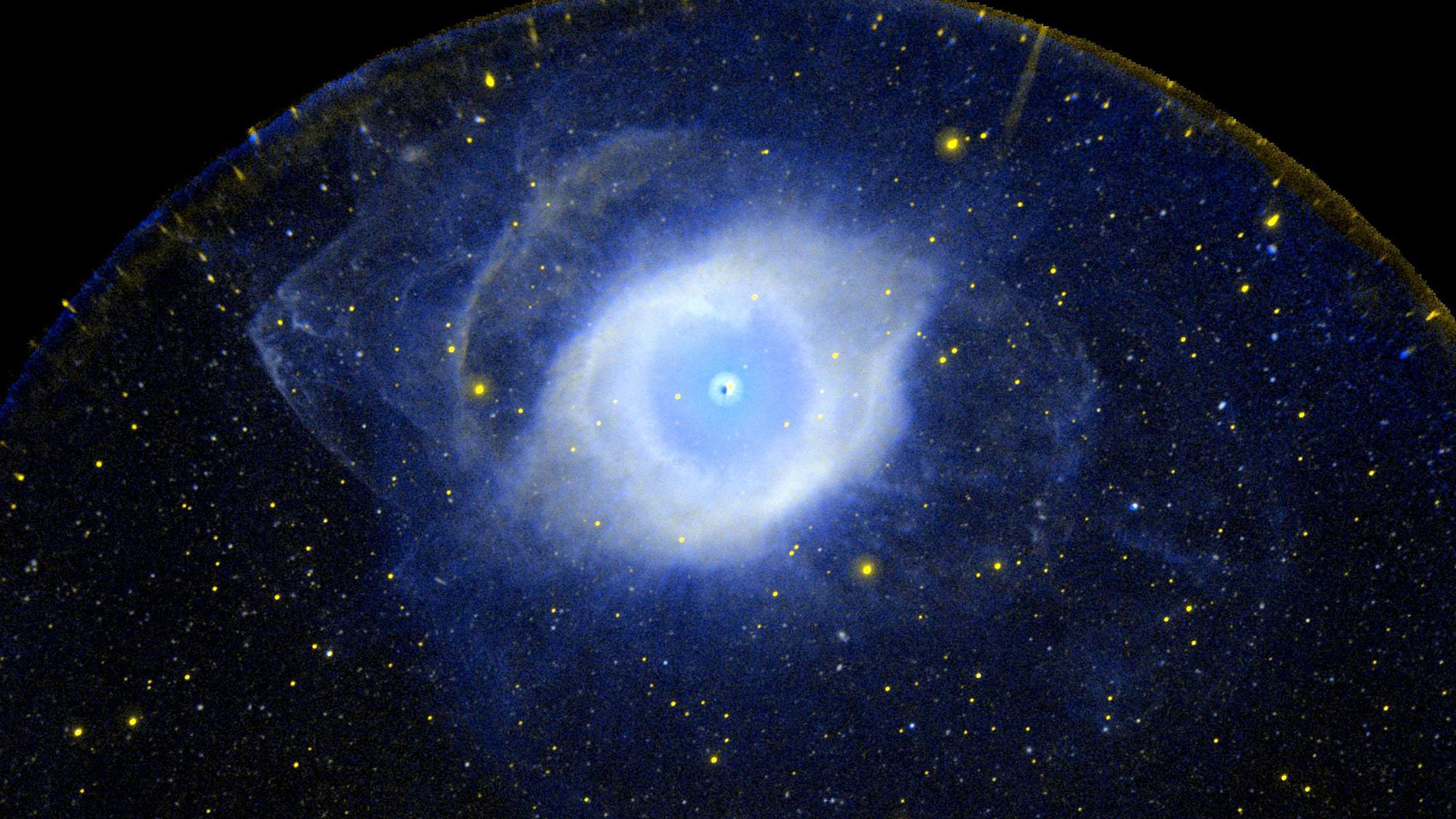
In one of the first major discoveries from the Vera C. Rubin Observatory in Chile, scientists have revealed a previously unknown galaxy orbiting the Milky Way . Described in a study that hasn’t been peer-reviewed, the galaxy, named Aquarius IV, is one of the lightest, faintest and farthest satellite galaxies ever seen.
This dim cluster of ancient stars was discovered on the extreme periphery of the Milky Way in early test data from the Rubin Observatory, offering a glimpse of the telescope's impressive abilities and shedding new light on our cosmic neighborhood.
Ultrafaint dwarf galaxies (UFDGs) are among the tiniest and faintest galaxies in the universe. These dim little clusters contain at most a few hundred thousand stars, compared with the Milky Way's approximately 100 billion, said Joshua Simon , an astronomer at the Observatories of the Carnegie Institution for Science who was not involved in the new research. Instead, "these galaxies are composed almost entirely of dark matter: 99 to 99.9% of their mass is dark, and only 0.1 to 1% is made up of stars," Simon told Live Science in an email.
Because UFDGs are so small and faint, even ones in the Milky Way's vicinity are difficult to detect. Such dwarf galaxies orbit ours, similar to how Earth orbits the sun . In a 2020 study , scientists estimated that hundreds of these satellite UFDGs may exist. However, only around 60 have been found so far, Aashay Pai , a graduate student in physics at the University of Chicago and a co-author of the new study, told Live Science in an email.
But the Rubin Observatory's supersharp vision is poised to increase that total. The telescope's 3,200-pixel, car-sized camera can detect objects up to 100 million times dimmer than those visible to the naked eye as it takes repeat observations of the night sky every few nights. This makes the observatory well equipped to find UFDGs.
However, the data analyzed in the new study wasn't from the LSST; it came from an earlier test run. This test data, collected between April 2025 and January 2026, was called Early Data Preview 2 (EDP2) and covered roughly 7% of the night sky.
The researchers used computer models on the EDP2 data to identify UFDGs as groups of stars whose brightness and colors suggested they had evolved together. The researchers assumed that these stars were around 13 billion years old, Pai said — nearly as old as the universe itself. This framework allowed them to distinguish UFDGs from stars and other galaxies in front of or behind the observed areas.
Get the world’s most fascinating discoveries delivered straight to your inbox.
Read Full Story at Live Science →