Astronomers discover compact galactic centers in early universe's red dots
Astronomers have found that "little red dots" in the early universe are likely compact galactic centers within larger structures, as evidenced by the Saguaro galaxy's similar dense core. This discove…
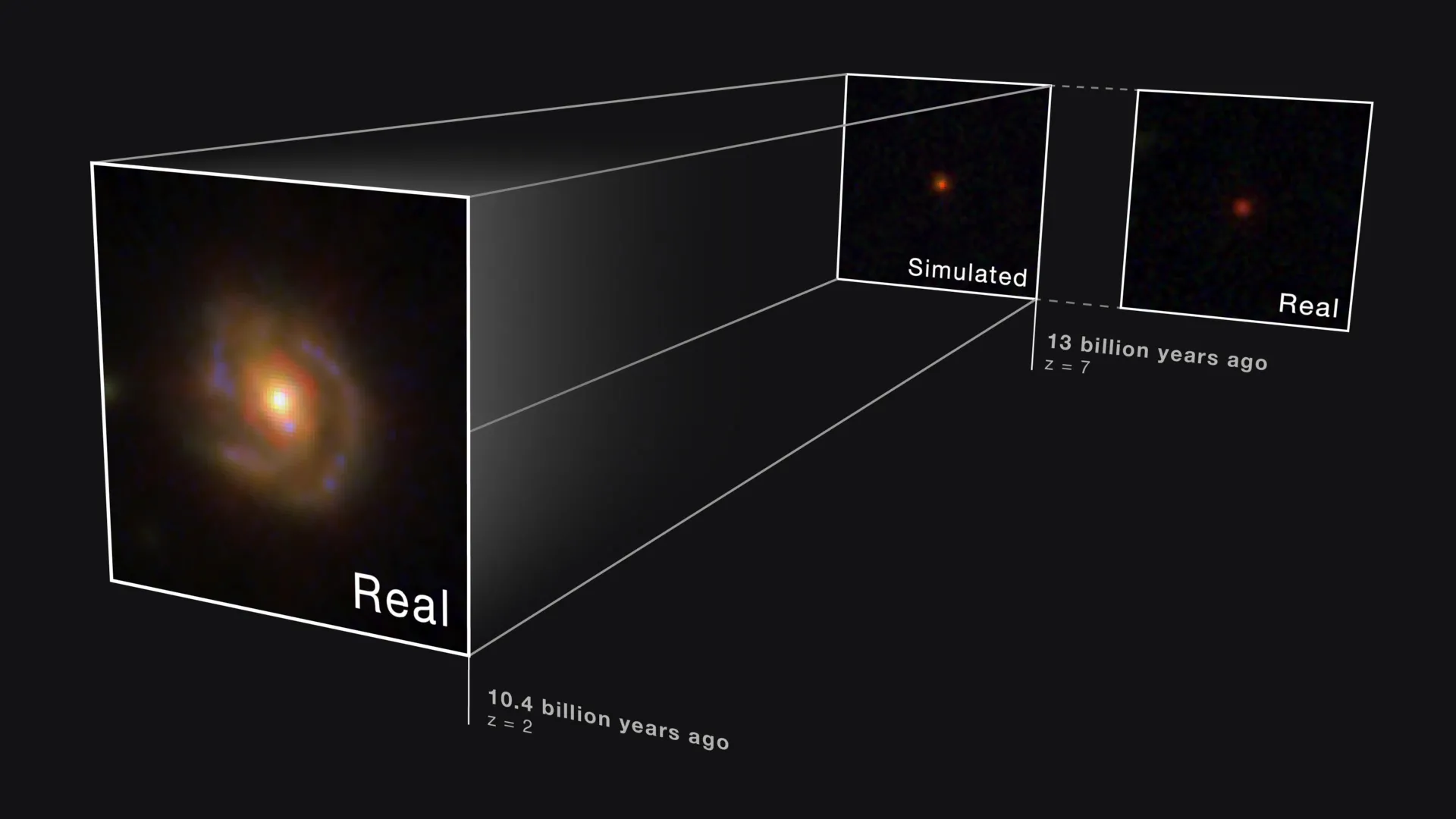
Astronomers have uncovered compelling evidence suggesting that the mysterious "little red dots" observed in the early universe are not isolated cosmic anomalies, but rather compact galactic centers hiding within larger structures. By conducting a detailed analysis of a nearby spiral galaxy nicknamed the Saguaro, researchers identified a bright, dense red core that mirrors the appearance of these distant, enigmatic objects. Crucially, this local object possesses a surrounding galaxy that is clearly visible to the James Webb Space Telescope, a feature typically obscured in the distant counterparts. This discovery provides a tangible model for understanding how these compact objects might have evolved and why they appear so distinct in the distant past, challenging previous assumptions that they were entirely separate or unique phenomena.
The significance of this finding lies in the context of how we observe the deep universe. The James Webb Space Telescope has revolutionized astronomy by detecting infrared light from the earliest epochs of cosmic history, revealing thousands of these little red dots. However, their true nature has remained a subject of intense debate. Some scientists argued they were supermassive black holes growing rapidly, while others suggested they were dense clusters of young stars. The Saguaro galaxy offers a crucial missing link because it allows astronomers to study a similar compact red center in high resolution, free from the extreme distance that blurs distant light. The researchers found that the Saguaro’s core exhibits the same spectral characteristics as the distant dots, confirming a physical similarity that was previously only theoretical. This local analog serves as a laboratory for testing hypotheses about the formation and evolution of galaxies in the first billion years after the Big Bang.
To demonstrate how a full galaxy can disappear from view, the research team performed sophisticated simulations to mimic how the Saguaro would appear if it were located billions of light-years away. The results were striking. When the galaxy was digitally placed at a distance comparable to the little red dots, its extended spiral arms and outer disk faded into invisibility due to the effects of cosmic expansion and atmospheric interference. Only the bright, compact central core remained detectable. This simulation proves that the little red dots are likely not naked cores, but rather the central engines of larger galaxies whose outer structures are too faint or redshifted to be seen by current instruments. The outer material is effectively hidden, not absent, which explains why these objects appear so small and point-like in Webb’s images.
This revelation fundamentally alters our understanding of early galaxy formation. If little red dots are indeed the cores of larger systems, it suggests that massive galaxies were assembling much earlier and more efficiently than previously thought. It implies that the building blocks of the universe we see today were already in place, but shrouded in obscurity. Future observations will need to account for this hidden mass, potentially requiring new techniques to detect the faint outer halos of these distant systems. For the broader scientific community, this means that the early universe was not just a collection of isolated bright spots, but a complex web of forming galaxies. The Saguaro galaxy acts as a Rosetta Stone, translating the cryptic signals from the dawn of time into a coherent picture of cosmic history. As technology improves, astronomers hope to peel back these layers, revealing the full structure of these ancient giants and refining our models of how the universe evolved from a hot, dense state to the structured cosmos we inhabit today.
Read Full Story at ScienceDaily →