The Milky Way’s fastest star could expose our black hole’s spin
The Milky Way’s fastest star could expose our black hole’s spin The star S301 swoops so close to our galaxy’s supermassive black hole that it could, for the first time ever, reveal that dark behemot…
The Milky Way’s fastest star could expose our black hole’s spin
The star S301 swoops so close to our galaxy’s supermassive black hole that it could, for the first time ever, reveal that dark behemoth’s rotation
Nothing can escape a black hole—except, potentially, its secrets.
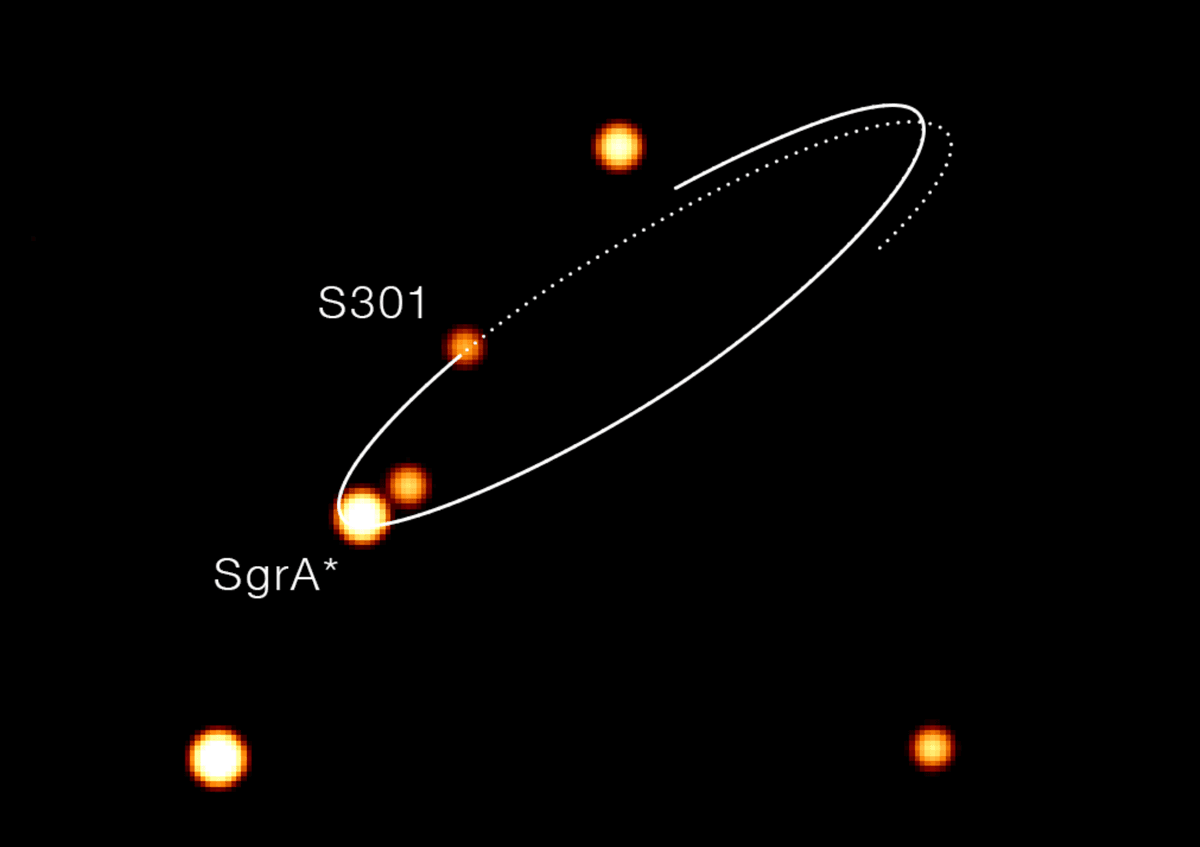
Astrophysicists have spied a unique star called S301 whipping around Sagittarius A* (Sgr A*), the supermassive black hole at the Milky Way’s heart. S301 orbits Sgr A* so tightly that the star’s trajectory should be bent by the black hole’s rotation. Detailed in a paper published today in Nature, this discovery should help researchers do something never done before: discern a black hole’s spin from the motion of a single star.
Found using sophisticated instruments on the European Southern Observatory’s (ESO’s) Very Large Telescope Interferometer (VLTI) in Chile, S301 is also the fastest star ever observed in the Milky Way. At its closest approach to Sgr A*, the star hits 25,000 kilometers per second—about 8 percent of the speed of light. At that speed, you could get from New York City to Los Angeles in about a sixth of a second (if you’d be willing to show up a little disheveled).
If you're enjoying this article, consider supporting our award-winning journalism by subscribing . By purchasing a subscription you are helping to ensure the future of impactful stories about the discoveries and ideas shaping our world today.
Despite their deserved reputation for unleashing numerous mind-bending physical paradoxes, black holes are thought to be among the universe’s simplest objects, only possessing three fundamental properties: mass, charge and spin. And while astronomers have managed to estimate the spins for some black holes, measuring this spin directly hasn’t been possible for lack of a suitable probe. S301 could change that.
“Nature is telling us that, just a footstep away compared to other black holes, there is a path toward directly checking whether a black hole is rotating,” says Stefan Gillessen, an astrophysicist at the Max Planck Institute for Extraterrestrial Physics (MPE) in Garching, Germany, and one of the study’s authors.
Read Full Story at Scientific American →