Astronomers observe massive star consuming neighbor before supernova explosion
Astronomers observed a massive star consuming its smaller neighbor before exploding in a Type II supernova, located 120 million light-years away. This event is significant for understanding stellar e…
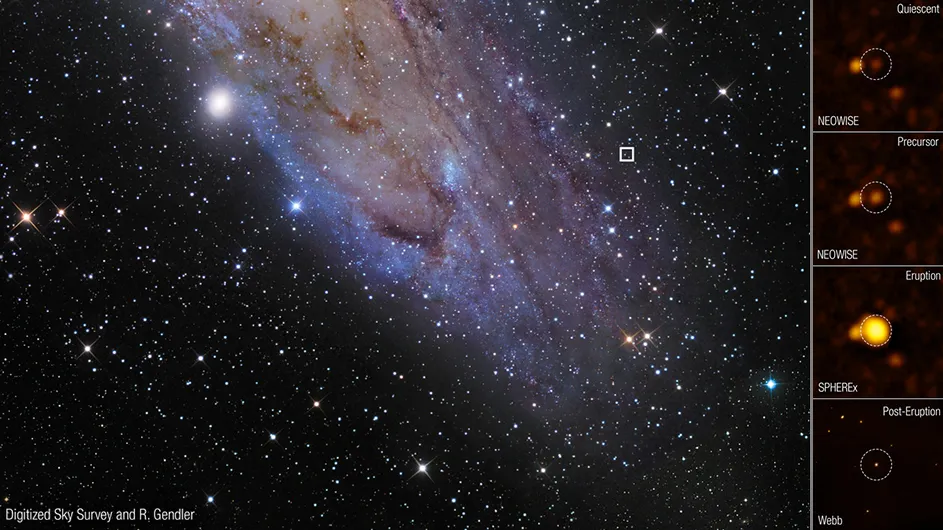
Astronomers recently observed a rare event involving a massive star that consumed its neighbor before ultimately exploding, marking a significant moment in stellar evolution research. This dramatic occurrence was detected in a galaxy about 120 million light-years away from Earth. The brightening of the system caught the attention of scientists, who quickly realized that the event was related to a giant star engulfing a smaller companion star.
This event is noteworthy because it provides valuable insights into the life cycles of massive stars and their interactions. In the universe, stars with greater mass often evolve differently than smaller ones. When massive stars reach the end of their life cycle, they can undergo supernova explosions. Understanding these processes is crucial because they play a vital role in the distribution of heavy elements throughout the universe, contributing to the formation of new stars and planets. Observations like this one help refine existing models of stellar evolution and the dynamics of binary star systems.
The recent event was documented using advanced telescopes and instruments that can capture different wavelengths of light. This allowed researchers to gather data about the temperatures, compositions, and dynamics of the stars involved. Initial analysis suggested that the explosion was likely a Type II supernova, a common type that occurs when massive stars exhaust their nuclear fuel and collapse. Scientists are now working to analyze the data further, hoping to unravel the specifics of the explosion and its aftermath.
The implications of this observation extend beyond the immediate findings. Understanding how massive stars interact and eventually explode can help scientists predict similar events in the future. This knowledge may also enhance our understanding of the evolution of galaxies and the formation of new stars. As researchers continue to study this event, they anticipate uncovering more about the life cycles of stars and the cosmic processes that shape our universe.
Read Full Story at Ars Technica →