Free Compound Interest Calculator 2026
See exactly how your money grows over time. Get year-by-year breakdowns, total returns, and ROI — with or without monthly contributions. 100% free, no signup.
How to Use This Compound Interest Calculator
6 simple steps to project your investment growth
The Compound Interest Formula Explained
Typical Interest Rates by Account Type (2026)
| Account / Investment Type | Typical Rate | Compounding | Notes |
|---|---|---|---|
| S&P 500 Index Fund | ~10% | Annual | Historical long-term average; returns vary annually |
| High-Yield Savings (HYSA) | 4–5% | Daily | FDIC insured; rates change with Fed policy |
| US Treasury Bonds | 3–5% | Semi-annual | Low risk; backed by US government |
| Certificate of Deposit (CD) | 4–5.5% | Daily / Monthly | Fixed term; penalty for early withdrawal |
| Traditional Savings Account | 0.01–0.5% | Daily | Very low yield; consider HYSA instead |
| Diversified ETF Portfolio | 6–9% | Annual | Moderate risk; diversification reduces volatility |
The Rule of 72 — Doubling Time Shortcut
Want to quickly estimate when your money doubles? Divide 72 by your annual interest rate. At 8%, your money doubles in approximately 9 years (72 ÷ 8 = 9). At 6%, it takes 12 years.
Related Financial Calculators
See Free Compound Interest Calculator in action
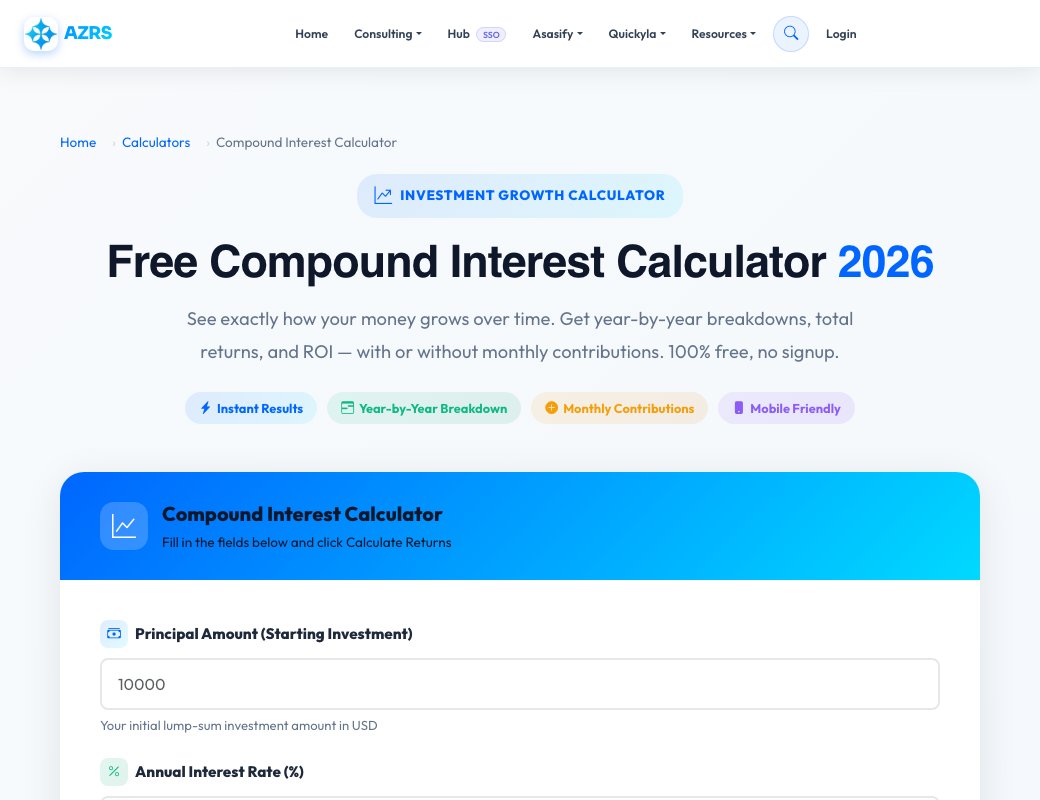
Free Compound Interest Calculator
Calculate how a lump sum or a regularly contributed savings amount grows with compound interest over time. Enter your principal, interest rate, compounding frequency and time period to see your final balance, total interest earned, and a breakdown of growth over time.
Compounding frequency matters: interest compounded monthly grows slightly faster than the same annual rate compounded yearly, because interest starts earning its own interest sooner. This calculator lets you compare frequencies directly.
Key features
Multiple compounding frequencies
Compare annual, monthly, and daily compounding on the same principal and rate.
Optional recurring contributions
Model regular deposits on top of a starting balance.
Interest vs. principal breakdown
See exactly how much of your final balance is interest earned.
Free and instant
No signup, results update as you change any input.
How to use it
- Enter your starting principal.
- Enter the annual interest rate.
- Choose a compounding frequency (annually, monthly, daily, etc).
- Enter the time period and optional contributions to see your final balance.
Worked example
Example
$10,000 at 5% annual interest compounded monthly for 10 years grows to about $16,470, compared to about $16,289 compounded annually — the more frequent compounding earns roughly $180 more on the same rate.
Who uses this tool
Savers
See how a savings account or CD balance grows with real compounding math.
Students learning finance
Visualize the difference between simple and compound interest concretely.
Anyone comparing accounts
Compare two accounts with different rates and compounding frequencies fairly.
Tips for the best results
- More frequent compounding (daily vs. annually) always produces a slightly higher return at the same stated annual rate — check the compounding frequency when comparing savings products, not just the rate.
- The 'Rule of 72' gives a quick mental estimate: divide 72 by the interest rate to estimate years to double your money.
- Even small differences in rate compound significantly over long periods — always compare the actual final balance, not just the percentage.
- Adding even modest regular contributions substantially increases the final balance compared to a single lump sum left alone.
Common mistakes to avoid
- Confusing simple interest with compound interest — compound interest grows faster because it earns interest on previous interest.
- Ignoring compounding frequency when comparing two accounts with the same stated annual rate.
- Forgetting that inflation erodes real purchasing power even as the nominal balance grows.
Why use AZRS QuickFix?
It is 100% free, needs no signup and has no watermark or usage limits. The tool runs in your browser, so what you type stays on your device, and it works on phones, tablets and desktops. New tools are added every week — bookmark this page or browse the full QuickFix toolbox.
Frequently asked questions
What is compound interest?
Interest calculated on both the original principal and any interest already earned, so the balance grows faster over time than with simple interest.
Does compounding frequency really matter?
Yes — more frequent compounding (daily vs. monthly vs. annually) produces a slightly higher final balance at the same stated annual rate.
What's the Rule of 72?
A quick estimate for how long it takes an investment to double: divide 72 by the annual interest rate. At 6%, that's about 12 years.
Is this compound interest calculator free?
Yes, free with no signup.
Can I add regular contributions?
Yes, enter an optional recurring deposit amount and frequency to see its effect on the final balance.
Is my data saved?
No, everything is calculated instantly in your browser.