Christian Holiday Calendar
See feasts, fasts and seasons for any year, with Western and Orthodox dates side by side.
Guidance only. For questions of belief or practice, speak with your pastor or church leader.
About the Holiday Calendar tool
The church year is a cycle of seasons: Advent, Christmas, Epiphany, Lent, Easter, Pentecost and the long stretch of Ordinary Time. Many feasts move each year because they are counted from Easter, which itself is set by the spring full moon.
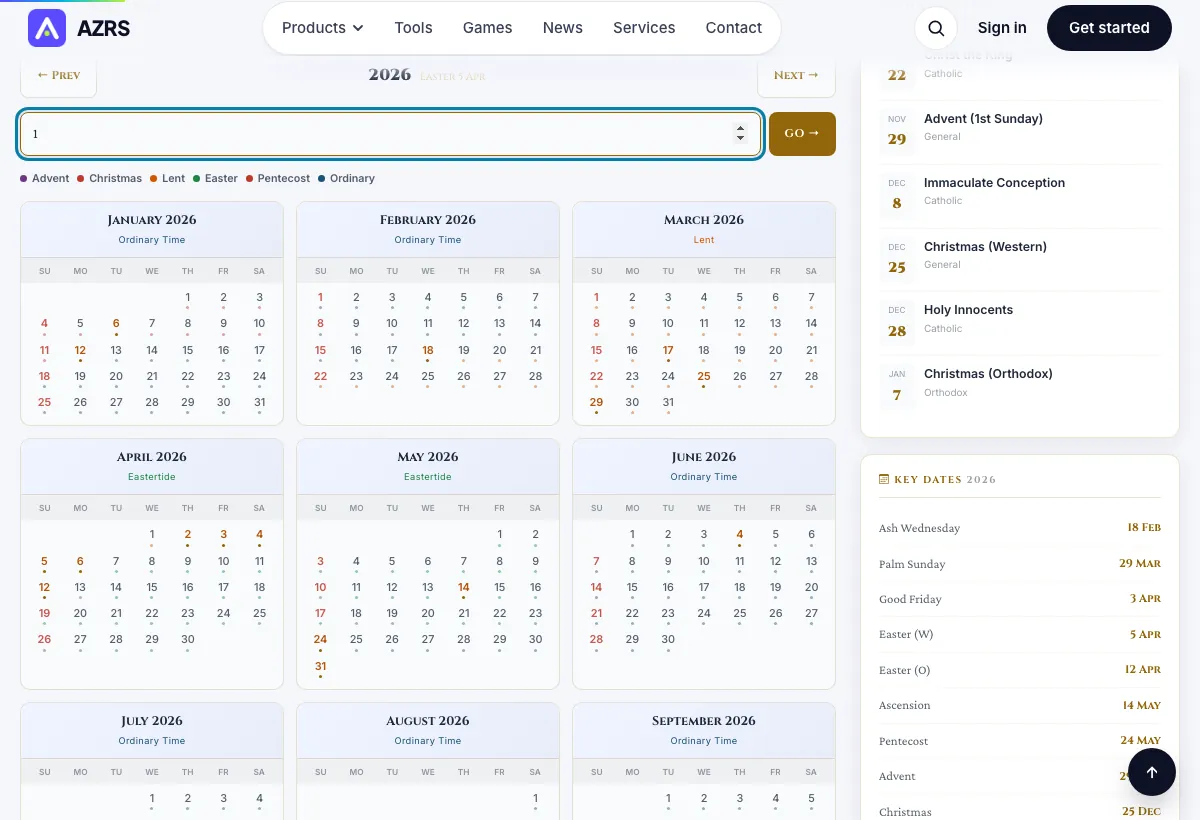
This calendar works out those dates on the page for any year from 1 to 9999. The Full Year tab shows twelve months with each season in its own colour. The Holidays tab lists every feast with a short note, and you can filter by Universal, Catholic, Orthodox or Protestant. The Seasons tab explains the colours and meaning of each season, and the Traditions tab compares how different churches keep the year.
Churches do not all agree on dates. Orthodox churches often keep Easter later than the Western churches, and some Orthodox churches keep Christmas on January 7. Local customs also differ, so confirm the date of a service with your own church or pastor.
How to use it
Pick a year. Use the Prev and Next buttons, or type a year in the jump box and press Go.
Read the colours. Each month shows days marked by season. Check the legend above the months to match colour and season.
Open the Holidays tab. Filter by tradition and load another year to see feast dates in order.
Check your church. Compare the date with your own church calendar, since local practice can vary.
A simple example
Easter Sunday and Ash Wednesday are listed with dates
Orthodox Easter is shown as its own entry
Pentecost falls 49 days after Easter Sunday
Tips for good results
- Use the Holidays tab when you want dates in a list, and the Full Year tab to see them in context.
- Choose the Orthodox filter to see when Orthodox Easter falls in the year you picked.
- Look at the Seasons tab before Advent or Lent to see what each season is about.
- Write down service dates from your own church, since this tool shows general dates.
Common mistakes
- Assuming Orthodox and Western churches share the same Easter date.
- Planning travel or events from the date alone without asking your church about service times.
- Forgetting that most feasts begin the evening before in some traditions.
- Treating Ordinary Time as unimportant. It is the longest part of the church year.
Common questions
How is the date of Easter decided?
In the Western churches Easter is the first Sunday after the first full moon on or after March 21. Orthodox churches use the Julian calendar for the same rule, so their date is often later.
Why does Christmas fall on December 25 for some and January 7 for others?
Churches that keep the Julian calendar for feast days place Christmas on January 7 of the Gregorian calendar. Others use December 25.
What are the colours on the calendar?
Purple marks Advent, red marks Christmas and Pentecost, orange marks Lent, green marks Easter and blue marks Ordinary Time on this page. Churches may use different colours in worship.
Can I look up past or future years?
Yes. Use the jump box to go to any year from 1 to 9999. The dates are calculated, not stored.
Does this calendar include saints days?
It lists the main feasts, many Catholic feasts and a few Protestant observances. It is not a complete saints calendar, so ask your church for local days.