Hourly to Salary Calculator (After Tax)
Convert an hourly wage to weekly, monthly and yearly pay — before and after real taxes · free, no signup
How Hourly to Salary Calculator (After Tax) works, step by step

Enter your hourly wage.
 Download it
Enter your hours worked per week.
Hourly to Salary Calculator (After Tax)
Type your hourly wage, hours worked per week and the US state you work in. This tool multiplies out your real gross pay (weekly, monthly, yearly) and then runs it through the actual 2025 IRS federal tax brackets for your filing status, real FICA (6.2% Social Security up to the wage base + 1.45% Medicare), and a named per-state income tax model, to show what you would actually take home.
State income tax is genuinely complicated — nine states charge no wage income tax at all (like TX, FL and WA), some use a single flat rate, and others use their own graduated brackets. This tool uses a real flat-rate table for flat-tax states and a stated approximate effective rate for graduated-bracket states, clearly labelled as an estimate. This is a real estimate built from real, named tax rules — not a paycheck-exact number, since it can't see your actual W-4, deductions, benefits or local city tax.
Key features
Real 2025 federal brackets
Applies the actual IRS marginal brackets for your filing status, not a flat guess.
Real FICA
6.2% Social Security up to the wage base plus 1.45% Medicare, exactly as withheld.
Named per-state model
Flat-rate table for flat-tax states, a stated approximate effective rate for graduated states, 0% for the nine no-income-tax states.
Every frequency at once
Weekly, monthly and yearly, gross and after-tax, side by side.
How to use it
- Enter your hourly wage.
- Enter your hours worked per week.
- Choose your filing status and US state.
- See your gross and after-tax pay for every frequency instantly.
Worked example
Example
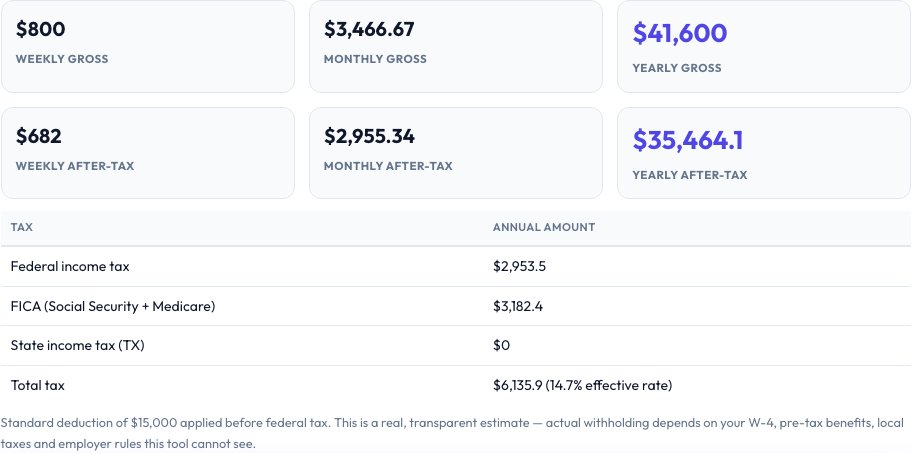
$20/hour, 40 hours/week, single filer, Texas (no state tax) → about $41,600/year gross, roughly $35,460/year after federal tax and FICA.
Who uses this tool
Job seekers comparing offers
See the real take-home difference between an hourly offer and a salaried one.
Freelancers setting rates
Reverse-engineer what hourly rate you'd need to match a salaried after-tax income.
Anyone moving states
Compare the real after-tax gap between a no-tax state and a high-tax one at the same wage.
Tips for the best results
- Use your actual scheduled hours, not a rounded 40, if you regularly work more or less.
- Remember overtime (hours over 40/week) is usually paid at 1.5x — use the Overtime Pay Calculator for that portion.
- This estimate excludes pre-tax deductions like 401(k) or health insurance, which would lower your taxable income and change the result.
Common mistakes to avoid
- Assuming this matches your exact paycheck — actual withholding depends on your W-4, benefits, local taxes and other deductions this tool cannot see.
- Forgetting that overtime hours are paid at a higher rate, not your flat hourly rate.
- Picking the wrong filing status, which meaningfully changes the federal tax owed.
Why use AZRS QuickFix?
It is 100% free, needs no signup and has no watermark or usage limits. The tool runs in your browser, so what you type stays on your device, and it works on phones, tablets and desktops. New tools are added every week — bookmark this page or browse the full QuickFix toolbox.
Frequently asked questions
Is this exactly what my paycheck will show?
No — it's a real, transparent estimate using the actual 2025 federal brackets, FICA and a stated per-state model, but it cannot see your W-4 elections, pre-tax benefits, local taxes or actual employer withholding rules, so treat it as a close estimate, not a guarantee.
Why does 2025 and not 2026 federal brackets?
The 2025 IRS brackets are the latest official published figures at the time of writing; the IRS typically announces the following year's brackets in the fall with only small inflation-based shifts, so this is the most accurate real data available.
Which states have no income tax?
Alaska, Florida, Nevada, New Hampshire (wages only), South Dakota, Tennessee, Texas, Washington and Wyoming.
How is the state tax for other states estimated?
Flat-tax states use their real flat rate. Graduated-bracket states (like California or New York) use a single stated approximate effective rate for a moderate income, since modelling every bracket for every state is beyond what a quick calculator can promise accurately — this is disclosed directly under the result.
Does it include overtime?
No, this converts your base hourly rate at the hours you enter; use the separate Overtime Pay Calculator for time-and-a-half math.
Is my data stored anywhere?
No, everything is calculated locally in your browser.