Talmud Search
Search the Talmud by topic and read the matching passages with their references.
Passages come from the Sefaria library. When Sefaria has no match, an AI search fills in, and that can contain errors. Check any passage you plan to quote in a printed edition, and ask your rabbi about how it is applied.
Searching Talmud...
Guidance only. For questions of halacha, ask your rabbi.
About the Talmud Search tool
The Talmud is the central text of rabbinic Judaism. It joins the Mishnah, the early collection of oral teaching, with the Gemara, the discussion that follows it. The Babylonian Talmud is the more widely studied, and the Jerusalem Talmud is the older, shorter version.
This tool searches it by topic. Type a word such as kindness, charity or honesty, or tap a topic button, and matching passages appear with their reference, the Hebrew or Aramaic text and an English translation where one is available. Results come from the Sefaria library.
If Sefaria has no match, an AI search fills in with passages and a short explanation. That fallback can misquote or mis-cite a passage, so check the reference in a printed edition before you rely on it. The Talmud is a book of argument and law, and how it is applied is a question for your rabbi.
How to use it
Type a topic. Use one or two words, such as prayer or honesty, or tap a topic button.
Search. Press the search button or press Enter, and wait for the results to load.
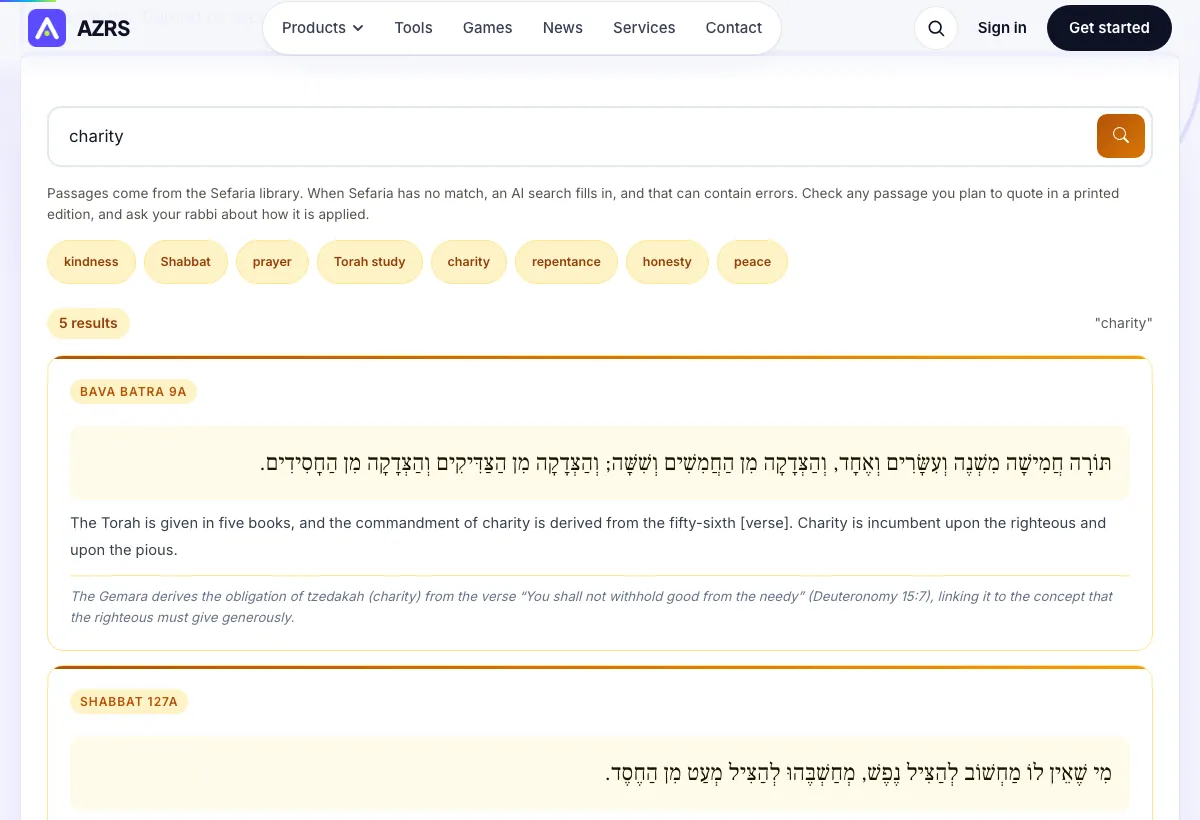
Read the passages. Each result shows a reference, the Hebrew or Aramaic text and an English translation.
Check the reference. Look the passage up in a printed edition or with a teacher before you quote it.
A simple example
A list of passages with their tractate references
Hebrew or Aramaic text and an English translation
A count of results above the list
Tips for good results
- Short topic words work best. Try peace, charity or repentance.
- The reference tells you the tractate and page, which helps you find the passage in a printed volume.
- A passage often depends on the argument around it, so read the surrounding page.
- Study with a teacher or a partner when you can, as is traditional.
Common mistakes
- Treating one quoted line as the ruling. The Talmud records the whole debate.
- Quoting an AI back-up result without checking the printed page.
- Using a long sentence for a search instead of a topic word.
- Using a passage to decide a practical question without asking your rabbi.
Common questions
What is the difference between the Mishnah and the Gemara?
The Mishnah is the early written collection of oral law. The Gemara is the later discussion and commentary on it. Together they make up the Talmud.
Where do the passages come from?
From the Sefaria library when it has a match. If it does not, an AI search fills in, and that can contain errors.
Is the English translation official?
No single translation is official. Sefaria offers several, and wording differs between them.
Can I use this to find a ruling?
No. The Talmud records debate and law, and practice is decided by rabbis. Ask yours for a ruling.
Does it cover the Jerusalem Talmud as well?
The search is aimed at the Talmud as a whole. The results depend on what the library returns for your topic.