SEO Analyzer
Enter a site address and get a full on-page audit of every page the crawler reaches.
Why Use Our SEO Analyzer?
Get comprehensive insights to improve your search rankings
Meta Tag Analysis
Check title tags, meta descriptions, and ensure they're optimized for search engines and click-through rates.
Heading Structure
Analyze H1 tags to ensure proper content hierarchy and keyword optimization throughout your pages.
Performance Metrics
Measure page load times, response times, and identify performance bottlenecks affecting user experience.
Link Analysis
Discover broken links, analyze internal linking structure, and optimize your site navigation.
Mobile Optimization
Check viewport settings and ensure your site works perfectly on all devices.
Technical SEO
Audit HTTP status codes, page sizes, and other critical technical SEO elements.
How to Use This Tool Effectively
Actionable SEO advice to get the most out of every analysis
Start With Your Competitors
Run your top 3 competitors through this tool first. Understanding their structure, keywords, and technical issues reveals exactly where you can outrank them.
Run Monthly Audits
SEO is not a one-time task. Schedule monthly checks to catch new issues before Google penalizes them. Consistent analysis beats one big yearly audit every time.
Fix High-Impact Issues First
Not all errors are equal. Prioritize: broken crawl paths → missing meta titles → slow load times → thin content. This order maximizes ranking gains per hour spent.
Internal Links Are Free PageRank
Every internal link passes authority between your pages. Use the Internal Link Finder to ensure your most important pages receive the most internal links.
Page Speed Directly Affects Rankings
Google's Core Web Vitals are a confirmed ranking factor. Pages loading under 2.5 seconds see significantly higher rankings and 40% lower bounce rates than slow pages.
Keep Your Sitemap Clean
Your sitemap tells Google what to index. Remove redirect chains, 404s, and noindex pages from it. A clean sitemap = faster, more complete indexation of good content.
More Free SEO Tools
Everything you need to dominate search rankings — all free, no signup required
🔍 SEO & Website Analysis
🧮 Free Calculators
⚙️ Developer & Utility Tools
How to use the SEO Analyzer
- Type the full address of your site, including https://, for example https://example.com.
- Press Analyze Website SEO. The crawler follows internal links from that page and reads up to 40 pages, so wait for the progress window to finish.
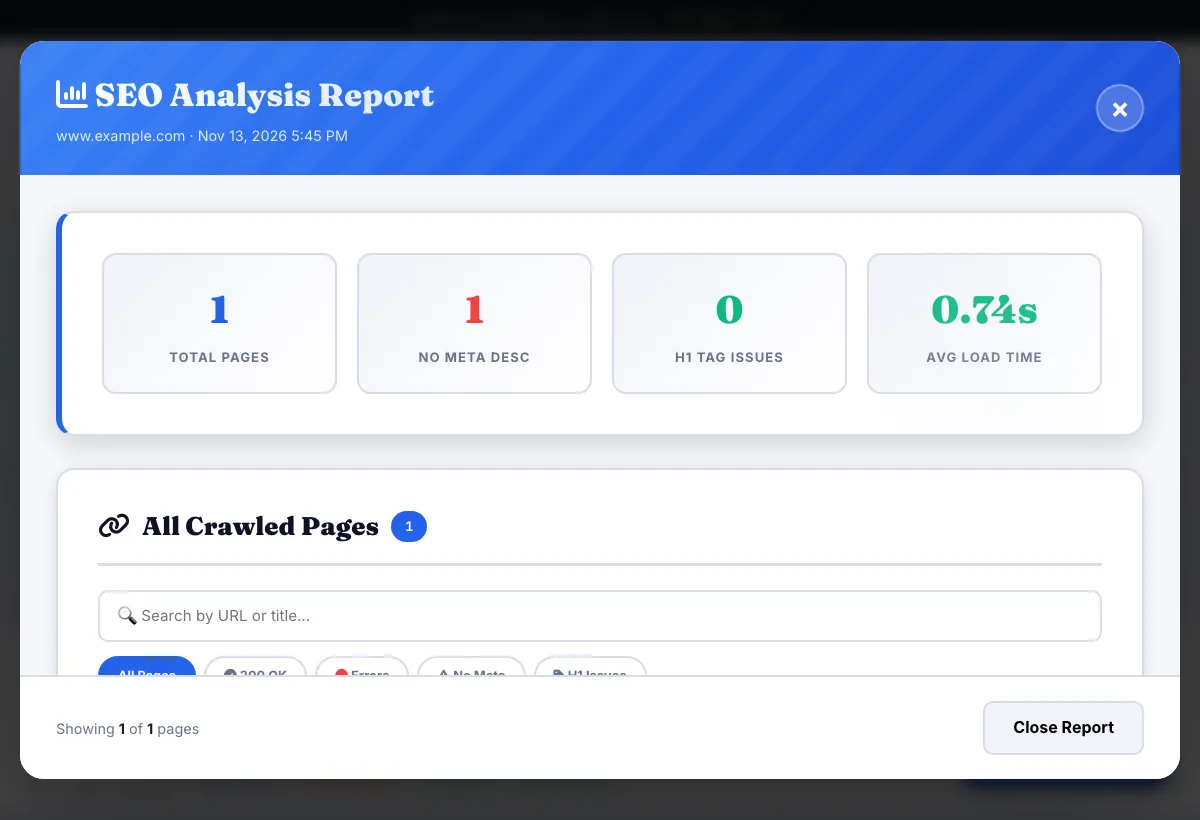
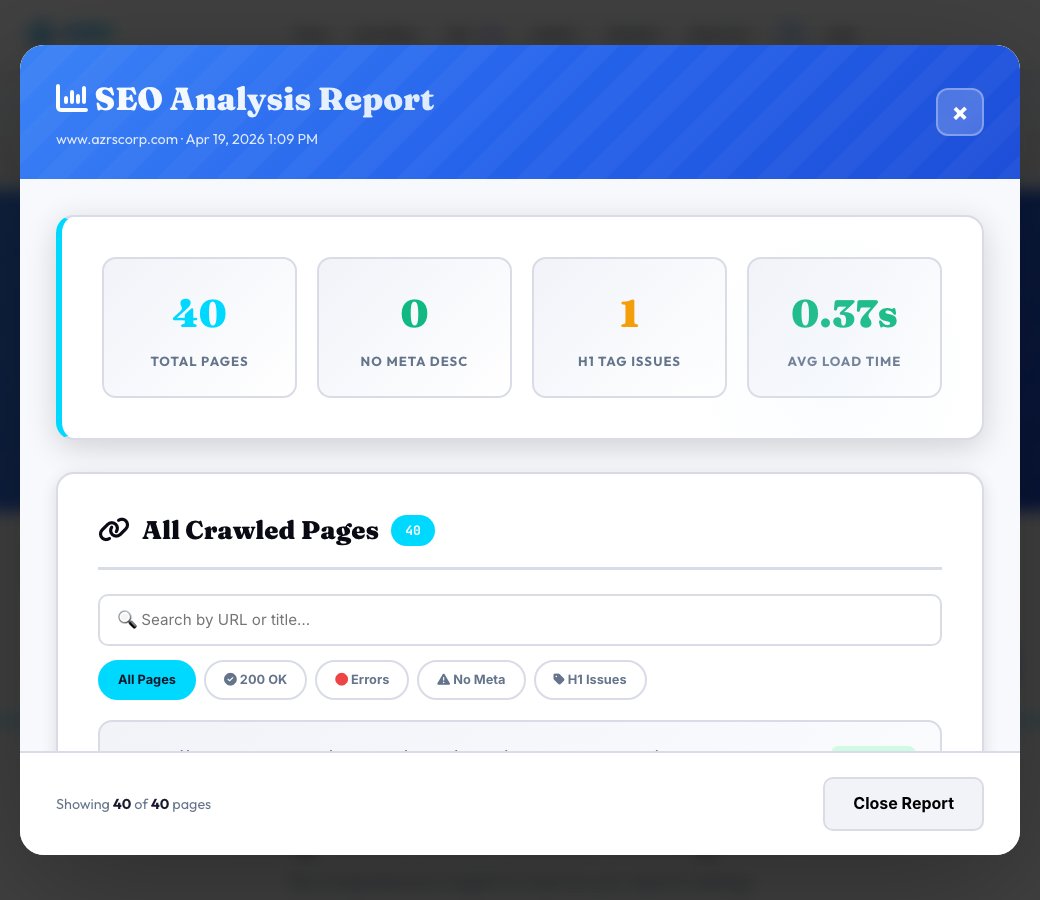
- Open the full report. Each page shows its status code, title, meta description, H1 count, load time and size.
- Sort out the red items first: pages with no meta description, pages with more than one H1, and error status codes.
- Fix the pages, publish, and run the analyzer again to confirm the warnings are gone.
Example: a 12-page small business site
Pages crawled: 12
Missing meta description: 3 (/about, /faq, /contact)
Pages with 2 or more H1: 2 (/services, /blog)
Average load time: 1.8 s

Fix order: add three 150-character descriptions, change the second H1 on each of the two pages to an H2, re-run. Expected result: 0 missing meta, 0 H1 issues.
Tips for better results
- Start from your home page so the crawler can reach the most pages.
- Audit your top competitors with the same tool to compare structure.
- Fix status errors before cosmetic issues like long titles.
- Keep titles near 50-60 characters and descriptions near 150-160.
Common mistakes
- Entering a URL without https:// or with a typo.
- Treating one slow page as a sitewide problem.
- Using several H1 tags to chase keywords instead of one clear H1 plus H2 sections.
- Never re-running the audit after fixes.
Frequently asked questions
What does the SEO Analyzer check?
For every page it reads the HTTP status, title, meta description, H1 headings, load time and page size, then summarises how many pages have problems.
How many pages does it crawl?
The crawl is capped at 40 pages per run so results come back quickly. Large sites should be checked section by section.
Why is one of my pages missing from the report?
The crawler only follows links it finds in the HTML. Pages that are only reachable through a search box, a login or JavaScript-only navigation may not be found.
Is a slow average load time always a problem?
Load time here is measured from our server, so treat it as a relative number. Compare pages against each other and look for outliers rather than chasing an exact figure.
How often should I audit my site?
Run it after any redesign, migration or big content update, and otherwise about once a month.
Does it change my site?
No. It only requests your public pages, the same way a browser would.
See Free SEO Analyzer — Full-Site Crawl & Audit in action
Free SEO Analyzer — Full-Site Crawl & Audit
Enter a starting URL and this tool crawls up to 40 pages of that site (following internal links, 8-second timeout per request) to build a real audit: page titles, meta descriptions, H1 counts, HTTP status codes and per-page load times, all stored so you can review them page by page instead of guessing from a single homepage scan.
Unlike single-page 'paste your HTML' checkers, this crawls the site the way a search engine actually discovers it — so pages missing a meta description, pages with zero or multiple H1 tags, and slow-loading pages surface automatically across the whole crawl, not just the one URL you typed.
Use it in 4 steps
Enter the site's starting URL (its homepage or any internal page).
Submit the crawl and let it follow internal links (up to 40 pages).
Review the page list: titles, meta descriptions, H1 counts and load times.
Re-run after fixes to confirm the missing-meta and multi-H1 counts drop.
Key features
Real multi-page crawl
Follows internal links up to 40 pages per run instead of auditing one URL in isolation.
Missing meta description count
Instantly see how many crawled pages have no meta description at all.
H1 structure check
Flags pages with more than one H1, a common on-page SEO and accessibility issue.
Per-page load time
Every crawled page's response time is logged so slow outliers are easy to spot.
A real example, step by step
Crawling a 25-page site turns up 6 pages with no meta description and 2 pages with two H1 tags each — a clear, prioritized fix list instead of manually opening 25 tabs.
Who uses this tool
Site owners doing a first SEO pass
Get a real, page-by-page list of technical gaps instead of a vague 'improve your SEO' score.
Agencies onboarding a new client
Run a fast baseline crawl before proposing a scope of work.
Developers after a redesign
Confirm titles, meta descriptions and heading structure survived the migration.
Tips for the best results
- Start the crawl from the homepage so internal-link discovery covers the most pages.
- Re-crawl the same domain after fixes — the previous crawl's pages are cleared so you always see current state.
- Pay attention to the multi-H1 count first; it's one of the fastest technical wins to fix.
- A crawl capped at 40 pages is meant for a fast audit pass, not a full enterprise-site inventory — for very large sites, audit key sections separately.
Common mistakes to avoid
- Assuming a 0 result means a site has no SEO issues — this checks structural basics, not keyword strategy or backlinks.
- Crawling a staging or password-protected URL, which returns mostly non-200 statuses and skews the results.
- Ignoring the H1 count column — search engines and screen readers both care about a single, clear H1 per page.
Frequently asked questions
How many pages does the crawl cover?
Up to 40 pages per run, discovered by following internal links from your starting URL, with an 8-second timeout per page request.
Does it check backlinks or keyword rankings?
No — this audits on-page technical SEO (titles, meta descriptions, H1 structure, status codes, load time) across the crawled pages, not off-site signals.
What happens to pages that return an error?
They're still logged with their HTTP status code so broken or blocked URLs are visible in the results, not silently skipped.
Can I re-run it on the same site?
Yes — re-submitting the same domain clears the previous crawl's stored pages and replaces them with fresh results.
Why isn't every page on my site included?
The crawl stops at 40 pages to keep the audit fast; for larger sites, run it against specific sections (like /blog/ or /products/) as a starting URL.
Is this free and unlimited?
Yes, free with no signup required.
Free, fast and private by design
No signup, no watermark. New AZRS tools are added every week.