Breathing Exercise Timer
A guided breathing pacer for box breathing and 4-7-8 breathing · free, no signup
See Breathing Exercise Timer in action
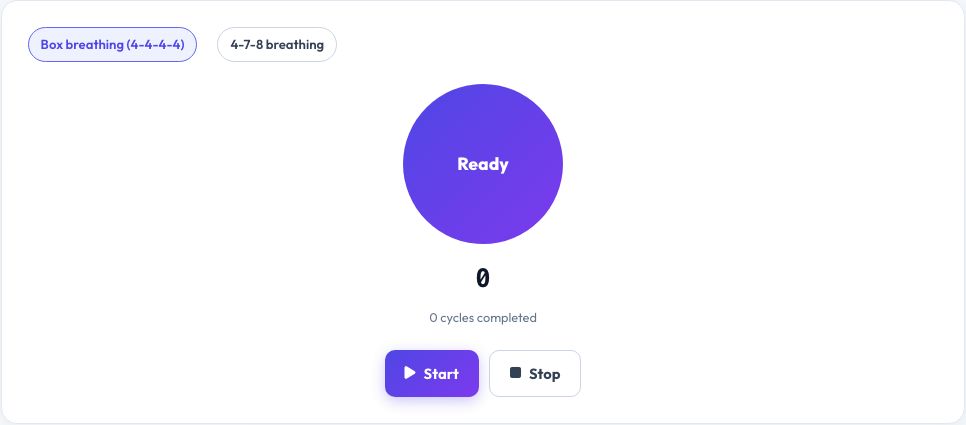
Free Guided Breathing Exercise Timer
Slow, paced breathing is a simple technique used to reduce stress and anxiety in the moment. This timer guides you through two well-known patterns with an animated circle that expands and contracts in time with each phase: box breathing (inhale, hold, exhale, hold, each for 4 seconds, used by military and athletes to stay calm under pressure) and 4-7-8 breathing (inhale for 4, hold for 7, exhale for 8, popularised for helping with sleep and anxiety).
A soft chime marks each phase change so you can close your eyes and follow the sound instead of watching the screen, and a cycle counter shows how many rounds you have completed. Every timing is adjustable if you want to build up to the standard counts gradually.
Key features
Two proven patterns
Box breathing (4-4-4-4) and 4-7-8 breathing.
Animated pacer
A circle that expands and contracts with each phase.
Audio cues
A gentle chime on every phase change.
Adjustable timing
Slow the counts down if the standard pace feels too fast.
How to use it
- Choose box breathing or 4-7-8 breathing.
- Press Start and follow the expanding and contracting circle.
- Breathe in, hold and out in time with each phase.
- Continue for as many cycles as feels comfortable, then stop.
Worked example
Example
Box breathing, 4 cycles → about 64 seconds of guided inhale-hold-exhale-hold, with a chime at each transition.
Who uses this tool
Anyone feeling stressed or anxious
A quick, guided way to calm down in a minute or two.
People with trouble falling asleep
4-7-8 breathing is commonly used as a wind-down routine.
Public speakers and performers
Box breathing before going on stage or into a big meeting.
Tips for the best results
- Breathe through the nose where comfortable, and keep the exhale slow and controlled.
- Start with a few cycles rather than many; stop if you feel lightheaded.
- Use box breathing before a stressful event and 4-7-8 breathing as part of a bedtime routine.
- Sit or lie down comfortably rather than doing it while active.
Common mistakes to avoid
- Forcing very deep breaths too quickly, which can cause lightheadedness.
- Using it as a substitute for medical care for ongoing anxiety or panic — it is a supportive technique, not a treatment.
- Holding the breath forcefully instead of gently, which increases tension rather than releasing it.
Why use AZRS QuickFix?
It is 100% free, needs no signup and has no watermark or usage limits. The tool runs in your browser, so what you type stays on your device, and it works on phones, tablets and desktops. New tools are added every week — bookmark this page or browse the full QuickFix toolbox.
Frequently asked questions
What is box breathing?
A pattern of inhaling, holding, exhaling and holding again, each for an equal count (commonly 4 seconds), used to calm the nervous system.
What is 4-7-8 breathing?
Inhale for 4 seconds, hold for 7, exhale for 8 — a longer exhale is thought to promote relaxation.
Is this medical advice?
No, it is a general relaxation technique, not a treatment for any medical or mental health condition — seek professional support for ongoing anxiety.
How many cycles should I do?
Many people start with 4–8 cycles; stop any time it does not feel comfortable.
Can I adjust the timing?
Yes, every phase length can be changed if the standard counts feel too fast or slow.
Does it make a sound?
Yes, a soft chime marks each phase change so you can close your eyes and follow along.