Hebrew Calendar
See today's Hebrew date, browse any year, and convert a Gregorian date to Hebrew.
2026
Guidance only. For questions of halacha, ask your rabbi.
About the Hebrew Calendar tool
The Hebrew calendar is lunisolar. Months follow the moon, and a leap month, Adar I, is added seven times in every nineteen years so that the holidays stay in their seasons. A year can have twelve or thirteen months, which makes the Hebrew date hard to work out by hand.
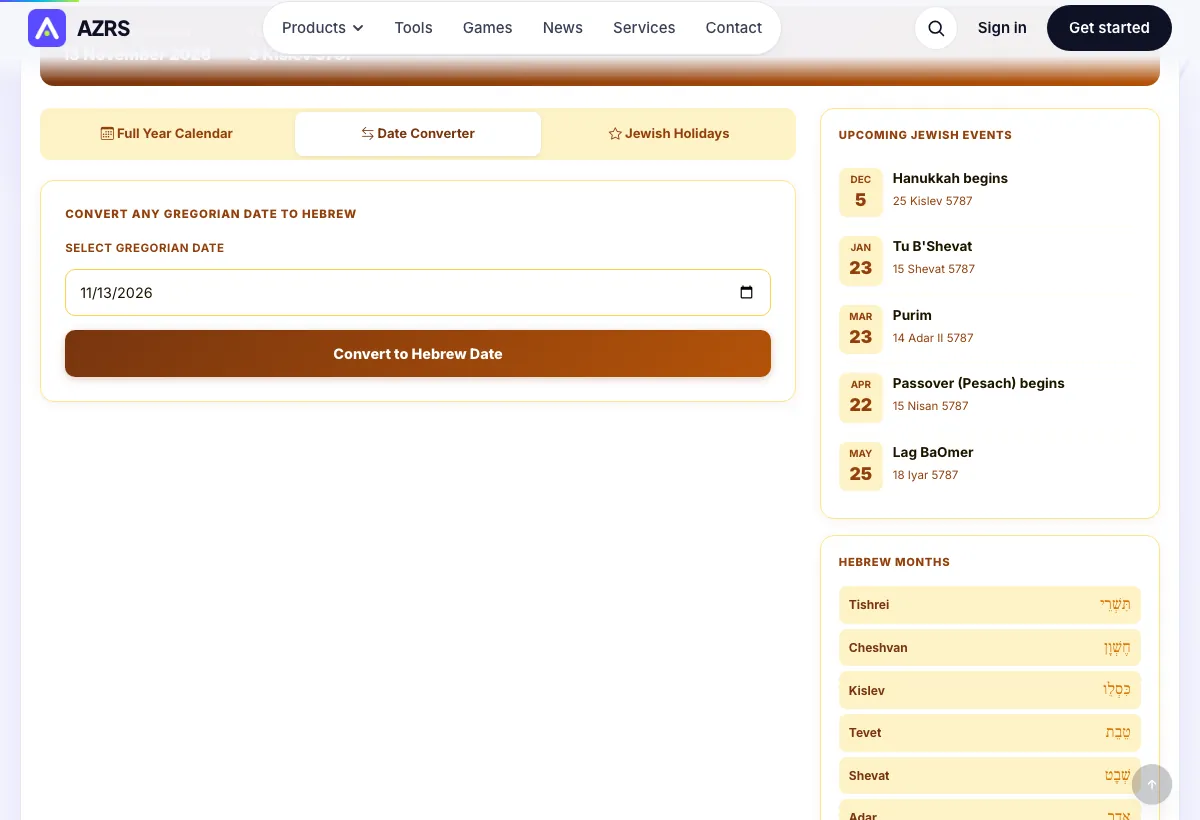
This tool shows today's Gregorian and Hebrew dates at the top. The Full Year tab draws all twelve Gregorian months with the Hebrew day number in each box, and marks Shabbat and the holidays. The Date Converter tab turns any Gregorian date into its Hebrew date and, when available, the weekly Torah portion. The Jewish Holidays tab lists the holidays for the year you are viewing.
Dates are worked out from the Hebrew calendar built into your browser, so any year can be shown. The Jewish day begins at sundown, so an evening on a given date already belongs to the next Hebrew date. For questions of halacha or a date that matters to you, ask your rabbi.
How to use it
Read today's date. Look at the strip at the top for today's Gregorian and Hebrew dates.
Browse a year. On the Full Year tab use Prev and Next to move between years. Each box shows the Gregorian day and the Hebrew day number.
Convert a date. Open the Date Converter tab, choose a Gregorian date and press Convert to Hebrew Date.
Check the holidays. Open the Jewish Holidays tab to see the holidays for the year you are viewing, then remember each begins at sundown the evening before.
A simple example
Hebrew date: 1 Tishrei 5787
Month: Tishrei, the first month of the year
This is Rosh Hashanah, which begins at sundown the evening before
Tips for good results
- Use the converter for yahrzeit and birthday dates, then confirm the date with your rabbi.
- If the event is in the evening, check the next Hebrew date as well, because the day changes at sundown.
- Look at the small highlighted days in the grid to spot holidays quickly.
- The month name at the top of each box shows which Hebrew month the Gregorian month falls in.
Common mistakes
- Forgetting that the Hebrew day starts at sundown, so an evening can fall on the next Hebrew date.
- Using the Gregorian date of a holiday as if it began that morning.
- Mixing up Adar I and Adar II in a leap year. Purim is kept in Adar II.
- Using the converter for a ruling on a yahrzeit date without asking your rabbi.
Common questions
What is today's Hebrew date?
It is shown at the top of the page and is worked out when you open it. After sundown the Hebrew date is already the next day.
Why does the calendar have a leap month?
The Hebrew year follows the moon and the seasons. A leap month, Adar I, is added in seven of every nineteen years to keep holidays like Passover in the spring.
How many days are in a Hebrew year?
A year has 353, 354 or 355 days in a regular year and 383, 384 or 385 days in a leap year.
Which holidays does the Holidays tab show?
The main holidays and a few others, such as Rosh Hashanah, Yom Kippur, Sukkot, Hanukkah, Purim, Passover, Shavuot and Tisha B'Av. The Jewish Holidays tool lists many more.
Can I rely on this for a yahrzeit?
It gives you a starting point. Ask your rabbi, because customs for leap years and for the date of death differ.