Inflation Calculator
See what an amount of money from any year since 1913 is worth today, using real US CPI data · free, no signup
How Inflation Calculator works, step by step
Enter an amount.
 Download it
Choose the year that amount is from.
Inflation Calculator — What Money From Any Year Is Worth Today
Enter an amount and a starting year, and this calculator converts it to today's dollars using the real annual US Consumer Price Index (CPI-U), the same index the Bureau of Labor Statistics publishes and the one most inflation calculators and news articles are built on. It covers every year from 1913, when the modern CPI series begins, through the most recent available annual figure.
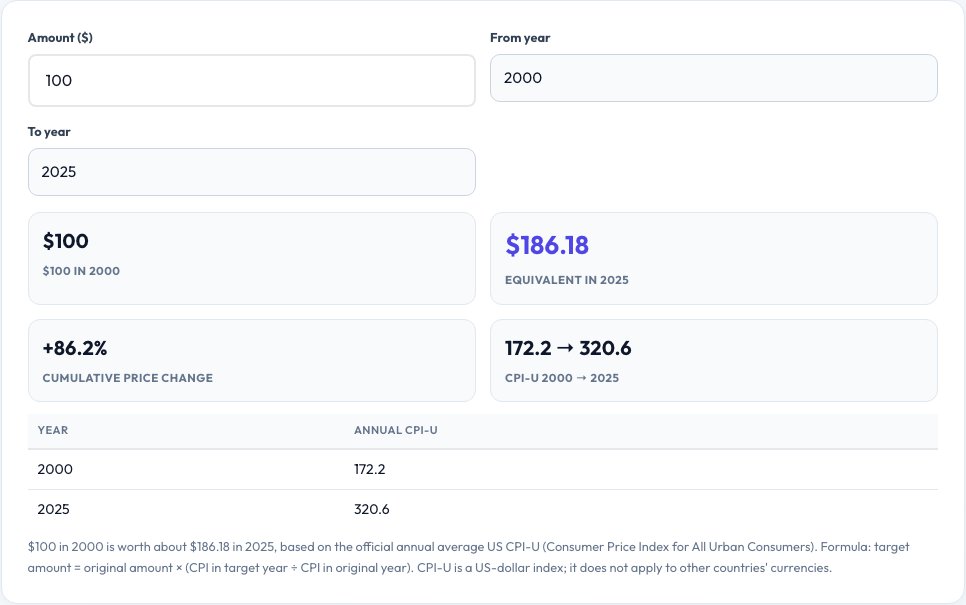
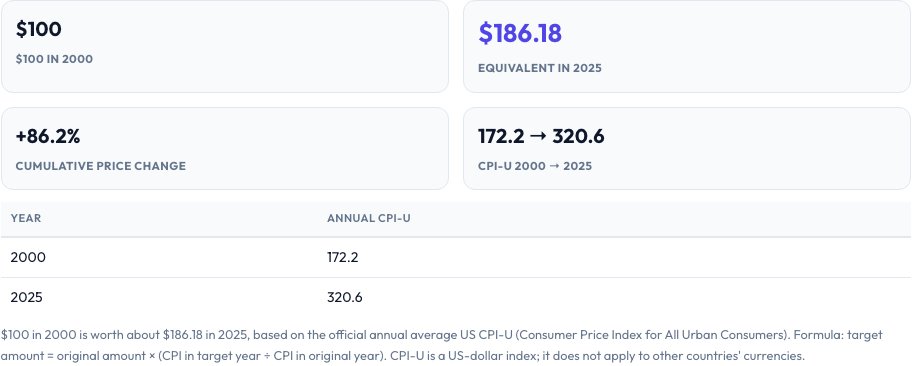
You can also run it in reverse: enter an amount in today's dollars and a target year to see what it was equivalent to back then. The math is simple once you have real CPI values for both years: target amount = original amount x (CPI in target year / CPI in original year) — this tool just saves you from tracking down the actual historical index numbers yourself.
Key features
Real annual CPI-U data, 1913-2026
Not a flat average inflation rate — uses the actual published index value for each year.
Two directions
Convert an old amount to today's value, or today's value back to a past year.
Cumulative inflation shown
See the total percentage change between the two years, not just the converted amount.
US-dollar, CPI-U based
Clearly labeled so you know exactly which index and currency the result is based on.
How to use it
- Enter an amount.
- Choose the year that amount is from.
- Choose the year to convert it to (defaults to the most recent available year).
- Read the converted amount and the total inflation percentage between the two years.
Worked example
Example
$100 in the year 2000 is roughly equivalent to about $185 today (exact figure depends on the latest published CPI-U value) — meaning prices overall roughly doubled over that period.
Who uses this tool
Anyone comparing an old salary, price or bill to today
See whether a historical figure was actually a lot of money in real terms.
Students and writers
Put a historical price or wage in an article or essay into honest modern context.
Family history and genealogy researchers
Understand what an ancestor's income or a historical purchase actually meant at the time.
Tips for the best results
- CPI-U is a US, dollar-denominated index — it isn't the right tool for converting other countries' historical currency values.
- CPI measures a broad average basket of goods; any single item (like housing or a specific product) can have inflated faster or slower than the overall average.
- Because the CPI series is annual, this tool uses each year's average index value rather than a specific month, which is accurate for most everyday comparisons but not exact for month-to-month analysis.
Common mistakes to avoid
- Assuming inflation is the same every year — the actual rate has varied enormously, from near zero to double digits in different decades, which is exactly why this tool uses real annual data rather than a flat average rate.
- Applying a US CPI-based result to a non-US historical price without converting currency first.
- Treating the result as precise to the cent for anything other than a rough real-terms comparison — CPI is a broad statistical index, not a price tag for any one specific item.
Why use AZRS QuickFix?
It is 100% free, needs no signup and has no watermark or usage limits. The tool runs in your browser, so what you type stays on your device, and it works on phones, tablets and desktops. New tools are added every week — bookmark this page or browse the full QuickFix toolbox.
Frequently asked questions
What data does this use?
The official annual US Consumer Price Index for All Urban Consumers (CPI-U), the same headline inflation index published by the Bureau of Labor Statistics and used by most inflation calculators and journalists.
How far back does it go?
Back to 1913, when the modern CPI series begins, through the most recent available annual figure.
Can I convert other currencies?
No, this is specifically a US-dollar, CPI-U based calculator; other countries publish their own separate price indexes with different histories.
Why is my result different from another inflation calculator I've used?
Small differences are normal between calculators depending on whether they use CPI-U, CPI-W, chained CPI, or annual-average versus specific-month figures — this tool uses annual CPI-U, the most commonly cited version.
Does this account for taxes or interest, not just prices?
No, it purely reflects the change in general price levels (purchasing power), not investment returns, wages, or taxes.
Is this financial advice?
No, it's a historical reference calculator for understanding purchasing power over time, not investment or financial planning advice.