Rent Affordability Calculator — How Much Rent Can I Afford?
See the real maximum rent you can safely afford from your income and actual expenses · free, no signup
How Rent Affordability Calculator — How Much Rent Can I Afford? works, step by step

Enter your monthly take-home income.
 Download it
Enter your total monthly expenses excluding rent (food, transport, debt, subscriptions, etc).
Rent Affordability Calculator
The classic rule of thumb is to spend no more than 30% of your gross income on rent, but that number ignores whether you already have heavy monthly expenses. This calculator starts from your monthly take-home income, subtracts your real fixed and variable expenses (excluding rent), and works out how much is genuinely left for rent while keeping a safety margin for savings — then compares that adjusted figure against the standard 30% guideline.
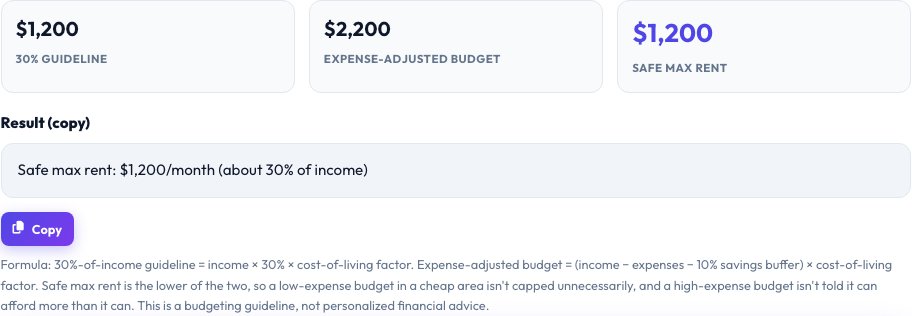
The result is the lower of the two numbers: the 30%-of-income guideline and what your actual budget can support after real expenses, adjusted by a cost-of-living factor for your area. That way a low-expense budget in a cheap area isn't capped unnecessarily, and a high-expense budget isn't told it can afford more than it really can.
Key features
Real 30% guideline, not just a slogan
Calculated from your actual entered income, not a rounded estimate.
Adjusted for your real expenses
Subtracts what you actually spend before deciding what's left for rent.
Cost-of-living factor
Scale the result up or down for your specific city or region.
Transparent formula
Shows both the 30%-of-income number and your expense-adjusted number side by side.
How to use it
- Enter your monthly take-home income.
- Enter your total monthly expenses excluding rent (food, transport, debt, subscriptions, etc).
- Set a cost-of-living factor for your area (1.0 = national average).
- See your safe maximum rent instantly.
Worked example
Example
Income $4,000/month, expenses $1,400/month, cost-of-living factor 1.0 → the 30% guideline says $1,200, and since the expense-adjusted budget ($2,200 left after expenses and a 10% savings buffer) is even higher, the safe recommended rent is capped at the lower number: $1,200. With heavier expenses, say $2,600/month, the expense-adjusted budget drops to $1,000 and becomes the binding, lower number instead.
Who uses this tool
Apartment hunters
Get a real number to filter listings by before you fall in love with one you can't afford.
People relocating
Adjust for a new city's cost of living instead of reusing an old budget.
Roommates budgeting together
Each person can run their own numbers before agreeing on a shared unit.
Tips for the best results
- Use your net (take-home) income, not gross, for a realistic number.
- Include irregular but recurring costs (car maintenance, annual subscriptions divided by 12) in your expenses.
- Treat the result as a ceiling, not a target — leaving room below it builds a real savings cushion.
Common mistakes to avoid
- Using gross income instead of take-home pay, which overstates what you can actually afford.
- Forgetting debt payments (student loans, credit cards) when totaling expenses.
- Ignoring the cost-of-living factor when comparing affordability across different cities.
Why use AZRS QuickFix?
It is 100% free, needs no signup and has no watermark or usage limits. The tool runs in your browser, so what you type stays on your device, and it works on phones, tablets and desktops. New tools are added every week — bookmark this page or browse the full QuickFix toolbox.
Frequently asked questions
Is 30% of income always the right rule?
It's a widely used general guideline, not a law — this calculator also checks your real expenses so a high-expense budget gets a more conservative number and a lean budget isn't under-estimated.
What counts as 'monthly expenses' here?
Everything except rent: food, transportation, insurance, debt payments, subscriptions and other recurring costs.
What does the cost-of-living factor do?
It scales the affordability calculation for your area — use above 1.0 for expensive metro areas and below 1.0 for lower cost-of-living regions.
Should I use gross or net income?
Net (take-home) income gives the most realistic result since that's what actually hits your bank account.
Is this financial advice?
No, it's a transparent formula based on a commonly used affordability guideline and your own numbers, not personalized financial advice.
Is my data stored?
No, everything is calculated locally in your browser.