Paycheck Frequency Comparison Calculator
Compare your real take-home pay per check across weekly, biweekly, semimonthly and monthly pay · free, no signup
How Paycheck Frequency Comparison Calculator works, step by step

Enter your annual salary.
 Download it
Choose your filing status and US state.
Paycheck Frequency Comparison Calculator
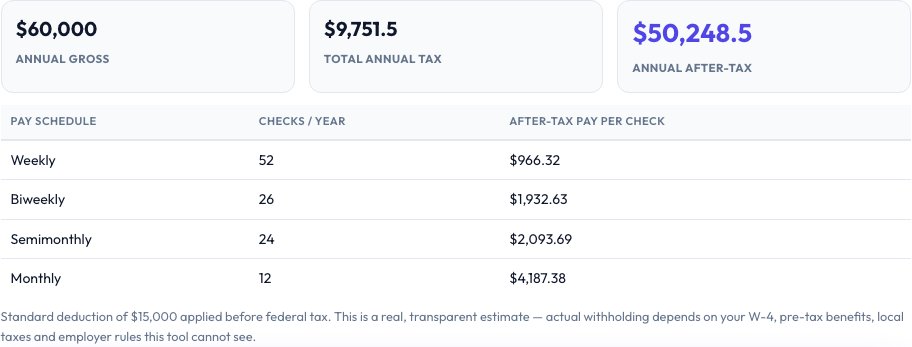
Enter your annual salary, filing status and US state once, and this tool computes your real annual take-home pay using the actual 2025 federal tax brackets, FICA and a named per-state model — then divides that same annual number across four common pay schedules (weekly = 52 checks/year, biweekly = 26 checks/year, semimonthly = 24 checks/year, monthly = 12 checks/year) so you can see exactly how much lands in your account each time, side by side.
This is a genuinely different question from 'what's my hourly rate worth annually' — the annual take-home is identical no matter the schedule, but the per-check amount and how often it arrives change your month-to-month cash flow, which matters for budgeting bills against payday.
Key features
Same real tax math
Uses the actual 2025 federal brackets, FICA and a per-state model on your annual salary, just like a full paycheck calculator.
Four schedules at once
Weekly, biweekly, semimonthly and monthly take-home shown side by side.
Real paycheck counts
52, 26, 24 and 12 pay periods a year respectively — not rounded guesses.
Cash-flow focused
Built specifically to answer 'how much do I actually get, and how often' rather than a single annual number.
How to use it
- Enter your annual salary.
- Choose your filing status and US state.
- See your after-tax take-home for weekly, biweekly, semimonthly and monthly pay, side by side.
- Compare how often and how much lands in your account under each schedule.
Worked example
Example
$60,000/year, single filer, Texas (no state tax) → about $966/week, $1,933/biweekly, $2,094/semimonthly, $4,187/month after federal tax and FICA — same annual total, very different per-check amounts.
Who uses this tool
Job seekers comparing offers with different pay schedules
See the real per-check amount, not just the annual figure, before accepting.
Anyone switching from biweekly to semimonthly pay
Understand exactly why two extra 'paychecks' a year in a biweekly schedule doesn't mean more total pay.
Budgeters
Plan bills against the real per-check amount for your actual pay schedule.
Tips for the best results
- Biweekly (26 checks/year) and semimonthly (24 checks/year) are often confused — biweekly means two extra paychecks some years, not the same as twice-monthly.
- The annual after-tax total is the same across all four schedules; only the per-check amount and frequency change.
- Use this alongside your actual pay stub once you have one, since real withholding can differ slightly from this estimate.
Common mistakes to avoid
- Assuming biweekly and semimonthly pay the same amount per check — they don't, since biweekly divides by 26 and semimonthly by 24.
- Comparing a weekly number to a monthly number without scaling, which makes offers look artificially different.
- Forgetting this is annual salary based — hourly workers with variable hours should use the Hourly to Salary or Overtime calculators instead.
Why use AZRS QuickFix?
It is 100% free, needs no signup and has no watermark or usage limits. The tool runs in your browser, so what you type stays on your device, and it works on phones, tablets and desktops. New tools are added every week — bookmark this page or browse the full QuickFix toolbox.
Frequently asked questions
What's the real difference between biweekly and semimonthly?
Biweekly pays every two weeks, which is 26 paychecks a year (occasionally 27); semimonthly pays twice a month on fixed dates, which is always 24 paychecks a year — biweekly checks are therefore smaller per check but come slightly more often.
Does total annual take-home change with the pay schedule?
No — the same annual salary produces the same total annual take-home regardless of how it's split into paychecks; only the per-check amount and how often you're paid change.
Why does my December sometimes have 3 biweekly paychecks?
Because 26 biweekly pay periods don't divide evenly into 12 months, most years have one month with three paychecks instead of two.
Is the tax math the same as the Hourly to Salary calculator?
Yes, both use the actual 2025 federal brackets, real FICA and the same named per-state model, applied to your annual salary here instead of an hourly rate.
Is this exact to the dollar?
It's a real, transparent estimate; your actual paycheck can differ slightly based on your W-4, benefits and local taxes this tool cannot see.
Is my data stored?
No, everything is calculated locally in your browser.