Buddhist Teachings Search
Search a topic and read matching teachings from the suttas and sutras, with a reference for each.
Results combine passages from SuttaCentral with entries written by an AI model. The AI entries can contain wrong references or wording. Check any text you plan to quote against a published translation.
Search by topic
Searching Buddhist teachings…
Guidance only. Traditions differ; ask a teacher from your own tradition.
About the Teachings Search tool
Buddhist literature is large. The Pali Canon holds the discourses preserved by the Theravada school, Mahayana sutras such as the Heart Sutra and the Lotus Sutra are central in East Asia, and Zen and Tibetan traditions have their own texts and commentaries. A topic search is an easy way to find where a theme appears.
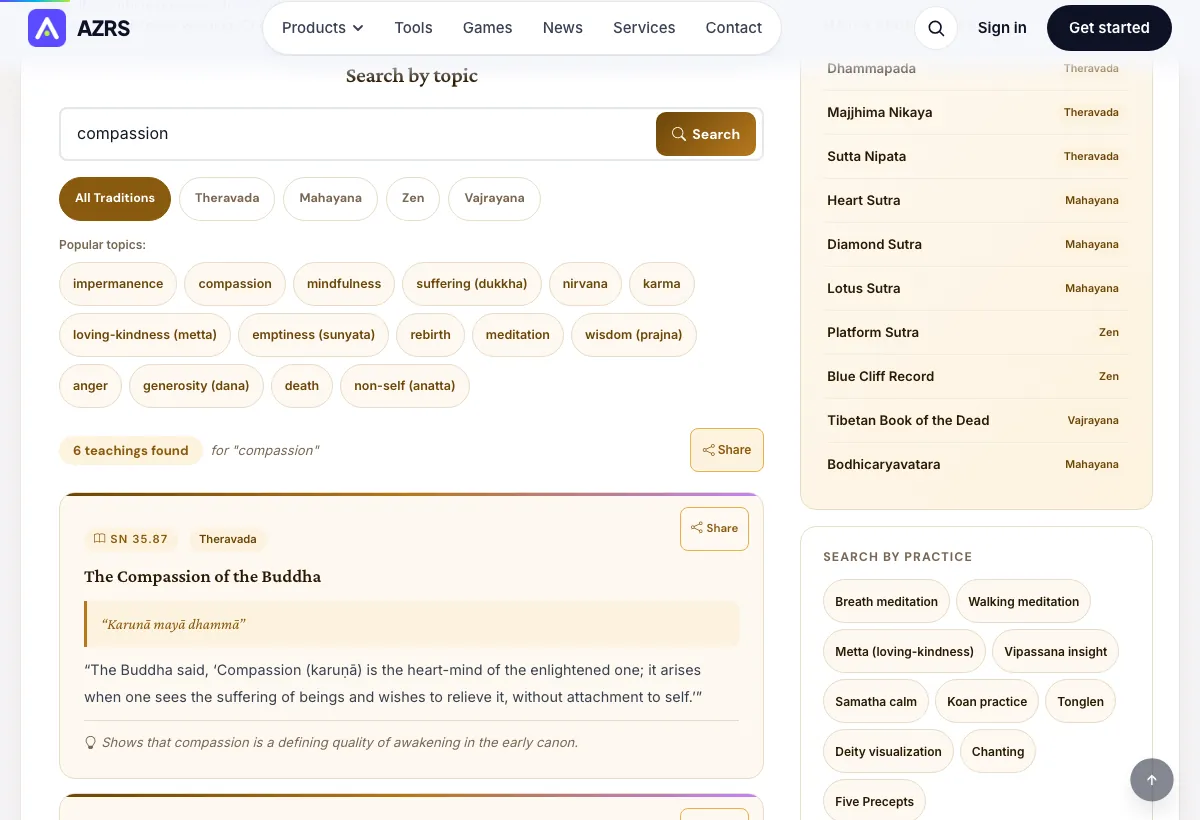
Type a topic, such as compassion, impermanence or anger, or tap a topic button. You can narrow the results to one tradition. Each result shows a reference, a title, the tradition, and a passage or short summary, with the original Pali or Sanskrit phrase when there is one.
Results combine two sources. Passages from SuttaCentral are real text from published translations. The page also asks an AI model for related teachings, and those entries can have wrong references or loose wording. Check anything you plan to quote against a published translation, and ask a teacher when a point matters.
How to use it
Type a topic. Enter a theme such as compassion or mindfulness, or tap one of the topic buttons.
Pick a tradition if you wish. Choose Theravada, Mahayana, Zen or Vajrayana to narrow the list, or leave it on All Traditions.
Read the results. Each card has a reference, a title, a passage and a short note on why it matters.
Copy or share with care. Use Copy to take the text away, and check the reference in a published translation before you rely on it.
Searching for compassion
A list of teachings that touch compassion, with a reference such as a sutta number
The tradition, a passage and a short note for each result
Tips for good results
- Start with a single word and then add a second word to narrow the results.
- Pali terms, such as metta, anicca or dukkha, can find different results than English words.
- Entries from SuttaCentral carry an identifier such as MN 10, which you can look up there.
- Traditions interpret the same theme differently, so read results as pointers, not as one teaching.
Common mistakes
- Quoting a result without checking it, especially an entry written by the AI model.
- Assuming that every tradition reads a passage in the same way.
- Searching with a long question. Short topic words work better.
- Taking a passage out of context. A teaching often depends on the discourse around it.
Common questions
Where do the results come from?
One part comes from SuttaCentral, which publishes translations of early Buddhist texts. The other part is written by an AI model that is asked for teachings on your topic. The page tells you this above the search box.
Can I trust the references?
References from SuttaCentral can be looked up there. References written by the AI model may be wrong or may not match the wording shown. Always verify before you quote.
What does the tradition filter do?
It asks for teachings from the tradition you pick, such as Theravada or Zen. It is a request, not a guarantee, so read the tradition label on each result.
Is this a replacement for studying with a teacher?
No. A search can point you to a passage, but understanding usually comes from study with a teacher or a community in your own tradition.
Why did my search return nothing?
Try a shorter or different word, or a Pali term. If the service is busy the search can fail, and trying again after a moment often works.