Bhagavad Gita Search
Search by a topic or a word and read matching verses in Sanskrit with an English translation.
Verses come from the Sefaria text library when it has a match. If it has none, the page asks an AI model for verses on the topic, and that text can contain mistakes. Check any verse you plan to quote against a printed edition.
Searching the Bhagavad Gita...
Guidance only. For rituals and observance, ask your temple or priest.
About the Gita Verse Search tool
The Bhagavad Gita is a conversation between Arjuna and Krishna on the battlefield of Kurukshetra, found in the Mahabharata. Its eighteen chapters speak about duty, action, knowledge, devotion and the nature of the self. Many readers come to it with a question rather than a chapter number, and this page is built for that.
Type a word such as duty, karma, fear or peace, or tap one of the topic buttons. The page returns verses that match, with the chapter and verse reference, the Sanskrit text, an English rendering and, when available, a short note on the meaning.
Verses come from the Sefaria library when it has a match. When it has none, the page asks an AI model to suggest verses on the topic, and that text can contain errors in the reference or the wording. Treat every result as a pointer, and check the verse in a printed edition or with a teacher before you quote it.
How to use it
Type a topic or word. Enter a theme such as dharma, devotion or peace of mind, or tap a topic button under the box.
Press Search. Press the search button or the Enter key. A short wait is normal while the results load.
Read each result. Each card shows the reference, the Sanskrit, an English translation and a short note if there is one.
Check what you plan to use. Compare the verse with a printed edition or ask a teacher before sharing or quoting it.
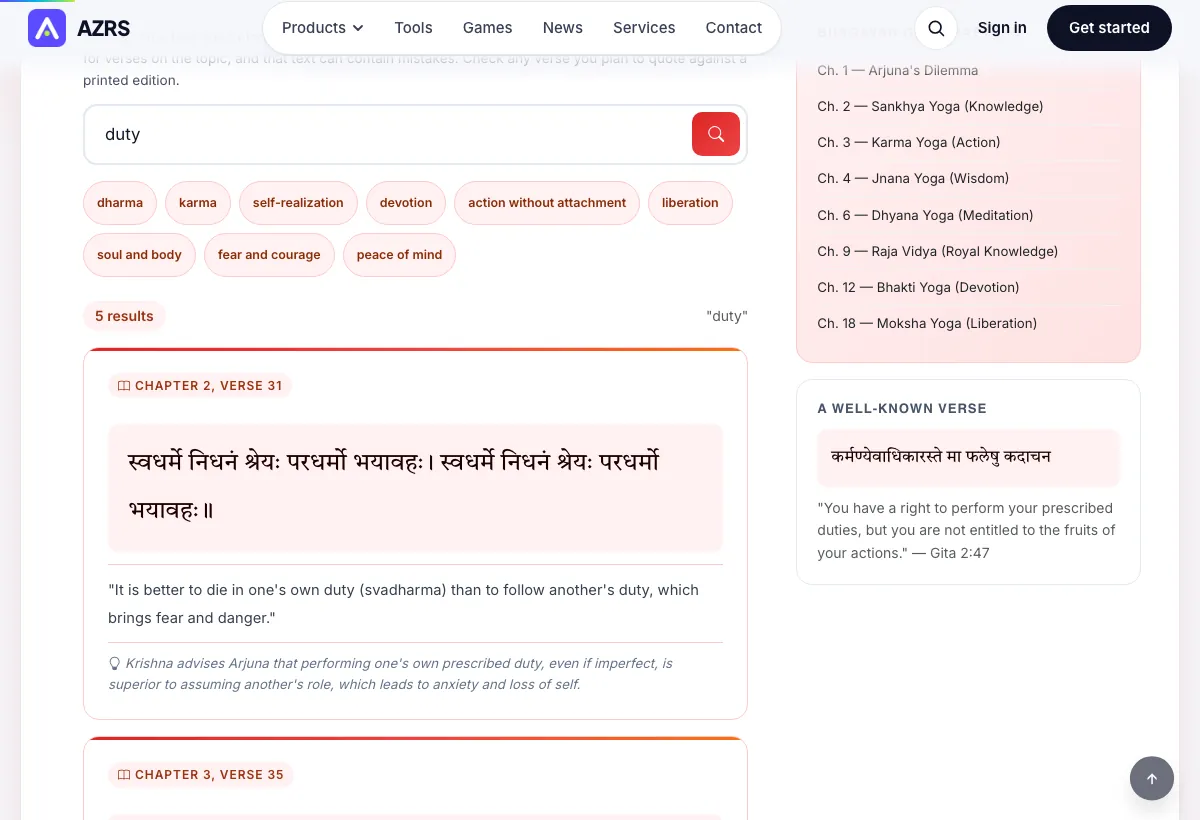
Searching for duty
A list of verses that mention duty, such as 2:47
Sanskrit text with an English translation under each reference
Tips for good results
- Short single words, such as duty or fear, often work better than long sentences.
- If you get nothing, try a related word, for example liberation instead of freedom.
- You can also search with a reference such as 2:47 to try to find a known verse.
- Different translators render the same verse differently. A result is one reading, not the only one.
Common mistakes
- Quoting a result without checking the reference or wording against a printed edition.
- Treating the short note on a verse as the teaching of any one school or commentator.
- Typing a full question and expecting an answer. The page matches words and topics.
- Assuming that no result means the Gita says nothing on the subject. Try other words.
Common questions
Which translation of the Gita is used?
The page does not stick to one translation. Matches from Sefaria use the translation held there, and AI suggestions are written by the model. Neither is an authorised edition, so check against a trusted printed one.
Why does the page sometimes use an AI model?
When the Sefaria library finds no match for your words, the page asks an AI model to suggest verses so you still get something to read. These entries may have wrong references or wording, and the page says so above the search box.
Can I search by chapter and verse number?
You can try typing a reference such as 2:47 or Chapter 2 verse 47. Matching depends on the library, so it works for some references and not for others.
Is this a commentary on the Gita?
No. It helps you find verses. The short notes are brief and general. For deeper understanding, read the Gita with a commentary from a tradition you trust or study with a teacher.
Does the page change the Sanskrit?
No. The Sanskrit text is shown as the library returns it. The page does not rewrite or shorten it.