Jewish Holidays Calendar
Pick a year and see every Jewish holiday and observance, with Hebrew names and a short note.
Loading Jewish holidays…
Guidance only. For questions of halacha, ask your rabbi.
About the Jewish Holidays tool
Jewish holidays follow the Hebrew calendar, so their dates move around the Gregorian calendar from year to year. Rosh Hashanah can fall in early September or in early October, and Passover can fall in March or April. This tool lists the holidays and observances for the year you choose.
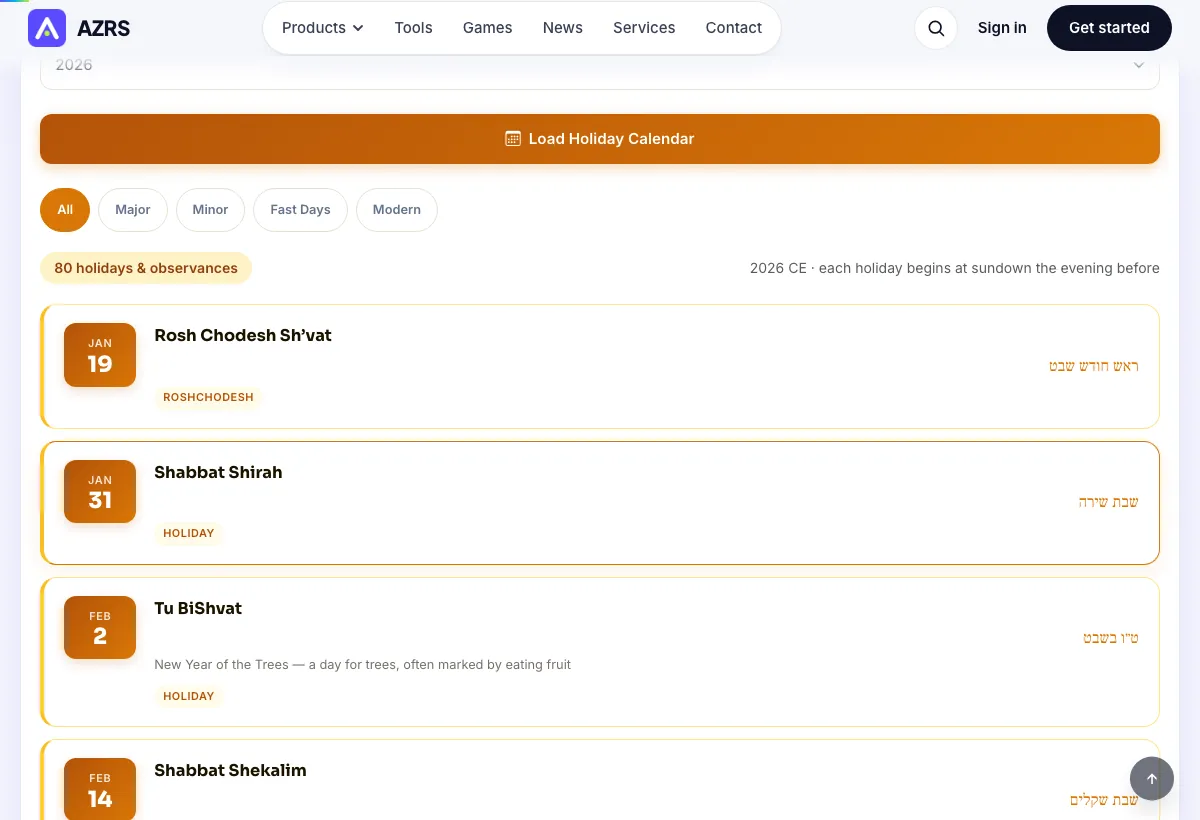
Select a year and the list loads with each date, the name, the Hebrew name and a short description for the main holidays. Use the filter buttons to show only the major holidays, the minor ones, the fast days or the modern observances. The list comes from the Hebcal service.
Each holiday begins at sundown on the evening before the date shown, and some holidays are kept for more than one day. Customs differ between communities and between Israel and the diaspora. For how to keep a holiday, ask your rabbi.
How to use it
Select a year. Choose a year from the menu. The list loads on its own, and you can press Load Holiday Calendar to refresh it.
Read the list. Each card shows the date, the name, the Hebrew name and a short note.
Filter the list. Use All, Major, Minor, Fast Days or Modern to narrow it.
Plan from the evening before. Remember each holiday begins at sundown the evening before the date shown.
A simple example
Yom Kippur and Tisha B'Av are listed with their dates
Each has the Hebrew name and a short note
Both begin at sundown the evening before
Tips for good results
- Use the Fast Days filter to see Yom Kippur, Tisha B'Av and the other fasts together.
- Look at the year before a trip or event, since the dates move.
- Some entries, such as Rosh Chodesh, mark the start of a month and are not full holidays.
- Check your community's calendar for the second day of a holiday if you live outside Israel.
Common mistakes
- Treating the date as the start. The holiday begins at sundown the night before.
- Forgetting the second day of some holidays outside Israel.
- Assuming the same Gregorian date each year.
- Using the tool as a halachic guide for how to observe a holiday.
Common questions
Why do the dates change each year?
The Hebrew calendar follows the moon and the seasons, and the Gregorian calendar follows the sun, so the two drift apart and realign over a nineteen-year cycle.
What does Major, Minor, Fast Days and Modern mean?
These are filters on this page. Major lists the main holidays, Minor the lesser days, Fast Days the fasts, and Modern the observances set in the last century.
Do holidays start the night before?
Yes. A Jewish day begins at sundown, so each holiday begins at sundown on the evening before the date shown.
Where does the list come from?
From the Hebcal service. The short notes are written for this page. Both are for information only.
Can I see a year far in the future?
You can pick years in the menu, which currently runs from 2025 to 2030.