Halal or Haram Checker
Ask a question and read the evidence, the schools' views and the references in one place.
No searches yet.
No bookmarks yet.
| Item | Ruling |
|---|---|
| Pork | Haram |
| Alcohol | Haram |
| Chicken (halal-slaughtered) | Halal |
| Fish & Seafood | Halal |
| Gelatin | Mashbooh |
| Mortgage (Interest) | Haram |
| Cryptocurrency | Disputed |
| Music | Disputed |
| Coffee & Tea | Halal |
| Silk for men | Haram |
| Gold for men | Haram |
| Lottery / Gambling | Haram |
Guidance only. Confirm any religious ruling with a qualified scholar or your local mosque.
About the Halal or Haram tool
This tool helps you look into a question of halal and haram. You type a question such as whether a food, a job or an activity is permissible, and it brings together evidence from the Quran and hadith along with the views of the four schools of thought: Hanafi, Maliki, Shafii and Hanbali.
Answers are produced with the help of an AI model and are labelled with a verdict colour and the supporting texts. The verdict is a starting point for study. It is not a fatwa, and it cannot take your personal circumstances into account.
Scholars may differ on many questions, and the answer can depend on where you live and what you know. Use the references to read further, then ask a qualified scholar or your local mosque for a ruling you will act on.
How to use it
Type your question. Write it as a clear question, such as whether a certain ingredient is permissible, or tap a category to see examples.
Press Ask. Wait a moment while the tool gathers the evidence. A verdict label and a short summary appear first.
Read the evidence. Open the Quran and hadith sections, then the views of the schools, and check each reference.
Save or share. Bookmark a result to find it again, or copy the link. Then take the question to a scholar if you need a ruling.
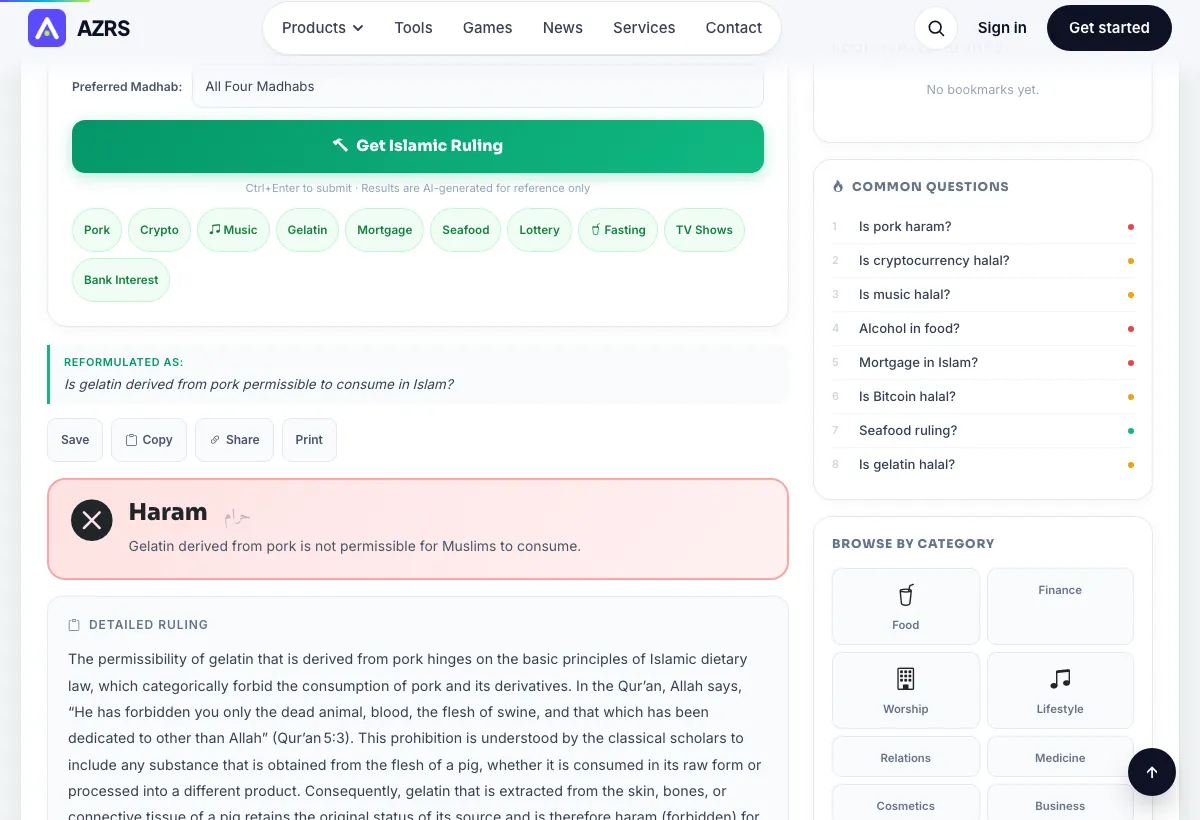
A sample question
Verdict shown with a colour label and short summary
Quran and hadith references listed
Views of the four schools shown side by side
Tips for good results
- Ask about one thing at a time, so the answer stays focused.
- Read the reference, not only the verdict label.
- Note where the schools differ, and ask your scholar which view applies to you.
- Include the context, such as the country or the product, when it matters.
Common mistakes
- Treating the verdict as a final fatwa.
- Asking several questions in one sentence.
- Skipping the references and the note about differences between schools.
- Using a result to judge someone else's choice.
Common questions
Is this a fatwa?
No. It is a study aid. For a ruling you will act on, ask a qualified scholar or your local mosque.
Where does the evidence come from?
It cites the Quran and hadith, and the views of the four schools. Check each reference yourself or with a scholar, because summaries can be incomplete.
Why do the schools sometimes disagree?
Scholars may read the evidence differently or weigh sources in different ways. This is a recognised part of Islamic scholarship.
Can the answer be wrong?
Yes. Because the answer is produced with an AI model, it can miss detail or misstate a point. Always verify before you act.
Are my questions stored?
The page can save your recent questions and bookmarks in your own browser. Clear them from the history panel at any time.