Dua Finder and Library
Describe your situation to find a fitting dua, or browse the library by topic.
Describe your situation and get duas from the Quran and Sunnah, plus AI-written suggestions that are labelled. Check the wording and source with a scholar:
Finding duas for your situation...
Guidance only. Confirm any religious ruling with a qualified scholar or your local mosque.
About the Dua Finder tool
A dua is a personal supplication, calling on Allah for help, forgiveness, guidance or thanks. This page lets you describe a situation, such as travel, illness or an exam, and returns duas that fit it. You can also browse the library and filter it by topic.
Each dua shows the Arabic with a meaning in the language you choose. Many come from the Quran and the authentic Sunnah, and the page marks which kind each one is. Some results are written by an AI helper, and those are labelled so you can tell the difference.
The tool is an aid for finding and reading duas. For the wording of a particular supplication, its source or its authenticity, check with a qualified scholar or a trusted book.
How to use it
Describe your situation. Type what you are going through, or tap a quick topic such as Travel, Exam or Forgiveness.
Choose a language. Pick the language for the meaning. The Arabic text stays as it is.
Generate the duas. Press the generate button. Read the suggested duas with their source and meaning.
Browse the library. Use the filter buttons to see duas for morning, evening, protection, travel and more, and load more when you need them.
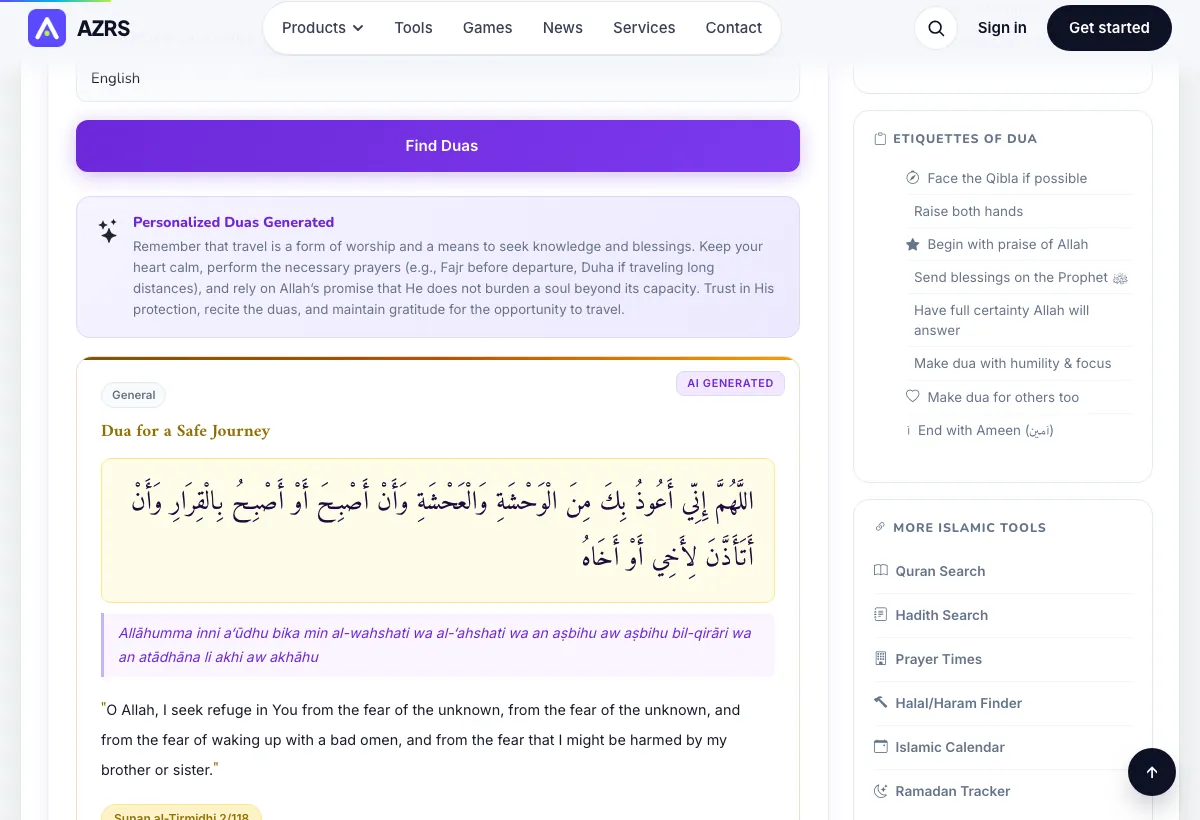
A travel dua
Duas for the start of a journey, with Arabic text
Meaning shown in your chosen language
Source noted as Quran or hadith where it applies
Tips for good results
- Read the Arabic slowly and, if you can, with a teacher, so the wording stays correct.
- Dua can also be made in your own words and in any language.
- Use the Today's Dua panel for a short daily reminder.
- Copy a dua to share it, and include its source when you do.
Common mistakes
- Treating an AI-written suggestion as if it were a transmitted dua from the Prophet, peace be upon him.
- Reading the transliteration only and never checking the Arabic.
- Sharing a dua without its source.
- Expecting the tool to give a ruling on a personal matter.
Common questions
Where do the duas come from?
The library draws on the Quran and hadith collections, with the source noted. Situation-based results may include text written by an AI helper, which is labelled.
Can I make dua in my own language?
Yes. Dua can be made in any language, and it can also be in your own words. The Arabic duas here are for reading and learning.
Why is the Arabic in the page not editable?
The Arabic texts are shown as published so they stay accurate. Only the meaning language changes.
What is the best time to make dua?
Teachings mention times such as the last third of the night, between the call and the iqama, and while in prostration. Ask a scholar for details.
Is the tool a replacement for a scholar?
No. It helps you find and read duas. For authenticity or a specific question, ask a qualified scholar.